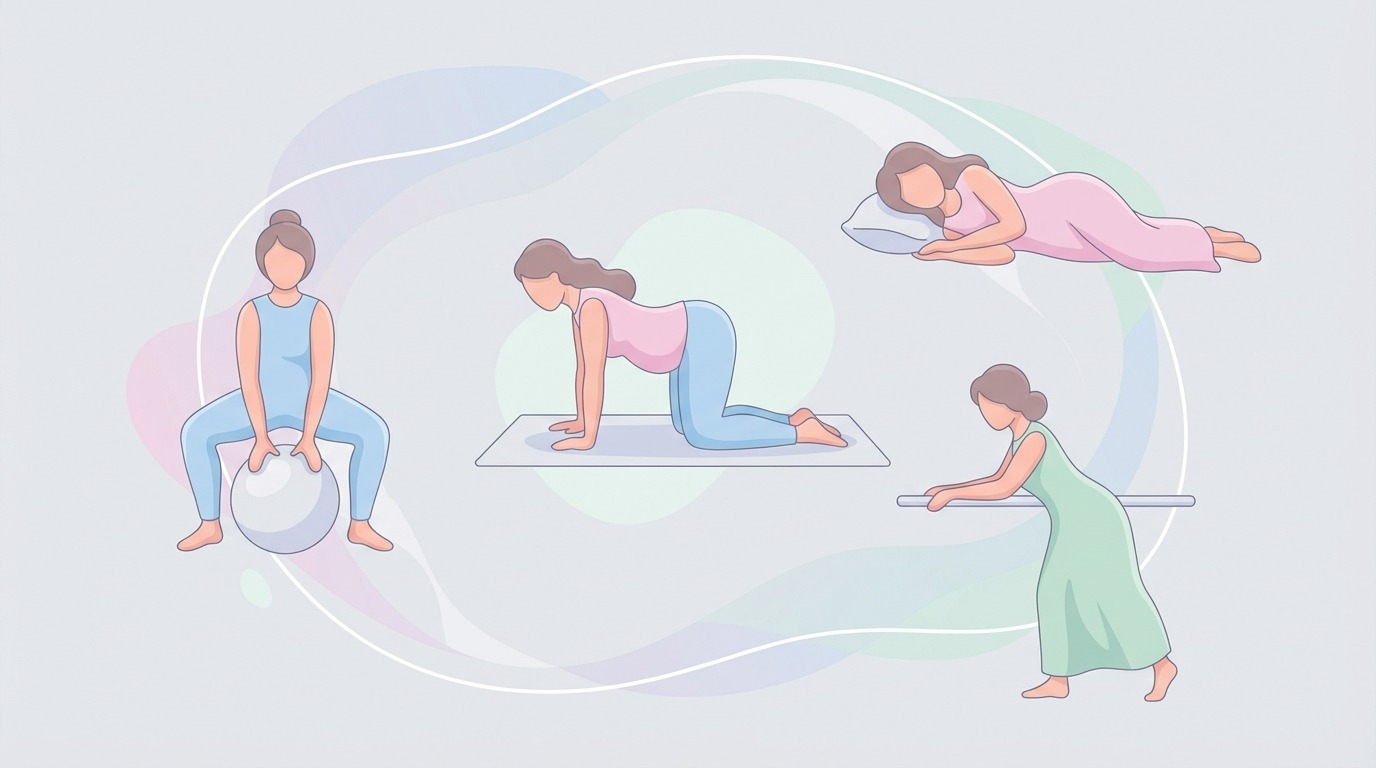
Positions Relieve Childbirth: The positions that relieve during childbirth.
The choice of positions during childbirth is not just a comfort detail; it is a powerful lever for relief, efficiency, and autonomy. By using gravity, freeing the breath, and protecting the perineum, adapted postures transform pain into directed strength. In many maternity wards, teams now encourage pregnant women to stay mobile, alternating standing, sitting, squatting, on the side, or on all fours according to sensations. This paradigm shift responds as much to the physiology of labor as to the aspirations for a more respectful childbirth. The benefits are concrete: better descent of the baby, more effective contractions, less lumbar pressure, and often an increased feeling of control and well-being.
Each phase demands a specific bodily response. When contractions settle in, the relaxation of the back and movement of the pelvis play a key role. Then, as dilation progresses, gravity and stability become allies. Partners are not spectators: they support, massage, offer support points, and help ritualize breathing. To navigate calmly, it is also important to know the signals that require an evaluation, such as suspected loss of amniotic fluid, and to understand the different stages of labor. The objective remains clear: align positions, breathing, and ambiance to guide the baby, conserve energy, and stay on course until the pushes.
| Short on time? Here’s the essentials ⏱️ |
|---|
| Mobility during labor promotes the baby’s descent and the relief of pain 💪 |
| Alternate positions standing, sitting, squatting, lateral, on all fours according to contractions 🔁 |
| Slow breathing and back relaxation optimize oxygenation and well-being 🌬️ |
| The partner supports, massages, offers supports: an active and precious role 🤝 |
| With epidural, stay mobile: side, sitting position, “peanut ball” 🥜 |
| Monitoring: in case of amniotic fluid loss, consult promptly 📞 |
| Prepare a plan: equipment, preferences, maternity checklist 📋 |
Positions That Relieve Childbirth: understanding the physiology of movement and breath
The laboring body serves the birth. Under the effect of oxytocin, contractions gain in intensity and rhythm. Endorphins modulate the perception of pain, especially if breathing remains fluid and the environment stays calm. This is precisely where positions make a difference: they channel the strength of contractions and conserve energy.
Why do gravity and mobility facilitate the baby’s descent?
Standing or squatting, gravity guides the fetal presentation toward the pelvis. The sacrum moves better, which frees up space. A gentle walk between two contractions sometimes speeds dilation because the uterus works with movement. Conversely, prolonged immobility often increases pressure on the lower back.
When the pregnant woman alternates postures, each pelvic angle is solicited differently. On the side, the perineum relaxes. On all fours, lumbar load is distributed, and back pain decreases. Unsurprisingly, most teams now recommend not staying stuck on the back, except for medical indication and targeted time.
Phases of labor and adapted bodily responses
During latency, the goal is relaxation and rhythm. Rocking on a ball, a hot shower, and long nasal breathing are effective. When dilation passes a threshold, posture may become more active: standing against a wall, leaning forward on the bed, or sitting forward to help engagement.
Temporal markers are useful, but how it feels takes precedence. To deepen the milestones, a guide on the stages of labor clearly explains the succession of phases and key signs. An alert signal like suspected amniotic fluid loss requires rapid evaluation, regardless of chosen position.
The partner’s role: support, massages, and grounding
Human support is a catalyst for inner safety. A partner can guide breathing, offer an anchor point during contractions, and massage the lower back. This presence lowers cortisol and enhances the effectiveness of contractions.
Many future families draw inspiration from articles dedicated to the father’s role during childbirth. The idea is simple: transform the room into a team space. Two well-placed hands on the shoulders, a voice guiding the breath, and a solid support during the painful wave, that’s already a relief strategy.
In short, the ideal posture is the one that allows the woman to keep her breath free, her pelvis mobile, and her confidence activated. This compass will guide what follows.

Standing, sitting, squatting: positions that reduce contraction pain and speed engagement
Vertical positions take advantage of gravity and favor head-pelvis alignment. They often reduce lumbar pain while making contractions more effective. In practice, they rely on a wall, a bar, or a partner. Breathing paces the effort and calms the nervous system.
Standing and walking: gravity and pelvis opening
Standing facing a wall, the upper body tilts slightly forward during contractions. Hands and forearms support the lean. Between waves, walking slowly prolongs the opening effect. Many feel clear relief at the sacral level.
Nothing prevents adapting the support: bed rail, window ledge, partner’s back. If sensitive in the groin, gentle micro-splits or hip rotations can release the area. An article on groin pain during pregnancy helps recognize mechanical factors and relieve them.
Sitting forward and ball: stability and lumbar relaxation
Sitting straddling a chair, cushion under the chest, breathing finds its place. The back relaxes, the rib cage opens. On a ball, the pelvis draws slow circles or figure eights, which soothes and guides the descent.
A useful detail: when breast sensitivity increases, leaning the torso a bit more forward avoids frontal pressure. Markers on breast changes during pregnancy help adjust supports. If monitoring is needed, the forward sitting position often remains compatible.
Squatting: maximum opening, intuitive pushing
Squatting increases the pelvic diameter by precious millimeters. It’s intense but very effective in the active phase. Heels supported by a small stool or stable sneakers help hold on longer.
This posture can be repeated in short sequences: two contractions squatting, then resting seated. The partner offers forearms like handlebars. The goal is not performance but bodily availability.
- 🧘 Breathing: inhale through the nose for 4 counts, exhale for 6 to 8 counts.
- 🧱 Support: wall, bed rail, partner’s shoulders.
- 🟠 Ball: circles, rocking back and forth, lateral figure eights.
- 🧴 Comfort: massage oil for lower back, warm towel.
- 🧦 Safety: non-slip shoes, clear space.
These options combine throughout labor. The important thing remains fluidity: move when the contraction rises, relax when it falls. The body learns quickly when listened to.
On all fours, kneeling, and on the side: protect the perineum, free the breath, and guide descent
Positions on the floor or bed with forward points of support offer a double advantage: they unload the lower back and free breathing. The perineum relaxes better, which can reduce the need for instrumental gestures. The head of the bed can be raised to create a comfortable incline.
On all fours: long back, reduced lumbar pressure
On knees and hands, the torso stays relatively high. You can hold the bed handles, a chair back, or a scarf fixed high. With each contraction, the woman tilts the pelvis and exhales long, which distributes tension.
This posture has an almost immediate effect on back pain. It allows circular massages and sacral counter-support. During pushing, breathing stays free, which favors the baby’s oxygenation.
Kneeling with support and lateral position: preserved perineum, ample breath
Kneeling, arms sometimes pass around the partner’s thighs to hang on. Relaxation is obtained by micro-lateral swayings. Between contractions, sacrum massage or pressure on iliac crests soothes the area.
The side position, meanwhile, protects the perineum well. The upper leg is supported by a cushion or stirrup. This setup allows very effective pushes without blocking breathing. It is also a great ally in case of epidural.
Particular situations: breech presentation and adaptation
Some deliveries occur with a breech presentation. The team assesses safety and chooses the most suitable option. To better understand this scenario, an explanation on the breech and Indian bridge position helps grasp technical adjustments.
Whether it is a well-flexed baby or other parameters, the bodily strategy remains the same: open, relax, ventilate. These positions offer fine control of pressure on the perineum and pelvic symmetry. They preserve reserves for pushing.
A common thread illustrates it all: Lina, in active labor, alternates on all fours and right lateral. During each contraction, she exhales “fffff.” Between waves, Marc places his hands on her shoulder blades to help her lie down with her breath. When the push comes, her upper leg is supported. The perineum remains supple and progress steady. Moral of the story: free back, free breath, fairer push.
Positions and epidural: stay mobile, free the breath, optimize monitoring
The epidural does not prohibit mobility. It directs it. When sensitivity is diminished, the challenge is to open the pelvis without forcing. Lateral positions, sitting forward, and the use of a “peanut ball” are strategic. Monitoring remains compatible in most cases.
Lateral, sitting forward, peanut ball: winning trio
On the side, a cushion between the knees prevents pelvis closure. The upper leg can be elevated with stable support. Movements stay gentle but effective for engagement.
In sitting forward position, the torso rests on the bed shelf. The rib cage opens, and breathing becomes ample. The “peanut ball” placed between the thighs creates a pelvic opening without prolonged effort. It mimics the squat effect, with stability.
Monitoring, safety, and the partner’s role
Sensors are placed and readjusted as needed. Teams master these settings to preserve mobility. The partner remains the comfort pilot: repositioning, sips of water, simple words to accompany breathing.
Logistical preparation reassures everyone. The maternity checklist prevents forgetfulness and installs a calming routine. A sturdy scarf, non-slip socks, and an ambiance spray complete the setup.
In case of strong emotion, a hand on the shoulder and a key phrase rekindle confidence: “Breathe, you open.” The body hears these signals and reorganizes itself. Positions are instruments; the orchestra is the team around the woman giving birth.
Because a well-lived childbirth often begins with involvement by two, targeted advice on the partner’s role gives concrete ideas: grounding, rhythms, hydration reminders. Effectiveness lies in simple, precise repetition.
Breathing, rhythm, and ambiance: harmonizing postures for well-being during childbirth
Breath shapes the experience. It guides attention and regulates pain. In a soothing space, breathing settles naturally. Positions serve breathing as much as they make it possible. Soft light, few interruptions, and calm instructions often suffice to free the process.
Useful breaths: slow, stepped, sighing
Slow breathing dominates early labor: calm nasal inspiration, long and silky expiration. In active phase, a “stepped” breath helps cross the peak: small inspirations, long controlled expiration. At the peak, sighing frees the diaphragm and relaxes the shoulders.
Each position must allow this fluidity. Standing, relax the neck. Sitting forward, avoid crushing the rib cage. On all fours, the belly hangs, which opens the breathing space. This breath-position-trust trio alleviates pain and maintains optimal oxygenation.
Ambiance and continuity of care: what comes after also matters
A stable atmosphere protects oxytocin secretion. Few noises, dim lights, low voices and simple words create a cocoon. After birth, skin-to-skin and on-demand breastfeeding strengthen attachment. Resources on newborn development and care extend this support.
Stay attentive to useful signals protects the process. Suspected amniotic fluid loss or unusual bleeding should lead to evaluation. Positions do not cancel vigilance; they make it more comfortable and efficient.
As a red thread, Lina keeps her markers: dim light, soft music, familiar scent. Marc announces each rising contraction, offers a pelvis tilt, and recalls the long exhale. This consistency creates a serene tempo. And it is this tempo that often makes the difference.
Key phrase: fluid breath, mobile pelvis, calm ambiance; the alignment of the three profoundly changes the childbirth experience.
“Movement guides, breathing opens, trust births.” ✨
Which positions to prioritize at the beginning of labor for less pain?
Gentle walking, standing facing a wall, and sitting forward on a ball are ideal. They use gravity, relax the lower back, and allow free breathing. Varying between these postures every 20 to 30 minutes often helps dilation.
How to protect the perineum during pushing?
The lateral position, on all fours, or kneeling with forward support allows a more flexible perineum and better-controlled breathing. Avoid blocking the breath and favor long exhalation during effort to reduce perineal pressure.
What if an epidural is placed?
Mobility remains possible: on the side, sitting forward, or with a ‘peanut ball’ between the knees. These positions open the pelvis without forcing and are usually compatible with monitoring. The team helps with regular repositioning.
How to concretely involve the partner?
They can provide support, guide breathing, massage the sacrum, and remind to hydrate. Practical references on the partner’s role during childbirth give ideas for verbal and gestural anchors, repeatable at each contraction.
When should medical evaluation be requested?
If suspected amniotic fluid loss, sudden pain change, or unusual bleeding occur. These signals take priority over position choice. It is better to contact the maternity ward and follow their safety instructions.