New Fathers Hormones: New fathers also experience hormonal changes
| Short on time? Here’s the essential ⏱️ |
|---|
| 🧠 New fathers experience real hormonal changes: decrease in testosterone, increase in oxytocin, and cortisol adjustments. |
| 👶 Time spent with the baby strengthens emotional bonds and modulates reactions to nighttime crying. |
| 📉 Measurable brain plasticity supports paternal adaptation and motivation to care for the child. |
| 🧩 A good hormonal balance is cultivated: fragmented sleep, skin-to-skin contact, routines, nutrition, and social support. |
| 🆘 Parental stress and paternal depression exist: early detection, resources, and co-parenting make a difference. |
Today’s fathers do not enter parenthood only through heart and arms; they also enter it through biology. Several studies now converge: the arrival of a baby triggers in men an endocrine adjustment and brain plasticity that support attention to the infant, stress regulation, and emotional bonds. In Germany, France, and elsewhere, the time fathers spend with their children has quadrupled since 1965. This immersion changes everything: testosterone declines, oxytocin rises, and paternal adaptation sets in. From neurobiologist Ruth Feldman to anthropologists Lee Gettler and Sarah Blaffer Hrdy, a consensus is emerging. Fatherhood is not just a cultural stance; it is a dynamic biological phenomenon. And if this reality were better integrated into family policies, perinatal clinics, and daily life, the hormonal balance of households would gain stability, to the benefit of all. Let’s take a concrete example: Malik, 32 years old, on paternity leave. In a few weeks of continuous involvement, he sleeps less but feels closer to his child. His body follows, and his mind organizes differently. Here is how.
Fatherhood and biology in action: what recent studies show
Current research describes a clear reality: in new fathers, hormonal changes are neither punctual nor incidental. They accompany the entry into a caregiving role. Anthropologist Lee Gettler observes a clear decline in testosterone, correlated with engagement with the child, and an increase in oxytocin, the key attachment hormone. This reconfiguration favors listening, patience, and sensitivity to the baby’s signals.
Nicolas Mathevon nuances a persistent cliché: responding to nighttime crying is not an “innate maternal aptitude.” It is rather a learning linked to shared time. When Malik alternates nights, his brain becomes more reactive to whimpering, even in light sleep. Experience guides biology, and biology amplifies experience.
Historically, Darwin referred to “latent characters” in males. Fatherhood seems precisely to reactivate certain caregiving circuits. Studies on species where males feed their young also show that survival improves as paternal care increases. In humans, this potential exists and unfolds in a favorable social context.
Why the social environment accelerates paternal adaptation
Leave policies, clinical recognition of paternal needs, and the role given to fathers in maternity wards influence paternal adaptation. The more Malik holds his baby close, the higher the oxytocin rises, and the stronger the virtuous circle becomes. This neuroendocrine mechanism encourages the repetition of positive interactions.
To support this dynamic, access to reliable resources helps the couple. When a maternal question arises, such as discharge during pregnancy or breast changes, answering it reduces the collective mental load. A better-informed household breathes easier, which reduces parental stress and protects everyone’s hormonal balance.
Implicitly, a message emerges: male hormones don’t just “go down” or “go up.” They synchronize behaviors useful to the baby. Ultimately, continuous engagement, even imperfect, remains the best biological catalyst.
Paternal brain plasticity: gray matter and emotional bonds
After birth, brain imaging studies show structural adjustments in fathers. A Spanish publication described a localized reduction of gray matter in the cortex, a key area for planning and emotional processing. This remodeling, comparable to “pruning,” improves priority selection.
Darby Saxbe observes that fathers with more marked plasticity report stronger parental motivation. They feel closer to their child sooner and engage more in daily life. The brain tool reorganizes itself to serve the bond.
Practically, Malik surprises himself by “cutting out” distractions. He rationalizes his energy: preparing the bottle, carrying, comforting. This refocusing doesn’t prevent fatigue but improves reactivity and patience. The brain optimizes the most useful route.
Managing emotional load and preventing stress
This plasticity doesn’t protect against overload. Lack of sleep, returning to work, and unforeseen events may raise cortisol. To stay on track, a hygiene plan is essential: micro-naps, recovery slots, slow breathing, and regular meals.
The household can also protect the baby’s fragile skin to reduce sources of anxiety. A guide on infant skin limits unnecessary alarms. Less uncertainty often means less adrenaline, thus a better hormonal balance for the parental duo.
To deepen understanding, a video interview with a neuroscience expert on parenting helps visualize these mechanisms and better explain them to relatives.
In the end, paternal brain plasticity is not a curiosity. It represents a high-performance upgrade of the attentional and affective system. And this is good news.
Male hormones, testosterone and oxytocin: a duo that refocuses priorities
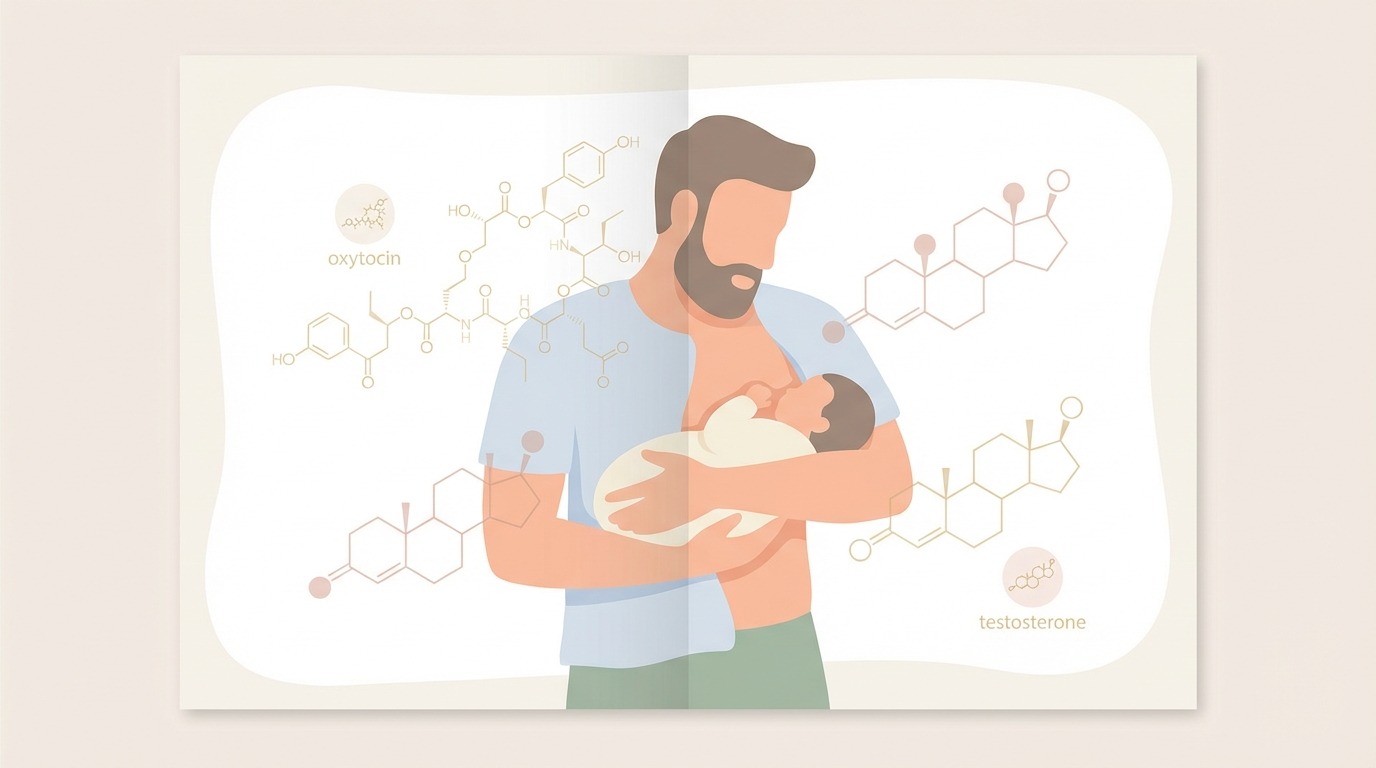
Testosterone often decreases during the transition to fatherhood. This retreat does not weaken masculine identity; it redirects it. Lower levels facilitate availability and tolerance for frustration. Conversely, oxytocin rises as soon as the father holds his baby, speaks softly, smells his scent, and practices skin-to-skin contact.
For Malik, each carrying session triggers this neurochemical “boost.” The heart calms, the gaze fixes on the baby’s eyes, the voice lowers a tone. The body signals that the infant becomes the priority. It’s not magic, it’s biology.
| Hormone 🧪 | Trend ↕️ | Effect on father 💡 | Triggers 🔔 |
|---|---|---|---|
| Testosterone | ↘️ | Less competition, more availability | Daily engagement, baby care |
| Oxytocin | ↗️ | Emotional bonds strengthened, soothing | Skin-to-skin, gaze, soft voice |
| Cortisol | Variable | Energy for alertness, risk of irritability | Lack of sleep, unforeseen events, mental load |
Mini action plan for hormonal balance
To promote a good hormonal balance, small repeated gestures suffice. They transform the day and smooth co-parenting.
- 🤱 Daily skin-to-skin (20 minutes): boost of oxytocin and mutual soothing.
- 🗓️ Short routines: bath, story, rocking; the brain loves repetition.
- 🥗 Simple, planned meals: practical ideas via this balanced family menu.
- 🧘 4-7-8 breathing after crying: regulates parental stress in 2 minutes.
- 📱 Block 30 minutes “screen-free” in the evening: time for slow interactions.
And when pressure rises, consulting a solid dossier on parental stress helps prevent exhaustion. A regulated father transmits contagious security.
From myth to everyday: concrete gestures to strengthen bonds
New fathers often hear that they “help.” Actually, they parent. This nuance changes task sharing and the construction of emotional bonds. The winning model relies on dedicated slots and rituals.
In the evening, Malik takes over: diaper change, pajamas, lullaby. He does not do “instead of,” he does “with” in his own style. The baby distinguishes these gestures, and attachment weaves with two complementary textures. This is how paternal adaptation becomes visible.
Logistics matters. Planning household nutrition reduces daily friction. During pregnancy, informing oneself about foods to avoid limits risks and reassures the couple. After birth, providing protein snacks and fruit makes short nights easier.
Anticipate, explain, soothe
Babies react to micro-variations in tone and rhythm. Speaking softly, singing without excess, and maintaining a regular tempo soothe. Caregivers see it every day: infants appreciate coherence more than perfection. The father can become the expert in calming transitions.
From the maternal side, understanding some landmarks avoids misunderstandings. An article on post-cesarean recovery helps distribute efforts without guilt. The same goes for the metallic taste linked to hormones, often disorienting. Empathy arises from shared information.
To inspire more concrete gestures, a video guide on attachment routines and parent-baby communication can complement these practical markers.
In short, the quality of paternal presence is built in the detail of rituals. Each repeated gesture becomes tangible proof of love.
Mental health of fathers: recognizing signals and acting early
Fatherhood exposes to emotional roller coasters. Joy does not cancel vertigo. In Switzerland, about 10% of fathers show postpartum depressive symptoms. Early identification changes prognosis. Markers? Persistent irritability, withdrawal, sleep disorders unexplained by baby awakenings, and dark thoughts.
For Malik, the third week was the toughest: feeling suffocated, ruminations, wanting to escape. He spoke to his partner, then to a midwife. A plan was set: alternating naps, daily walks, and appointments with a psychologist. Symptoms decreased within ten days.
Parental stress is better regulated with routines and reliable information. Knowing that maternity also brings physiological vulnerabilities, sometimes dramatic, nurtures compassion. For example, understanding bodily changes during pregnancy or breast variations prepares the couple to cooperate rather than accuse each other.
Network, hygiene of life, and alert threshold
Setting up concrete reinforcements protects the relationship and the baby. The duo can create a “safety net”: mobilizable relatives, teleconsultations, and non-negotiable task lists (sleep, shower, eat). A well-functioning household helps a brain to breathe.
Nutrition supports hormonal regulation and mood stability. Planning simple meals with this family balance guide may be enough to break the fatigue spiral. The metabolism likes constancy as much as the brain likes routines.
If signals persist, asking for help is not a sign of weakness but an act of responsibility. Early care protects the parent-child-couple triad. It is the bravest move a father can make.
“When a father tunes into his child, his body rewrites its score: less testosterone, more oxytocin, and a heart beating to the rhythm of the bond.”
Are hormonal changes in fathers systematic?
They are frequent but their intensity varies according to daily engagement, sleep, mental load, and social environment. Direct care time increases oxytocin, while testosterone tends to moderate during active fatherhood.
How can a father naturally strengthen his oxytocin?
Practice skin-to-skin contact, look the baby in the eyes, speak softly, sing, massage, and adopt regular routines. These micro-gestures, repeated every day, consolidate emotional bonds and soothe the nervous system.
Is parental stress inevitable?
It is common, not inevitable. Routines, fragmented sleep, slow breathing, task sharing, and reliable information reduce it. A complete dossier on parental stress helps prevent exhaustion.
Should one worry about a drop in testosterone?
No, if overall well-being is preserved. This drop accompanies paternal adaptation and favors attention to the baby. If fatigue, irritability, or reduced desire persist, a medical opinion is useful.
What markers support co-parenting after a cesarean?
Plan recovery time, organize night shifts, and inform oneself about convalescence. The father can intensify carrying and baby care to maintain the bond while the mother recovers.