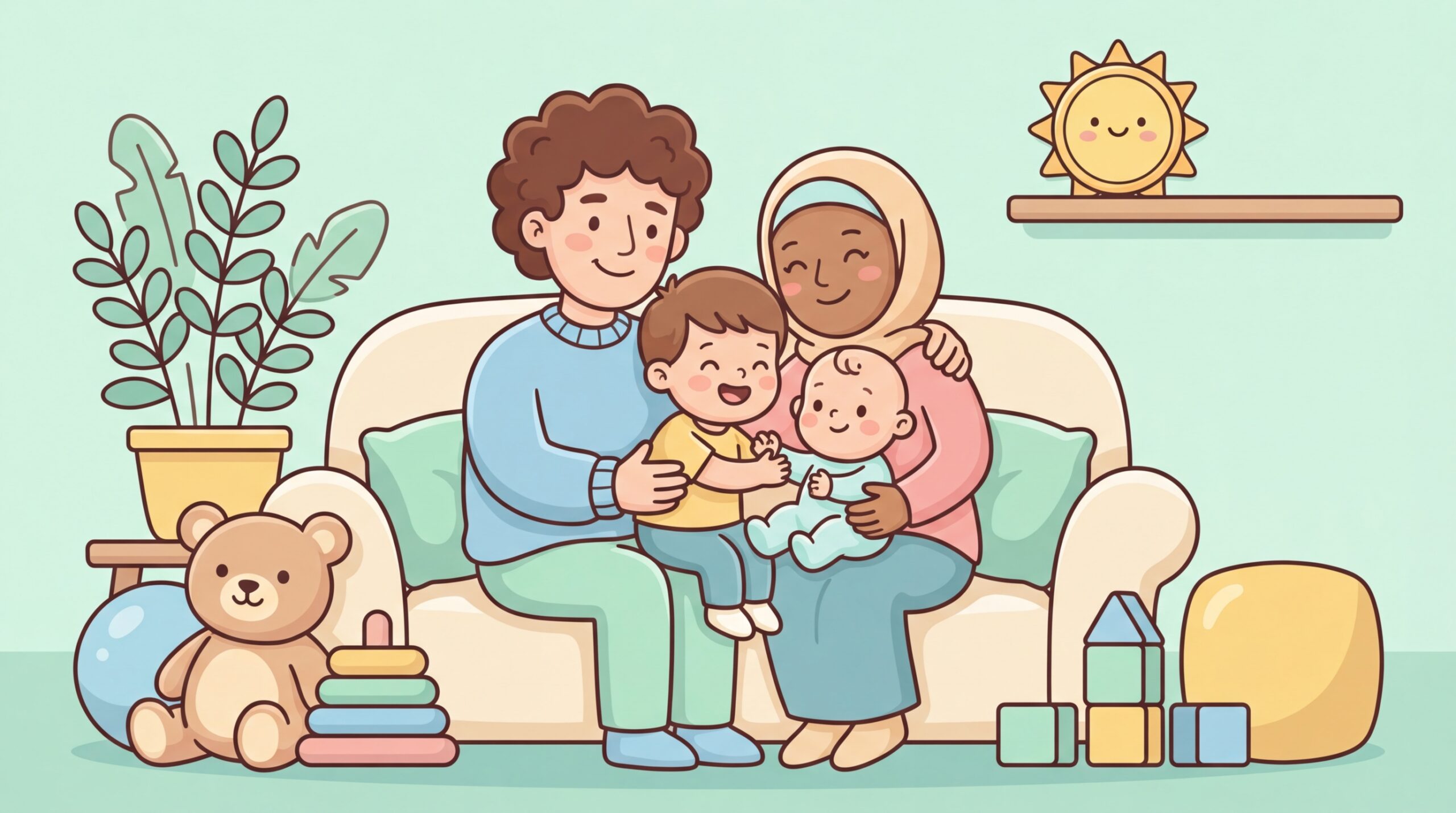
Famille À Moi: Story: La famille à moi for 1-3 years old.
Toddlers love stories that resemble their daily lives. A tender tale about family quickly becomes an emotional anchor, especially between 1-3 years, when awareness blossoms and curiosity nestles in every gesture. Rhythmed by simple images and gentle words, this kind of story opens a door to the learning of the world, inner security, and shared affection. Even better, it illuminates every family relationship and transforms small events into treasures of emotion. 🌟
In this key period of early childhood, the book accompanies the child to name their feelings, understand routines, tame separation, and celebrate every reunion. A reading aloud, a few repeated gestures, a blanket placed on the knees, and the magic happens. Thus, an album around “My Family” is not just a playful tool: it serves as a bridge between home, daycare, and the park, where each meeting nourishes trust. In the evening, between wakefulness and sleep, the storytelling voice soothes, reassures, and structures emotional memory. This file brings together concrete ideas, markers from field practices, and activity ideas to extend the pages into life.
| Short on time? Here’s the essentials ⏱️ |
|---|
| A tale about family creates a secure bond and strengthens affection 💞 |
| Between 1-3 years, repetition and ritual boost awareness and learning 📚 |
| Naming emotions clarifies family relationships and reduces tensions 😌 |
| Sensory activities extend the story into real life 🎨 |
| Talking about diverse families, from birth to adoption, fosters inclusion 🌈 |
| A simple reading corner, a calm voice, and the child calms down before bedtime 🌙 |
“My Family” Tale: a foundational story for 1-3 year olds
A tale centered on family acts like an emotional mirror. Between 1-3 years, the child looks for concrete landmarks: who loves whom, who always comes back, who comforts when it hurts. In “My Family,” scenes of the morning, the snack, or the bath provide a stable framework. Thanks to these images, the little reader appropriates simple words: “mom,” “dad,” “grandpa,” “blankie,” “again.” This vocabulary nourishes trust and supports the learning of routines.
For lasting effect, the story benefits from being read often, at the same time of day. This ritual secures and promotes attentional awareness. For example, Lina, 2 years old, snuggles every evening between her brother Théo and their grandmother. The gentle voice, slow gestures, the blanket that scratches a little: everything becomes a signal for relaxation. Quickly, the characters’ expressions guide reading emotions and strengthen affection.
Why a family tale soothes
The toddler’s brain loves repetition. It makes the outcome predictable, hence reassuring. In a family story, the child hears that the parent comes back, that separation has an end. In parallel, each page highlights a family relationship: morning cuddle, help putting on the coat, encouragement when the block tower falls. Thus, tension decreases and social skills develop little by little.
Special attention to visual codes reinforces the impact. Warm colors, expressive faces, and everyday objects (cup, toothbrush) speak louder than long speeches. The text rhymes or repeats a key phrase: “Here is my family!” This sound anchor imprints in memory and supports language awareness.
Establish a regular and warm framework
The ritual is not improvised: it is built. A reading corner with a cushion, few distracting toys, dim lighting, and affection becomes tangible. To enrich these moments, common landmarks help adults. Concrete ideas are proposed here to create stable landmarks at home: cultivating family rituals and traditions. This anchoring proves powerful during early childhood, as it reduces unnecessary unpredictability and supports the learning of boundaries.
A striking example: the “kiss page.” Every evening, the reader and child reproduce the same gesture on the same page. This driving foundational moment links the book to real tenderness. The effects are quickly seen: less agitation, a longer gaze at the image, and a calmer breathing. In short, reading becomes daily proof that “family holds together.”

Awareness and learning: activities around the tale for early childhood
The book does not stop at the last page. To amplify awareness, micro-activities transform the story into a learning ground. With “My Family,” three axes work wonders: sensory, language, and imitation. A thread is created between the story and life. The child touches, points, repeats, then plays the scene: serving the snack to the blankie, tucking in the doll, looking for “Grandpa’s socks” around the house.
In ten minutes, a workshop suffices. A basket contains three objects starred in the book: a spoon, a hat, a small box. The parent names and the child manipulates. Then, a mini “find and seek” strengthens visual attention: “Where is the spoon?” When they point, applause follows. This loop values success and consolidates shared affection.
Symbolic play and emotional memory
Symbolic play mimics the family relationship experienced in the story. Baby feeds the plush toy, then sings it a lullaby. This scenario supports emotional regulation, as the child replays joys and little sorrows. A support like the simplified families game adds a social dimension. A clever idea is to adapt a card game by sorting “who lives with whom” without competition.
For variety, a playful version exists around animal characters. It allows naming bonds and observing roles. An accessible product available in stores offers a similar mechanic: a kangaroo 7 families game which inspires a homemade adaptation for toddlers (fewer cards, more images). Thanks to this approach, the child links images, names, and functions, which solidifies the learning of categories.
Express and sensory workshops
- 🧸 Story bag: slip 4 objects from the book into a bag. The child draws, names, and places them on the matching image.
- 🎨 Family handprints: paint a “family circle” with palms. Display near the reading corner.
- 🔔 House sounds: reproduce everyday sounds (spoon, key, paper). The child associates pages with noises.
- 🧩 Photo puzzle: cut a photocopy of a page into 3 large pieces. Rebuild together while commenting.
- 🥣 Imaginary picnic: reenact the snack scene, feed the blankie, then oneself. Verbalize hunger, thirst, “again.”
Each activity remains short to respect the attention span of children from 1-3 years. The start is announced, closed by a ritual phrase, then tidied up. This clear structure nourishes security, essential to cognitive awareness.
To consolidate, a “word wall” with 5 key images from the book allows pointing and repeating. Start with “mom,” “dad,” “kiss,” “goodbye,” “good evening.” At each success, a shared gesture celebrates progress: a “fist bump” or a little dance. This bodily anchor makes learning joyful. Affection is seen, heard, felt, and memorized durably.
Talking about all family forms from 1-3 years
Toddlers quickly perceive that households differ. A tale about family can therefore present, delicately, various realities: a single parent, two moms, very present grandparents, an adoption, or joint custody. The earlier simple words are used, the sooner the child understands that love is the fabric, and that each family relationship has its shade. 🌈
A well-known album stages the question of being “born under X” through an alphabet book. Searching for letters, children discover that the mystery of origin takes nothing away from today’s affection. The chosen words emphasize Love, Giving, Hope, family, Questions, Parents. This approach works well because it remains concrete and joyful, at eye level. It avoids heaviness and brings a key: “You are loved, here and now.”
Using simple words without stigmatizing
The golden rule fits in one sentence: tell the truth, at the right size. One can answer like this: “In this story, the baby has two dads. They love him very much and take care of him.” The present soothes, the short phrase reassures. One can also highlight strengths: “This family has imagination to organize cuddles and games.” Thanks to this positive framing, the child records a norm: kindness.
Family changes raise other questions. The announcement of a new baby, for example, arouses curiosity and jealousy. A progressive preparation, with images and gestures, lightens the transition. Concrete advice exists to do it gently: announcing the arrival of a second child can become a celebration of words and small attentions. Thus, the older sibling feels involved, not left out.
Connecting the everyday and the symbolic
Parallels can be woven between a birth and a big collective event to show the breadth of the emotion. Some albums draw closer the arrival of a baby and Man’s first step on the Moon. This poetic montage explains that an intimate wonder equals a world achievement: both change a life. With calm images and common words (wait, look, arrive), the child grasps the idea of a shared special moment.
Over rereadings, the child sees, compares, and retains one thing only: love has no single form. This conviction, planted early, protects against mockery and nourishes empathetic curiosity. It also arms against difficult questions, as the adult has already paved the way with clear and gentle words. Ultimately, plurality becomes another color in the large palette of connection.
Joyful reading rituals: from living room to daycare
Shared reading flourishes where the voice circulates: home, daycare, library, and even videoconference with a grandparent. Audio story platforms and volunteer reader workshops have strengthened this culture of shared storytelling. Recording a narration, replaying it in the evening, then resuming it in a group the next day weaves continuity. The child recognizes the voice, anticipates the formula, and calms down. This loop values oral transmission, so dear to toddlers.
To succeed in these moments, attentive framing is required. Solicitations are cut, noise reduced, time taken. A visual timer or an opening song announces: “The book is starting.” During early childhood, these landmarks save attention. A soft atmosphere, regular eye contact, and gazes align on the page. The tale finds its place, without pressure.
Sharing the voice, multiplying bonds
The variety of voices enriches learning. A grandfather tells with emphasized r’s, an educator mimes, an aunt sings a refrain line. The child discovers rhythms, timbres, silences. They understand that words travel from mouth to mouth. A practical tip: record relatives and create a “voice box.” Every evening, choose a capsule: Grandma’s narration for bedtime, Uncle’s for snack time. This gesture nourishes distant affection.
The bedtime ritual deserves special mention. The continuity between reading, cuddling, and soft light forms a winning trio. Concrete landmarks help parents structure this key moment, for example with ideas focused on bedtime: small family bedtime rituals. By consistently associating the book with relaxation, the child triggers a calm response just by seeing the cover. It is a precious shortcut on restless evenings.
Setting up reassuring reading corners
A rug, two cushions, and a low box for albums: no more is needed. The child chooses, sits, handles, “reads” backwards, then returns to the text. These back-and-forth motions are allowed to live. In daycare, a “book referent” per small group facilitates rotation and maintains attention quality. Numerous rereadings create a familiarity that encourages spontaneous narration by the child. They are allowed to tell in their own way: it is their victory.
At the end of these rituals, an anchored message settles in: in this family, we speak to each other, listen to each other, meet around words. Hastened evenings, an audio version is helpful. Calm weekends, whispered reading extends pleasure. Whatever the form, human presence remains the beating heart of the story.
From tale to life: extending the story through play, cooking, and movement
A good book spills over the day. After “My Family,” daily life turns into an active learning ground. We cook the hero’s soup, look for leaves in the park like on the autumn page, dance the kiss circle. This animation fixes sensory awareness and offers memorable hooks. It also strengthens cohesion, as everyone has a role to play.
The outdoors offers a thousand opportunities. In spring, we watch buds, count snails, collect three treasures to paste in a notebook. Many simple ideas accompany these moments: spring activities to live as a family. Then we connect these discoveries to pages of the book: “Look, the same flower!” The child loves these echoes because they establish a continuity between fiction and reality.
Cooking affection
Family cooking represents a laboratory of awareness. Cutting a banana with a blunt knife, pouring peas, stirring the soup: every gesture counts. A simple, healthy, and convivial recipe becomes an edible chapter of the tale. Balanced tracks guide menus and establish gentle habits: healthy family eating or a “collective” dish like Sunday minestrone, to adapt according to age. The book says “we share,” the pot confirms. 🍲
One can also ritualize a “bear’s picnic” after weekend reading. Each brings a fruit, a small cloth is set, then the book’s formula is repeated before biting. This everyday theater anchors joy and values cooperation. The family relationship is then seen in small gestures: giving, waiting, thanking.
Moving together, growing together
Movement seals learning. A mini motor course illustrates the page “We go to the park”: pass under a tunnel, jump over a cushion, throw a ball into a basket. Sports resources aimed at families motivate these active rituals, even when time is lacking. Some brands offer ideas to initiate collective play and coordination. One can be inspired by programs designed for youth: family sports routines give a simple and joyful framework.
Finally, we finish with a calm return: belly-hand breathing, stretches, song. The child learns that body and emotions communicate. By linking reading, cooking, and movement this way, the book leaves the shelf to live in life. The loop is complete: family becomes the best playground, for awareness, and lasting affection.
“A story read with the heart becomes a home that travels from page to page, and from arm to arm.” 💫
How long to read to a 1-3 year old without losing them?
Between 5 and 12 minutes suffice, depending on fatigue level and moment’s interest. Better a short and regular reading, at the same time slot, than a long irregular session. Solid rituals consolidate attention and calm.
How to react if my child always asks for the same story?
It’s positive: repetition reassures and strengthens language learning. You can vary intonation, invite the child to complete a key word, or change the reading place. This gentle variation maintains interest while respecting the need for predictability.
How to talk about adoption or different families before 3 years old?
Use simple present sentences: “Here, there are two moms taking care of the baby.” Avoid complex details, emphasize affection and stability. Images and rituals help anchor this message of love and security.
What to do if jealousy towards a new baby appears?
Anticipate with a special “big kid” basket, give them a small role (fetching the diaper, choosing a bodysuit) and create an exclusive 5-minute ritual daily. Validating the emotion already transforms it into a constructive relationship.