Fine Motor Skills: The development of fine motor skills in 5-6 year olds.
Between 5 and 6 years old, children’s hands become real laboratories. Movements become more refined, fingers slenderize, hand-eye coordination intensifies, and the mind finally anticipates the movement. This phase places fine motor skills at the heart of daily life: putting on a coat, tying a shoelace, cutting along a line, holding a pencil precisely. The challenge is twofold. It is about nurturing a harmonious motor development while cultivating confidence and curiosity. School learning, including writing, is rooted in these discreet but decisive skills.
In this overview, pedagogy benefits from being playful, methodical, and warm. Ritualized manual activities strengthen grasping, laterality, and digital dexterity. Construction games, pouring activities, and crafts refine manual skills, while a thoughtfully designed environment secures exploration. The teacher, parent, and educator observe, adapt, and encourage. The 5-6 year age range thus constitutes a key moment, at the junction of gesture and thought. Here, the hand questions, the eye verifies, and the head organizes. Well accompanied, progress becomes rapid, fluid, and joyful.
| Short on time? Here’s the essentials ⏱️ |
|---|
| Prioritize hand-eye coordination with aiming and fitting games 🎯 |
| Work on grasping and the tripod pinch with clay, beads, and tongs ✋ |
| Ritualize 10-15 minutes of manual activities per day 🧩 |
| Prepare writing through broad gestures, then fine graphics ✍️ |
| Combine playful pedagogy, safety, and clear progression ✅ |
Neuro-motor foundations of fine motor skills in 5-6 year olds
At 5-6 years old, the motor cortex and sensorimotor networks orchestrate increasingly fluid sequences. Fingers lose brute strength but gain precision. This shift allows combined gestures, necessary for buttoning or cutting.
Grasping evolves. The thumb-index pinch gains stability, and the pinky learns to fold to support the hand. With this base, the child holds tools better. The movement becomes more economical and less tiring.
Hand-eye coordination and laterality: a strategic duo
Hand-eye coordination synchronizes gaze and action. It guides the pencil, directs glue on a small surface, and orients scissors. This synchrony is strengthened by target tasks, like pouring beads into a marked container.
Laterality also consolidates. Dominant and helper hands are defined. This distribution clarifies each hand’s role. Errors decrease, and movements speed up.
From gross to fine: a motor continuity
Fine progress builds on postural foundations. A stable trunk frees shoulders, then elbows, then wrists. This way, dexterity increases. Understanding this chain is illuminated by a detour into gross motor skills showing natural progression.
An example speaks. Lina, 6 years old, struggled to color within the lines. After two weeks of throwing and balancing games, her wrist relaxed. The tracing better followed the line. The reason? Better body grounding.
Window of opportunity and plasticity
This period offers strong plasticity. Neurons adjust their connections in response to practice. This flexibility justifies short, targeted rituals. Ten minutes daily is better than a long weekly workshop.
Visual and tactile feedback guides refinement. When the child sees success, the motor pattern stabilizes. When they feel the right pressure, they regulate effort. These anchors are invaluable.
Underlying it all, emotional regulation matters. A calm environment reduces tension and frees the hand. For challenges, tasks are broken down. Each victory becomes a springboard. This is the compass at the start.
Structured manual activities: strengthening dexterity with pleasure
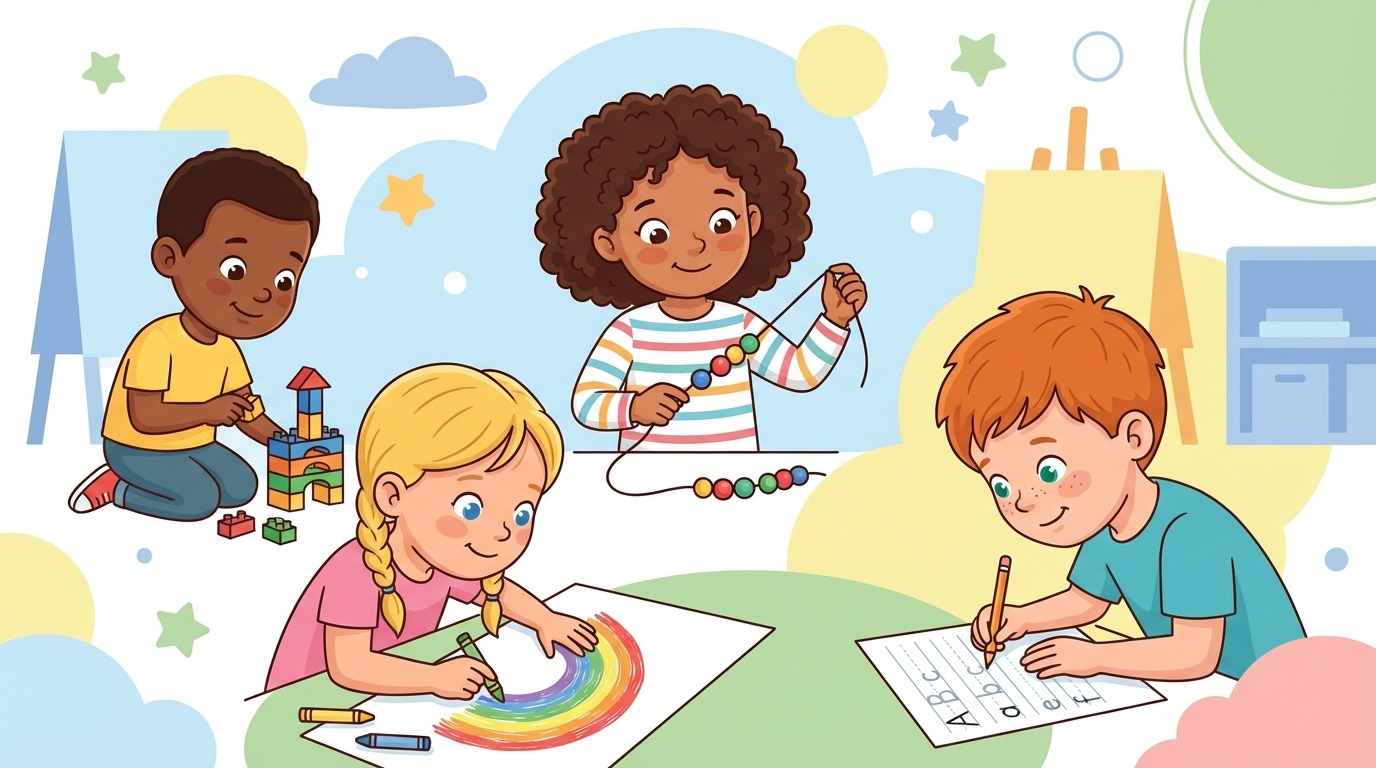
Targeted manual activities support digital dexterity and wrist stability. They train precision and perseverance. A clear and motivating protocol encourages engagement. Start simple, then increase complexity.
Progression remains essential. Vary object size, texture, and time. The child faces just the right challenge. They exert effort without discouragement. Pleasure becomes the driver.
Workshop ideas at home and in class
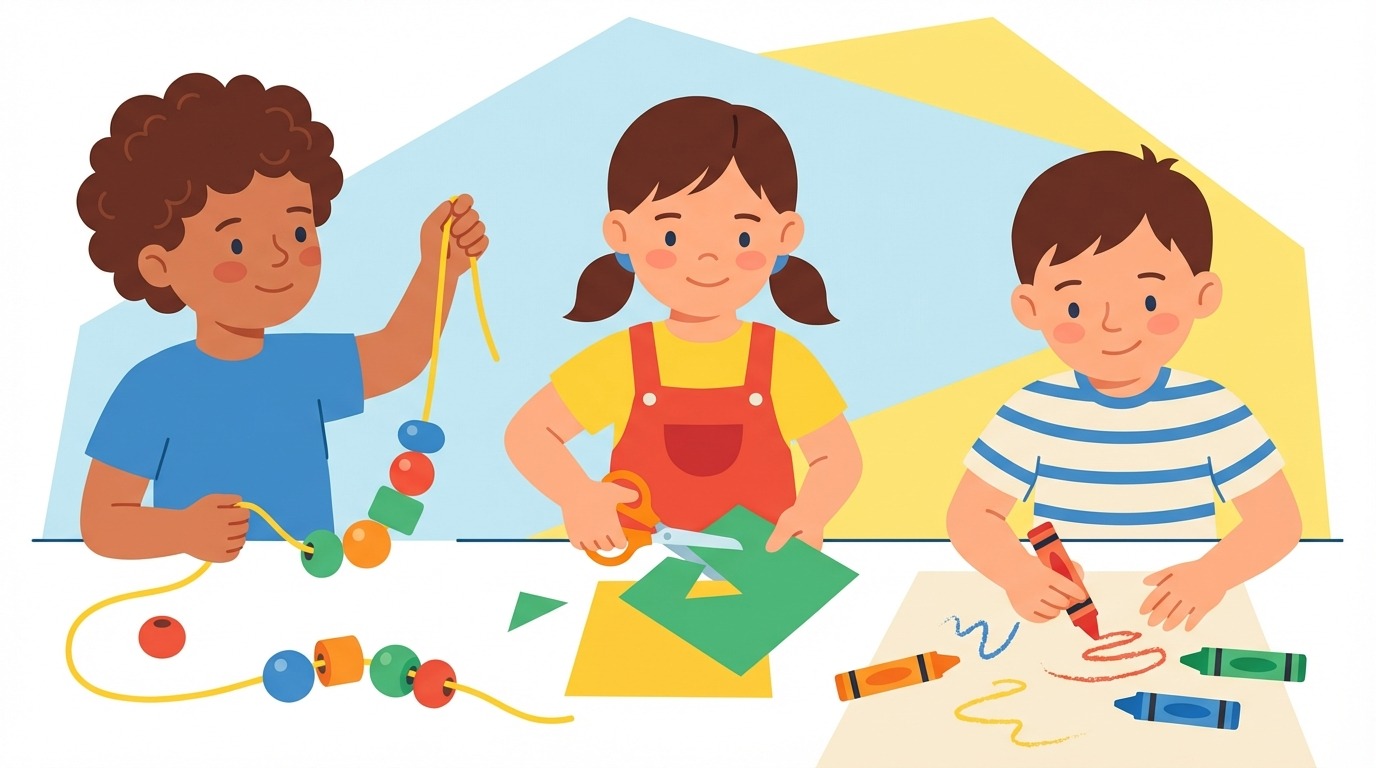
- 🧵 Progressive threading: big beads, then small; color alternation; visual model to follow. Strengthens hand-eye coordination.
- ✂️ Guided cutting: straight lines, curves, then shapes. Spring scissors to start. Work on a flexible wrist.
- 🧲 Tongs and pincers: transfer pom-poms; time a 60-second sleeve. Boosts fine grasping.
- 🍝 Modeling clay: rolls, small balls, alternating pinching. Regulates strength and pressure.
- 🧃 Pouring: spoon, pipette, funnel. Aims the eye, controls the hand, adjusts speed.
- 🧩 Progressive fitting: tight templates, then complex shapes. Develops manual skills.
Everyday materials offer great opportunities. A cardboard box becomes a tunnel, garage, or theater. This game fosters imagination and bimanual manipulation. Simple ideas spring from these creative cardboard games.
The calendar inspires as well. A seasonal craft requires precise gluing, folding, and cutting. It creates emotional motivation. Success is seen, touched, and proudly shown.
How to ritualize without boredom
Set up a dedicated corner, with labeled boxes and ready tools. Guided choices stimulate autonomy. Two proposals per day suffice. The child gains method and confidence.
Verbalization accompanies the hand. Name the movement, pressure, and direction. This anchors the movement. Avoid overload of instructions. The brain breathes better.
To end the session, a short self-evaluation helps. The child points out what worked, then one thing to try tomorrow. This ritual nurtures the desire to progress. The hand follows the intention.
Writing and graphics: from broad gestures to precise strokes
Writing settles on robust gestural foundations. Before the letter, there is the trajectory. The arm traces broadly, then the wrist guides finely. The hand executes, and the eye corrects in real time.
Work on shape families: vertical, horizontal, oblique, loops, bridges. Each family trains separately, then chains together. Rhythm is established. Legibility follows.
Grasping, posture, and pressure: the winning trio
The tripod grip stabilizes the tool. The triangular pencil facilitates this grasping. The wrist remains slightly extended. The forearm slides, the elbow accompanies. The hand does not tense.
Posture supports endurance. Feet on the floor, pelvis settled, table at elbow height. The gaze stays mobile. Fatigue recedes. Muscle soreness too.
Graphic progression and micro-skills
Break down learning. Trace without lifting, then lift-then-set down. Connect two points. Follow a path. Each step reduces overload. The child focuses on a single constraint at a time.
Supports vary: vertical board, easel, grid paper, slate. Large format frees the shoulder. Small format requires more precision. Switch between them wisely.
- 🌊 Warm-up: waves, loops, winding paths on A3 format.
- 🎯 Targeting: connect-the-dots, path to follow, then micro-points to connect.
- 🧭 Orientation: up/down, left/right, crossed obliques.
- ✍️ Letters: groups by common gestures; step by step.
- 🧰 Review: regular return to less stable shapes.
For a serene projection to the following year, it is useful to deepen at 6-7 years. The same gesture families then refine. Automatism settle with no tension. Fluidity prevails over speed.
Finally, “just the right force” is learned. Soft modeling clay, pencils with soft leads, and fine brushes guide regulation. Avoid holes in the paper. Dexterity is nourished by nuances. Even written as “dexterité”, fineness remains the same.
Pedagogy through play: manual skills and hand-eye coordination in action
Play structures learning. It sets a rule, a goal, and clear feedback. Success counts points. Motivation renews with each round.
Card and board games refine planning and manipulation. Draw, sort, align. Fingers act intentionally. The eye monitors coherence.
Smart games to progress without stress
A magnetic moving game works aiming and trajectory. Mazes stimulate the stabilizing hand. Puzzles require spatial orientation. Each reinforces a building block of the gesture.
Memory and attention mix with fine motor skills. A short rule, a clear challenge, and it’s done. Playful resources like the 7 Families Kangaroo game multiply trials and manipulations. Precision improves without thinking about it.
Maritime skill games invite gesture control. The Little Ship game illustrates this link between simple rules and precise movement. Place, adjust, anticipate the fall. The hand learns to dose.
Safety, rhythm, and cooperation
A safe framework frees exploration. Choose adapted tools and clear instructions. Safety advice avoids mishaps. The child dares more with attentive adults.
Cooperative play also has a place. It lessens competitive pressure. Encourages mutual help and verbalization of the gesture. Shared pleasure anchors learning.
At the end of a playful cycle, transposition is observed. Cutting becomes cleaner. Gluing neater. The hand learned through play. That’s the major asset of play.
Early detection, accommodations, and educational alliance: making every child succeed
Certain signals call for strengthened attention. Very high pencil grip, quick fatigue, painful hand, or refusal to write sometimes recur. Simple screening through observation better targets help. The goal: remove obstacles early.
Analyze posture, grasping, pressure, finger dissociation, and precision. Also observe workspace organization. Does the child waste time looking for tools? This detail often reveals a need for adjustment.
Adjustments that make all the difference
A few adjustments often suffice. Triangular pencils, guide highlighters, contrasting lines. An inclined plan relieves the wrist. Spring scissors offer useful rebound. The gesture calms down.
Sequencing tasks reassures. Cut into short, visible steps. Each micro-success feeds the next. Engagement climbs.
Daily autonomy and transferred skills
Fine motor skills generalize to life routines. Buttoning, zipping, spreading, screwing. These gestures are worth as much as an exercise book. They develop bilateral coordination and precision.
In the same logic, the path to bodily autonomy supports confidence. Concrete landmarks ease collective transitions. Dedicated resources for toilet training in daycare illuminate these sensitive steps.
School-family cooperation and monitoring
Success rests on a clear alliance. The classroom adult and family share simple goals. Choose two priority axes. Plan three weekly rituals. Monitoring remains light but constant.
A monthly observation grid summarizes progress. It notes pinch stability, endurance, and legibility. Proposes adjustment for the following month. This cycle makes improvement visible.
If a developmental coordination disorder is suspected, referral to a professional is necessary. The earlier support is set in place, the faster the child regains comfortable movement. Hand and mind regain confidence. The course is maintained.
How much time per day to dedicate to fine motor skills at 5-6 years old?
Aim for 10 to 15 minutes daily, in two mini-sessions if possible. Regularity outweighs duration. Choose a simple activity, then offer a variant the next day.
Which tools promote a good pencil grip?
Short triangular pencil, soft grip if needed, inclined plane, and sheets with visual markers. Add a wrist mobility exercise before writing.
How to help a child who presses too hard?
Use soft leads, fine markers, and pinch games. Propose a color code for pressure (light, medium, strong). Work on slate then paper to regulate effort.
Are board games really useful?
Yes, they train hand-eye coordination, planning, and fine manipulation. Choose short rules, grasps materials, and quick rounds to maintain engagement.
When to consider a specialized opinion?
If pain, intense fatigue, or strong aversion persist more than 8 to 10 weeks despite adaptations, consult. An assessment guides effective accommodations.
« A child’s hand guided with kindness writes the future with precision. » ✨