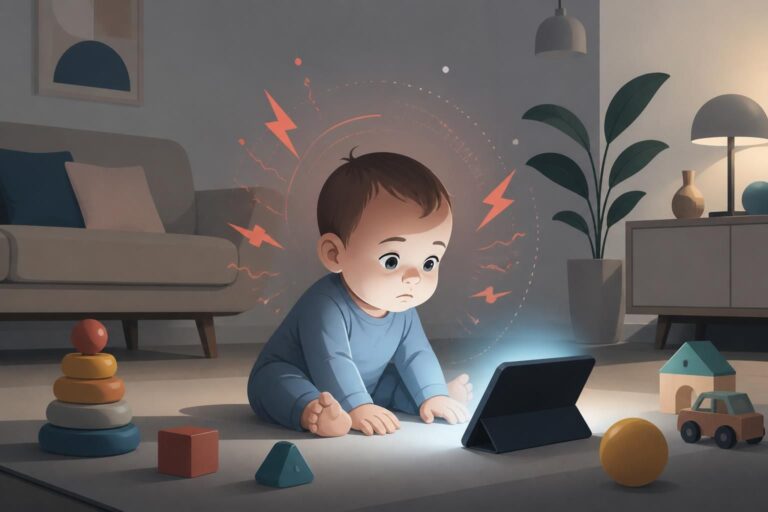
Overstimulation Child Impact: The impact of overstimulation in children aged 1 to 3 years.
| Short on time? Here’s the essentials ⏱️ |
|---|
| Overstimulation happens when the child receives more information than they can process 😵💫. |
| Good development requires a balance between awakening, free play, and rest ⚖️. |
| Watch for signs: fatigue, irritability, anxiety, sleep disturbances 😴. |
| Limit screen time: avoid before age 2; from 2 to 5 years, about one hour per day 📱. |
| Favor listening, co-regulation, and free play to reduce stress 🧩. |
| Beware of false hyperactivity diagnoses when the child is simply overwhelmed 🚦. |
| Lighten the schedule, create rituals, and plan quiet times daily 🗓️. |
| Simple activities suffice: reading, nursery rhymes, outdoors, warm interactions 🌿. |
In many households, toddlers grow up amid a whirlwind of sounds, images, and activities. This bubbling fosters curiosity, but it can also overload a brain in full development. Between 1 and 3 years old, adaptive capacities remain fragile. When the impact of stimuli exceeds what the child can regulate, stress rises, fatigue builds up, and behaviors flare up.
Families seek a clear guide: how to support awakening without falling into overstimulation? The landmarks exist, concrete and reassuring. They rest on three pillars: rhythm, listening to signals, and quality of the relationship. At home, a gentle routine, simple language, and open-ended games prevent overload. It is this daily ecology that protects the child from a sensory and emotional avalanche.
Overstimulate Child Impact: understanding overstimulation in children aged 1 to 3 years
Stimulation is essential nourishment. It comes through speech, soft music, movement, and invitations to explore. However, overstimulation appears when the flow exceeds processing capacity. The child no longer filters. They then react with crying, agitation, or sudden withdrawal.
For this age group, the brain refines its connections. Attention circuits build step by step. A healthy alternation between awakening and rest encourages this maturation. An excess of stimuli blurs information selection and weakens self-soothing.
Distinguishing stimulation and overstimulation
Appropriate stimulation respects the child’s rhythm. It relies on daily rituals and free play. Talking with simple words, singing nursery rhymes, describing what is being done, often suffices. Inspiring ideas can be found in these resources: sensory activities for toddlers and nursery rhymes and songs.
Overload, on the other hand, occupies all the time. The adult directs, corrects, proposes without pause. The child’s brain has no room left to integrate and memorize. The result is quickly visible: tension, refusal, and sleep disturbances.
Awake windows and bodily signals
Awake windows are short at 1 year old, then lengthen. Observing signs helps to adjust. When the child averts their gaze, rubs their eyes, or grimaces, they signal rising fatigue. A quiet time is necessary, without screens, in a dim corner.
The adult’s role is to modulate the environment. Lower the volume, reduce visible toys, and slow down the stream of proposals. This adjustment protects attention capacity and prevents emotional escalation.
Neurodevelopmental landmarks
Between 12 and 36 months, language explodes and motor skills gain confidence. The prefrontal cortex remains immature however. The child therefore needs a regulating and predictable adult. To deepen these milestones, this dossier can help: brain development between 1 and 3 years.
The key message is simple: dose. Stimulate, yes. But leave pockets of silence and fertile boredom. This apparent emptiness is a powerful ground for creativity.
Signs and impacts: stress, anxiety, fatigue, hyperactivity, and confusing behaviors
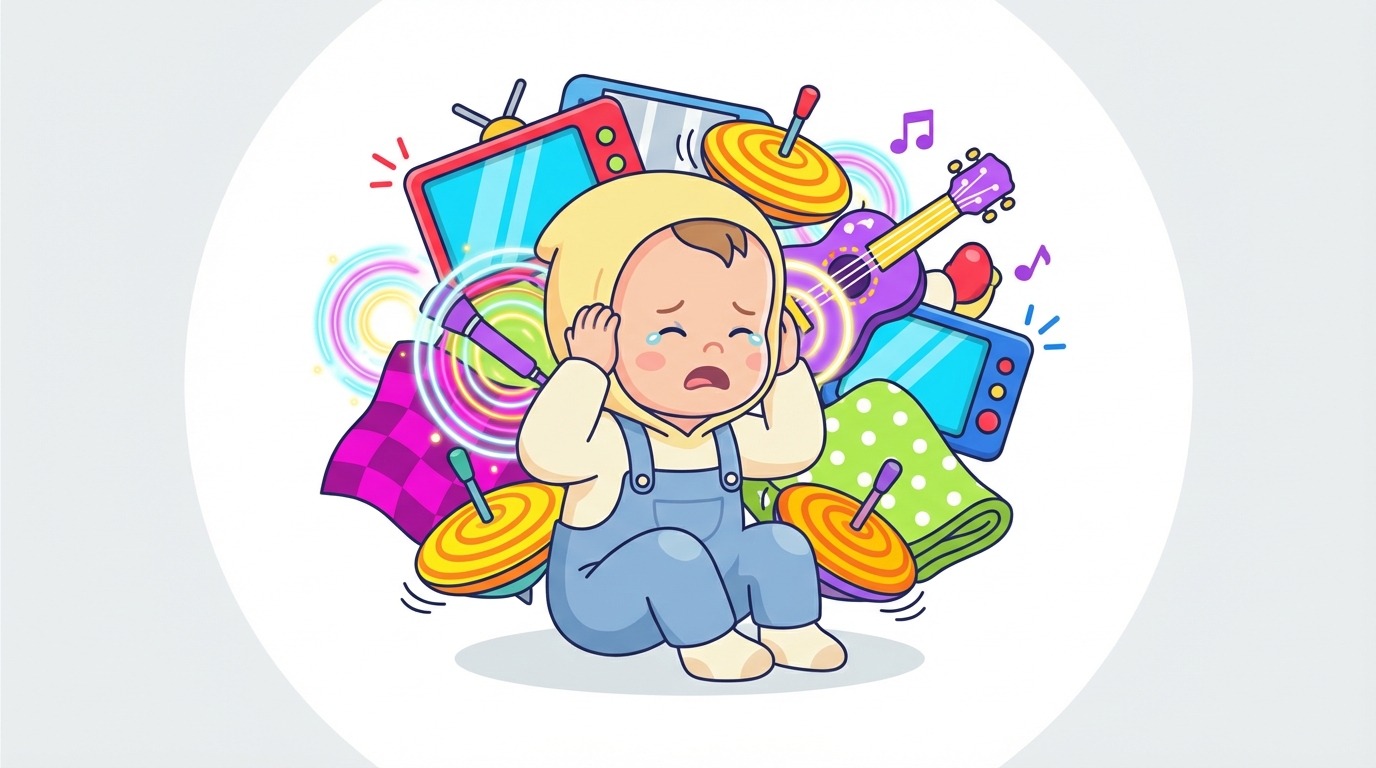
Overstimulation is often confused with hyperactivity disorder. The child runs, climbs, screams, and panic spreads. Yet the cause may be an excess of sensory inputs. An overly rich environment triggers survival responses: flight, fight, or withdrawal.
These reactions do not indicate a will to oppose. They show overload of the nervous system. The body says: too much, too fast, too intense. The adult benefits from hearing this subtle language.
Signals to spot without delay
- 😣 Sudden irritability after a very stimulating activity: sign of stress.
- 😴 Yawning, eye rubbing, agitation before sleep: accumulated fatigue.
- 🌀 Switching rapidly from one game to another: fragmented attention due to overload.
- 💥 More frequent tantrums late in the day: empty reservoir, rising anxiety.
- 🤫 Withdrawal, avoiding gaze, silence: attempt at self-protection against noise.
- 🏃 Constant and impulsive movements: false “hyperactivity” linked to excess stimuli.
These signs can also be heard through variations in listening. The child no longer hears simple requests. They cut off conversation. They no longer follow short instructions.
Short- and medium-term impacts
In the short term, the main impact remains difficulty falling asleep. When the child is used to stimulation, bedtime silence causes anxiety. The brain demands the same intensity level. Falling asleep then takes longer.
Continuously, performance pressure creates inner doubt. The child compares themselves. They feel like a failure if the adult pushes too hard. Self-esteem falters, and the relationship becomes strained.
| Signal 🚨 | Context 👀 | Immediate action ✅ |
|---|---|---|
| Crying after party | Noise + lights | Gentle isolation, water, cuddle |
| Running aimlessly | Cluttered living room | Tidy up, offer 1 single game |
| Refusal to sleep | Late screens | Turn off, calm reading |
| Tantrums in series | Busy schedule | Cancel, go out to the park |
To nuance, some phases at 3 years remain stormy by nature. A useful resource details these critical passages: tantrums around 3-4 years. The challenge is to cross-reference context, signs, and the amount of stimulation.
When the balance tips, refocusing the environment often provides quick relief. It is the most powerful and least costly tool.
Preventing overstimulation: soothing routines, simple environment, and careful screen management
Prevention starts with daily hygiene. A balanced day protects the nervous system. It includes movement, fresh air, quiet times, and restorative sleep.
An effective principle: fewer visible toys, more relational quality. Better a well-lived simple activity than four in a row.
The power of free play
Free play strengthens autonomy, creativity, and self-esteem. The adult remains present but follows the child’s lead. This time nourishes mutual listening. It also promotes self-regulation.
When boredom arises, it is a chance. It calls on imagination. Taking out a few neutral objects suffices: boxes, fabrics, blocks. The brain rests from instructions and regains fluidity.
Screens: clear guidelines
Current recommendations remain stable: avoid screens before age 2. Between 2 and 5 years, aim for about one hour per day, co-viewing, with gentle content. Practical details are gathered here: screens and young children.
Reducing sensory intensity of content preserves attention. Cutting all exposure 60 minutes before sleep helps falling asleep. A reading with a calm voice replaces evening screens advantageously.
Protective rituals
Structure three immutable landmarks per day: calm wake-up, respected nap, routine bedtime. Repetition reassures the brain. It reduces decision-related fatigue.
In the schedule, allow white margins. Canceling without guilt remains a caring gesture. The child does not need an adult’s planning.
Families often benefit from a simple “reset”: a walk outside, a fresh drink, a silent cuddle. After this break, attention returns and mood brightens.
Case study: Leo, 2 years old, between sensory overload and regained balance
Before adjustment, Leo lived very busy days. Quick waking, cartoons during breakfast, music in the car, noisy daycare, and multiple workshops in the evening. Falling asleep lasted more than an hour. Tantrums broke out at the slightest refusal.
His parents imagined emerging hyperactivity. Yet, careful observation spoke of overstimulation. The environment overstimulated his senses. His body responded continuously with agitation.
Targeted interventions
The first step was radical but gentle: cutting screens in the morning, slowing the pace, and reducing visible toys. A quiet corner with a rug, books, and warm light was then created. In the evening, a short ritual took place: bath, story, cuddle.
The parents sharpened their listening to signals. As soon as Leo rubbed his eyes, the activity stopped. Breathing together soothed the system. Time outside at the park replaced a structured workshop.
Observed results
In ten days, falling asleep gained 30 minutes. Crises decreased by half. Attention on a single game improved from 3 to 10 minutes. Leo smiled more, talked more, and asked less for television.
This change was no miracle. It was based on a new sensory ecology. Leo’s body was no longer forced to flee excess. To better understand these dynamics, this dossier explores stress in young children and this guide describes typical behavior between 1 and 3 years.
Relational lever
The strongest lever was the adults’ calm presence. They slowed the speech rate and simultaneous requests. Instructions were given one at a time, with eye contact and a gentle voice.
The key phrase heard every evening: “We do less, but do it better.” This mantra changed the household atmosphere. The relationship regained its central place.
Co-regulation, listening, and healing play: concrete strategies for ages 1 to 3
The nervous system of the child first regulates with an adult. This is called co-regulation. The adult lends calm through breathing, voice, and rhythm. This alliance transforms overstimulation into felt safety.
A simple toolbox often suffices. It fits in a bag, a living room, or a park. The idea is to replace intensity with quality.
Co-regulation gestures
- 🌬️ Butterfly breathing: inhale 3 seconds, exhale 4, while watching an imaginary flame.
- 👐 Gentle deep pressure: hands on shoulders, then release, with the child’s consent.
- 🎶 Slow nursery rhyme whispered: lengthen vowels, lower volume.
- 🧱 Heavy play: push a basket full of books, to “anchor” the body.
- 🌿 Nature bath: walk barefoot on grass, feel the wind, look far.
Nursery rhymes and slow music quickly calm the system. An inspiring selection is here: nursery rhymes and songs for children. This shared time strengthens the bond and sets a reassuring framework.
Prune, then enrich with care
Start by removing noise, lights, and instructions. Then reintroduce one activity at a time. Listening guides order and pace. The child’s gaze says when to stop.
Offer open-ended games: blocks, modeling clay, simple puzzles. Avoid toys with lights and sounds. The brain gains stability when the stimulus is clear.
After calm, a short ritual seals soothing: glass of water, cuddle, and story. This sequence creates anchoring. It becomes a backup key during storms.
“Better a calm child who learns slowly than a hurried child who no longer learns.”
How do I know if my child is overstimulated or simply active?
Observe the context and recovery. Normal activity involves calm back-and-forth and proper sleep. Overstimulation shows through frequent tantrums, accumulating fatigue, and difficulty settling even in calm environments. If soothing does not return after a simple routine, reduce overall intensity by one level.
Do screens worsen overstimulation at 2 years?
Yes, due to the fast pace of images, bright colors, and loud sounds. Exposure should be avoided before age 2. Between 2 and 5 years, limit to about one hour per day, co-view, and turn off at least one hour before bedtime. Prefer slow and interactive content off-screen: books, songs, symbolic play.
Should all organized activities be eliminated?
No. It is primarily about dosing. A well-chosen, short, age-appropriate activity can be beneficial. The sign of good dosing: the child leaves the activity still available to play and sleep. In case of tensions or exhaustion, lighten the schedule and favor free play.
My child has tantrums late in the day, is it related to overstimulation?
Often yes. The day accumulates stimuli: daycare, transports, noise. Late afternoon, the reservoir is empty. A decompression phase helps: soft light, snack, silent cuddle, then calm play. If tantrums persist despite these adjustments, consult to explore other factors.
How to react during a tantrum without reinforcing the behavior?
First, secure: low voice, posture at child’s height, few words. Breathe together, then offer a simple choice: “water or cushion?” Avoid long explanations. When the emotion subsides, name what happened and value recovery. The goal is not to extinguish the tantrum but to guide regulation.