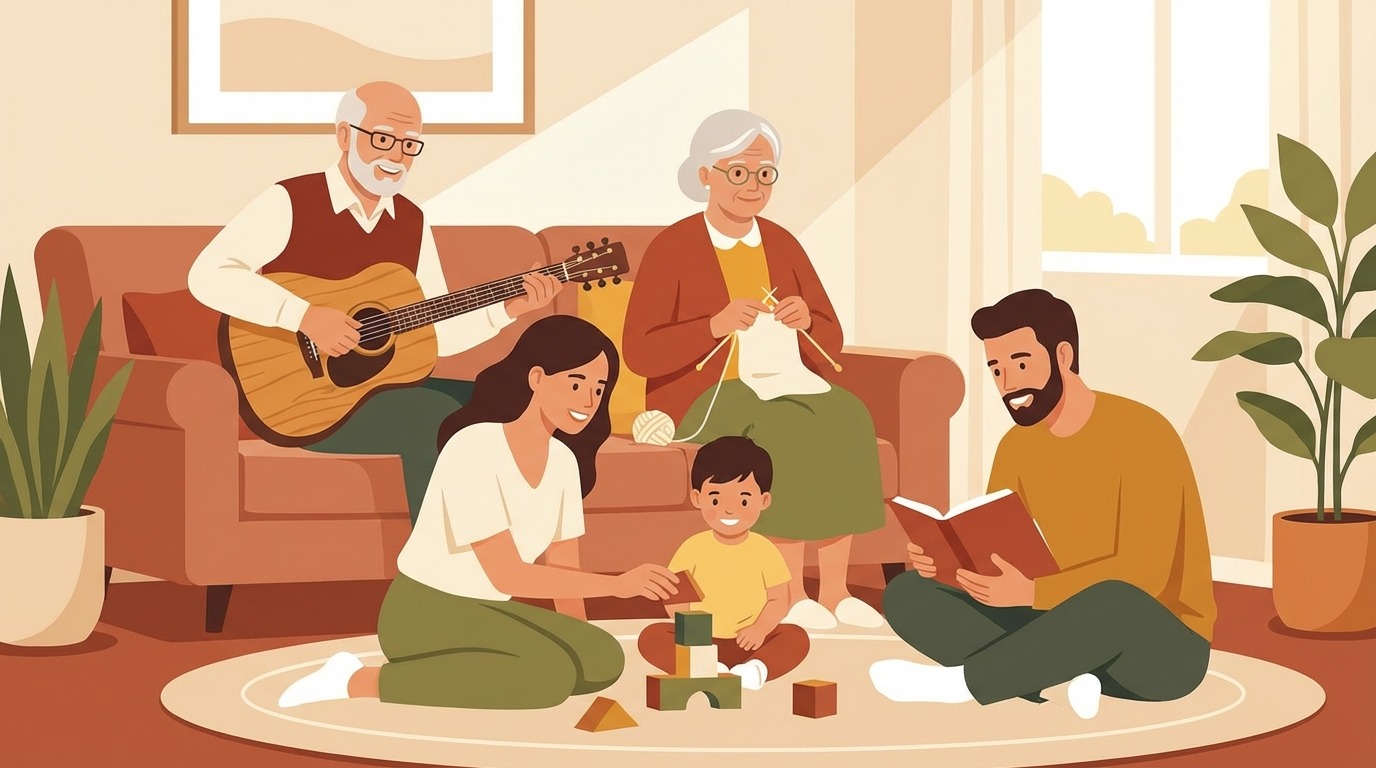
Parents Grandparents Harmony: Promoting harmony between parents and grandparents.
| Short on time? Here’s the essentials ✨ |
|---|
| Clarify roles : parents decide, grandparents support 🤝 |
| Prioritize communication : saying “for us, it’s important that…” opens dialogue 🗣️ |
| Accept small deviations : at Grandma’s, an ice cream doesn’t ruin the harmony 🍦 |
| Create intergenerational rituals to nurture family cohesion 🔗 |
| Stay the course : listening and respect preserve family well-being 🌿 |
In many families, the role of grandparents evolves. Between increased availability, desires to pass on knowledge, and modern realities, the alliance between generations is enriched. Yet, balance can be strained when educational approaches differ. To transform these tensions into strength, focus is placed on role clarity, quality of communication, and the meaning of sharing. It is here that harmony is born, at the heart of a solid, coherent, and deeply human family relationship.
In this spirit, concrete markers make daily life easier. Small deviations at the grandparents’ become treasures, not threats. Common rituals strengthen cohesion. Above all, children feel a united team around them. They flourish because they see adults who listen, respect each other, and cooperate. In 2026, this framework proves invaluable: it helps each household navigate confidently between family heritage and current realities.
Grandparents’ involvement: role and impacts on the modern family for lasting harmony
Grandparents do not occupy a decorative place. Their presence reassures, their experience enlightens, and their history connects the child to a lineage. However, they do not replace parents and do not decide in their place. Their role is complementary: they bring something else, in a different way. In practice, this balance reduces tensions and strengthens harmony daily.
The ideal framework remains simple. Parents set the rules and assume educational authority. Elders support with kindness, share know-how, and offer generous listening. Calmly saying “Thank you for your help, and here is what we wish” asserts this framework without offending. Thanks to this clear boundary, the family relationship becomes more peaceful.
Transmission, security, and shared benchmarks
When a child listens to a youth story from their grandfather, they don’t just receive a story. They grasp a sense of time, an ability to put things in perspective, a strength of spirit. These benchmarks nourish their internal security. At the same time, the repetition of small rituals – the famous Wednesday pie, the Sunday walk – establishes an emotional continuity that contributes to family well-being.
Families often recount this benefit. In the Martin family, for example, Lina, 5 years old, handles morning separations better when she knows a video call will await her in the evening with her grandparents. This simple appointment becomes an emotional pillar. It consolidates overall harmony.
When approaches differ: staying the course without clashing
Differences sometimes arise regarding sleep, sugar, or screens. Instead of opposing head-on, the parents–grandparents duo benefits from moving “side by side.” A short, factual phrase, stated calmly, encourages mutual respect. For example: “For us, screen time must end at 7 PM, non-negotiable.” Firmness soothes when it is clear and stable.
Recent data support this optimism. A French survey cited by the press showed that most elders find parental education appropriate. Only a minority express strong disagreements. This confirms that dialogue, when regular, maintains cohesion rather than conflict.
Practical tools that make a difference
Three levers structure cooperation. First, a 10-minute weekly “check-in” by phone or video to set key rules for the week. Next, a brief sheet posted at Grandpa and Grandma’s (bedtimes, allergies, limits). Finally, a positive channel for feedback: sharing what worked, and adjusting what doesn’t.
For shared moments, play remains a major ally. Exploring simple ideas, this guide on the benefits of play in children inspires activities that nurture complicity without overstimulation. Thus, concrete action meets theory, and the family relationship gains in clarity.
In the end, the key is summed up in one sentence: “clear role, clear words, clear heart.” When places are assumed, the child feels supported by a team aiming for their family well-being. This solid base prepares what follows: setting limits… gently.
Parents and grandparents: clear and gentle boundaries for smooth harmony
Saying no without antagonizing is the delicate art of united families. Parents protect the framework. Grandparents bring warmth and flexibility. Between the two, communication acts as a bridge. Thanks to short and respectful messages, everyday life breathes. Listening turns every friction into an opportunity for collective growth.
A rule works when it is simple, constant, and explained. No need to argue for hours. A phrase like “For us, it’s important that the nap takes place before 2 PM” is enough. The tone must remain calm. The message, non-negotiable. Thus, respect for the parental role naturally prevails, without tension.
Useful scripts to maintain the relationship
Faced with unsolicited advice, responding with gratitude and a steady stance avoids escalation. For example: “Thank you, we’ll note that. For now, we follow the pediatrician’s recommendations.” This approach validates the intention to help and refocuses the decision with the parents. Often, this immediately defuses tension.
Regarding feeding, everyone knows the temptation of sweets. Nevertheless, some limits are necessary. A kind exchange, backed by reliable benchmarks, helps a lot. This file on sugar in baby’s diet offers concrete milestones. Aligning with common sense and data, relatives coordinate without judging.
Quick action list to preserve cohesion
- 🧭 Define 3 non-negotiable rules (sleep, safety, screens) and post them at Grandpa and Grandma’s.
- 💬 Use “clear messages”: “For us, it’s important that…”
- 📅 Organize a mini check-in every Friday to adjust routines.
- 🧩 Allow 1 “special Grandma’s rule” on playful details, not on core education.
- 🌱 Praise grandparents’ efforts: recognition nurtures harmony.
Conflicts dislike the light. As soon as a discussion becomes regular, suspicion drops. The child then perceives a stable base. They learn that different adults can cooperate. This silent message strengthens their inner world and sense of belonging.
When a child’s preference occasionally swings to one grandparent, emotions can sting. Yet, this phase is normal. It broadens the attachment circle while offering a breather to parents. The key is to keep exclusive moments with the child, so they feel the consistency of the main bond.
In summary, limits remain an act of love. They enhance the family relationship rather than stifle it. Gently, they become support, not a barrier.
Accept differences and small deviations: educational flexibility without losing structure
At the grandparents’, one more cartoon or an ice cream after dinner does not sabotage harmony. On the contrary, these “extras” give a unique flavor to the relationship. Children understand well that rules vary according to place. They thus discover the richness of the social world. This pluralism does not erase parental education. It complements it.
How to stay serene? By setting clear boundaries and leaving flexibility in the center. The red line protects health, safety, and sleep. Around it, the space of play and surprise offers welcome breathing room. Each side feels respected. The child enjoys nuances without losing their benchmarks.
Avoid competition between grandparents
Comparison traps many clans. Some elders try to “win” affection through gifts. Yet, a child’s love is not a cake to share. It is a source that grows with each meaningful bond. Simple gestures – listening, telling stories, crafting – are worth more than an expensive toy. The quality of presence weighs more than the quantity of objects.
To encourage this path, everyone can cultivate their signature. One passes on the vegetable garden, another drawing, a third cooking. Betting on authenticity, cohesion is strengthened. The child is not torn. They are fulfilled by a variety of affectionate colors.
Set boundaries without guilt
When “small deviations” become repeated “large leaps,” better to reframe. Again, a short sentence suffices: “We save sweets for the weekend.” Elders understand a firm benchmark posed respectfully much better than a long lecture. The tone makes the music. A firm smile often beats a sermon.
Parents can also propose pleasant alternatives. A yoga-relaxation session advantageously replaces a sugar excess, for example thanks to these ideas for yoga and relaxation for children. Thus, the relationship redirects towards lasting pleasures, without offending anyone.
When the child’s preference shakes things up
It happens that a toddler asks for their grandmother more than their parents for a short period. Rather than seeing this as rejection, one can read it as a developmental phase. This openness broadens their safety net. It also allows adults to catch their breath. By planning exclusive moments with the child, everyone quickly regains emotional balance.
Ultimately, accepting daily nuances is giving the child a rich relational palette. And this richness nurtures their family well-being as much as their confidence.
Intergenerational activities and time for two: nurturing the daily alliance
Nothing unites better than shared action. “Time for two” creates lasting memories, rooted in joy. Grandparents often offer a slower rhythm. Children settle, learn, and feel seen. Parents gain precious support and a breather. The whole family relationship is lightened.
To structure these moments, a micro-ritual suffices. On Saturday, the handed-down recipe. On Wednesday, the plant workshop. At each meeting, a one-hour red thread, no more, no less. The child anticipates with happiness. The adult keeps promises without fatigue. And the home becomes a place of harmony, not a center of activity.
Concrete and easy-to-implement ideas
- 🥣 Grandma’s “cooking notebook” with 10 recipes and the associated story.
- 🌿 Grandpa’s “mini-garden”: three plants to follow, from sowing to harvest.
- 📚 The “story hour” with audio recording for evenings without visits.
- 🎨 The “museum of artworks”: a wall to hang successive creations.
- 🚶 The “curiosity walk”: count birds, spot colors, invent a legend.
The seasons inspire. In spring, outings together enchant ties again. This guide of spring family activities offers simple and joyful ideas. By varying pleasures, everyone finds their place and shares their talent. Cohesion is woven step by step.
Free play and gentle physical activity also count. With elders, the child explores at their own pace, far from performance. Affective and cognitive benefits accumulate. Here again, quiet time becomes an ally. A mat, cushions, soft music: all is ready.
For distant families, the 10-minute video call changes everything. We read a story, sing, show the drawing of the day. In 2026, these digital habits consolidate proximity despite distance. They complement, without replacing, real meetings.
In the end, activity is not a gadget. It is a gentle method to embody sharing, listening, and respect. Step by step, the ordinary becomes an emotional heritage.
Managing tensions and building lasting cohesion: a 5-step method
No family escapes disagreements. What matters is how they are transformed. Instead of arguing in the heat of the moment, a brief, clear, and regular protocol can change everything. The child observes this daily diplomacy. They then learn that harmony is not the absence of conflict, but the art of going through it together.
The “CALM” protocol for families
Channel the conversation: 15 minutes, seated, without phone. Advance a fact, not an accusation. Let each speak 3 minutes without interruption. Mark a minimal agreement (1 non-negotiable rule). Engage a 7-day trial action. Simple, reproducible, this framework protects communication and listening.
This approach reduces unnecessary emotion and aligns priorities. It gives everyone a place. It respects roles. Week after week, cohesion solidifies. Messages become leaner, more effective, gentler.
Useful insights and common blind spots
Tensions often concern a few recurring themes: sleep, sugar, discipline. To clarify, three educational compasses are established. A “signature rule” of grandparents is accepted on a festive detail, but the heart of parental rules is sanctuarized. This intelligent sharing soothes, as everyone feels heard and useful.
Recent figures invite realism. A majority of elders say they are aligned with the parents’ education. When disagreement exists, it remains limited. This data encourages not to dramatize. It motivates especially to establish short and constant talk times, rather than rare and explosive adjustments.
Cultivating mutual recognition
Nothing soothes as much as gratitude. Saying “Thank you for respecting the nap” or “Thank you for supporting the evening ritual” reactivates the desire to help. Concrete thanks have more impact than vague compliments. They create a virtuous circle of effort and trust.
Underlying principle remains: preserve the team. When the child sees adults talking, respecting, and supporting each other, they feel secure. This security structures their character. It accompanies them long after childhood.
Ultimately, moving forward together is giving the child a reliable “village.” This village helps them grow upright, confident, and joyful.
Roadmaps for family well-being: routines, health, and small steps that matter
Family harmony is nourished by small daily adjustments. Clear routines, healthy pleasures, and shared quiet times are enough to transform the atmosphere. Parents gain serenity. Grandparents find their rightful place. The child gathers precious stability for their growth.
Practically, a short and predictable evening routine reassures. Screens are turned off earlier. A story is read. The day’s “favorite moments” are talked about. Elders can extend this ritual during care periods. With consistency, sleep improves, and the home breathes.
Health markers and misunderstanding prevention
Health remains a sensitive area. To be clear, everyone relies on common and up-to-date resources. When doubt persists, better to share a reliable source than to improvise. This reflex aligns practices and limits misunderstandings.
Gentle physical activities and active games stimulate mood and reduce evening tension. Combining movement and relaxation, the family channels energy without shouting. Evenings gain softness, and the family relationship is lightened.
A final word on gifts and affection
The object is never the essence. Time is. Rituals are. Presence especially. Investing listening and sharing builds strong bonds. It protects the educational course. And anchors the child in a story that wishes them well, now and tomorrow.
To conclude this roadmap, a joyful reminder: simplicity always wins. A game to invent, a soup to stir, a joke from Grandpa… so many sparks that ignite the great light of cohesion.
How to set boundaries without hurting grandparents?
Formulate short and stable rules (“For us, it’s important that…”), thank for efforts, then propose a pleasant alternative. A calm tone, clear expectations, and explicit recognition preserve harmony.
What to do if the child occasionally prefers one grandparent?
Rest assured: it is often a normal phase. Maintain exclusive parent-child moments while valuing the bond with elders. This alternation broadens their attachment circle and strengthens their internal security.
How to avoid competition between grandparents?
Bet on authenticity rather than gifts. Each grandparent cultivates their signature (cooking, gardening, stories). The child benefits from complementary bonds, without comparisons or escalation.
Which activities strengthen intergenerational relationships?
Simple and regular rituals work well: shared cooking, mini-garden, story hour, curious walks. Also take inspiration from seasonal ideas to vary pleasures.
How to align health and feeding practices?
Share reliable and up-to-date resources, clarify non-negotiable rules (sleep, sugar, screens), and organize a weekly 10-minute check-in to adjust without tension.
“When adults agree, children breathe: family harmony is a compass, not an option.” 💚