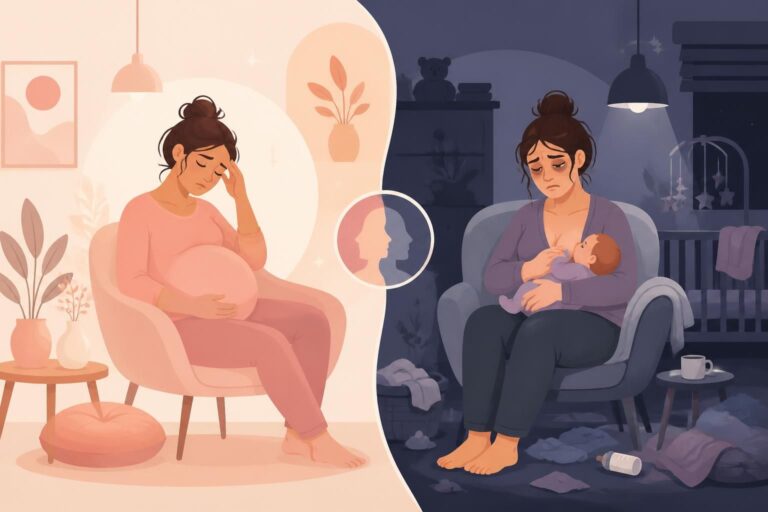
Stretch Marks Pregnancy: Prevention and treatment of stretch marks during pregnancy.
| Short on time? Here’s the essentials ⏱️ |
|---|
| 💡 Stretch marks affect 55 to 90% of pregnant women. They mostly appear late in pregnancy on the belly, breasts, and hips. |
| 🧬 Two main drivers: mechanical stretching of the skin + hormonal variations (cortisol) that reduce collagen and elastin. |
| 🛡️ No prevention is foolproof, but daily hydration + slow massage help the skin better tolerate stretching. |
| 🥑 Nutrition matters: omega-3, vitamin C, proteins, and water support skin fibers. |
| 🧴 Choose an anti-stretch mark oil or a cream rich in emollients; Centella asiatica and vitamin E are interesting options. |
| 🧪 After childbirth, a treatment can reduce the marks: retinoids (not during breastfeeding), peelings, microdermabrasion, fractional lasers. |
| 🧘 Self-esteem progresses with realistic skincare solutions … and a kind view of the changing body. |
Stretch marks during pregnancy are neither inevitable nor trivial. They tell the story of a body that adapts quickly, sometimes too quickly. When the skin stretches due to the rounding belly and the breasts gaining volume, the skin mechanics become tense. Micro-tears then form in the dermis, where collagen and elastin usually ensure resilience. To the naked eye, these initially purplish lines lay down in parallel bundles, then lighten until they become pearly. They are harmless, but their emotional burden is very real.
A crucial point must be made immediately. There is no 100% shield. However, a combined strategy clearly reduces risk and intensity: methodical hydration, regular massage, gentle management of weight gain, wise choices of anti-stretch mark oil, and some targeted nutrition habits. After birth, a range of treatment options help diminish marks, especially if applied early. Between realistic expectations and concrete actions, there is room to maneuver. This guide gathers useful references to decide with serenity and efficiency.
Why stretch marks appear during pregnancy: causes and factors to know
Understanding the mechanism changes the perspective. Due to rapid growth of abdominal and breast volume, the skin undergoes repeated tension. When the tension exceeds its capacity to adapt, fibers break. Visible stretch marks are therefore not just “surface marks” but the result of a deeper micro-trauma. This explains why hydration alone is sometimes insufficient, even though it helps greatly.
Mechanical stretching and hormones: a decisive duo
Two processes add up. First, mechanical stretching increases quickly with weight gain. Then, hormonal influence, notably a rise in cortisol, slows collagen and elastin synthesis. When structural components weaken, the dermal architecture yields more easily. That is why two women with the same weight gain may experience very different outcomes. Hormonal background and baseline fiber quality play a strong role.
The affected areas follow the pattern of stretching: belly, breasts, hips, thighs, and buttocks. Initially, stretch marks are red or purplish. The inflammatory phase makes them more receptive to certain treatments. Over time, they whiten. Strategies then change, because tissue response diminishes. Acting at the right time matters.
Documented risk factors and practical signs
Recent clinical data confirm a wide prevalence range of 55 to 90%. Several factors stand out: family history, pre-pregnancy BMI, baby’s birth weight, and young age. One aspect is often intriguing: previous stretch marks on the breasts seem to increase risk during pregnancy, while those observed on the thighs may, conversely, indicate a lower probability of developing new ones. Skin heritage thus guides the prevention strategy.
In real life, these numbers translate into simple actions. Regular weight gain protects the skin. A daily care routine started early helps delay the appearance of striae or reduce their extent. Each gesture gains effectiveness if maintained over time. A routine established from the first trimester provides a window of opportunity.
Misconceptions to overcome for better action
No, a miracle cream does not “re-glue” broken fibers. The skin heals and then calms but does not always restore its previous appearance. On the other hand, minimizing the value of a thorough massage would be a mistake. Mechanical stimulation improves microcirculation, enhances perceived elasticity, and supports tissue relaxation. The effect is not magic, it adds to other levers.
Another common confusion: totally avoiding weight gain. Maternal and fetal health demands appropriate gain. The realistic goal is to avoid rapid spikes. Regular monitoring reassures and allows gradual adjustments. Ultimately, steady small steps are better than ineffective “bursts.”
Interim conclusion: causes are known, levers exist. The core topic now is: how to structure a routine that ticks important boxes without burdening daily life.

How to best avoid stretch marks during pregnancy: pragmatic prevention routine
A winning approach combines three aspects: external care, nutrition, and pace of weight gain. The goal is not perfection, but coherence. Simple, repeated gestures make a difference. Clara’s story, 22 weeks pregnant, illustrates it well. By applying an anti-stretch mark oil daily, drinking more, and spacing protein snacks, her skin became more supple. Her emerging stretch marks became less visible.
Targeted hydration and slow massage: a foundation that delivers
Massage belly, sides, breasts, thighs, and buttocks twice a day on slightly damp skin. The hydric film increases active ingredient penetration. With an open hand, make deep circular movements, then gentler upward strokes. Fifteen minutes suffice. A cream rich in emollients or a quality vegetable oil nourishes the lipid barrier. Prevention gains impact through regularity.
Need a guide for gestures and textures? A comprehensive dossier on skincare for the expectant mother details routines and seasonal references. For breasts, a highly solicited area, dedicated advice is here: breast changes during pregnancy. This focus helps dose pressure and frequency without irritating the areola.
Smart nutrition: support collagen and elastin from within
The skin loves what nourishes its fibers. On the menu: proteins at every meal, vitamin C (citrus fruits, kiwis, peppers), zinc (legumes, seeds), and omega-3 (fatty fish, walnuts, rapeseed). Water remains essential. A glass every waking hour maintains stable tissue hydration. Some practitioners recommend omega-3 supplementation during pregnancy. Discussion with the midwife or doctor guides the right dose.
Weight rhythm, sleep, and micro-movements
Stabilizing weight gain prevents stretching spikes. Regarding movement, gentle walking, swimming, or prenatal yoga improve circulation. The skin benefits from this increased oxygenation. Regular sleep also limits cortisol, which indirectly promotes collagen production. Each pillar strengthens the others.
- 🧴 Massage 1 to 2 times/day with an anti-stretch mark oil or a enveloping cream.
- 💧 Drink in small sips throughout the day for better hydration.
- 🥗 Aim for protein, vitamin C, zinc, and omega-3 intake every day.
- 🚶 Move gently; circulation supports skin care.
- 📆 Proceed with small consistent habits rather than “bursts.”
A demonstration in images often helps anchor massage technique. This video search helps identify precise, slow, and effective gestures.
Some also consider essential oils with regenerative properties (rose geranium, green mandarin, helichrysum). Caution however. Several essences are contraindicated during pregnancy. Pharmaceutical advice is required before any use. It is better to stick to formulas specifically tested for pregnant women.
Stretch marks and products: what are creams, oils, and star actives worth in 2026?
The question comes up endlessly: “Which cream really works?” The consensus remains clear. No product guarantees absence of stretch marks, but some ingredients support the skin usefully. The key lies as much in the formula as in the gesture and consistency. An effective care combines occlusive emollients, humectants, and pro-fiber actives.
Formulas that make sense: emollients + humectants + boosters
Sweet almond, avocado, apricot kernel oils, or shea butter seal hydration. Glycerin and hyaluronic acid hold water in the upper layers. On the “boost” side, Centella asiatica, alpha-tocopherol (vitamin E), and collagen-elastin hydrolysates often appear in favorable trials. Their role? Encourage synthesis and slow fiber degradation, as much as possible.
Anti-stretch mark oil vs. cream: how to choose?
The anti-stretch mark oil offers glide and prolonged massage. The cream provides comfort and long-lasting hydration. Many expectant moms opt for a duo: oil in the evening for the massage ritual, cream in the morning to dress quickly. This scheme reinforces compliance. The important things remain skin tolerance and user pleasure, guarantees of regularity.
Safety during pregnancy: check INCI lists
Avoid topical retinoids during pregnancy and breastfeeding, unless strictly medically indicated. For essential oils, seek advice. A pregnancy-compatible label reassures. Very reactive skins prefer fragrance-free formulas. When in doubt, test on the crook of the elbow for 48 hours. Safety takes precedence over innovation.
To refine your choices and compare routines, this guide on stretch mark prevention offers a pragmatic overview. The best decisions are often the simplest to follow daily.
And what about homeopathy and natural approaches?
Some protocols include Calcarea fluorica 7 CH, sometimes combined with Graphites 7 CH. Evidence remains limited, but the approach can be integrated as support with medical advice. Regarding plants, rosehip appeals for its reparative fatty acids. Again, patience and regularity make the difference. Nature helps; regularity makes it real.
Verdict: a single product does not “do” prevention. A coherent system significantly improves outcome. The tool becomes powerful when the routine is sustained.
Treatments after childbirth: from visible improvement to realistic limits
Once stretch marks have settled, the goal shifts to reduction. Options are ranked according to mark color, age, and skin phototype. The earlier the intervention, the better the skin’s response. However, the postpartum schedule must respect recovery, potential breastfeeding, and healing status.
Topical dermatologicals and peelings: first step
Outside pregnancy and breastfeeding, tretinoin can improve appearance in nearly one case out of two. Dermatological follow-up is mandatory. Glycolic or trichloroacetic acid peelings stimulate remodeling. The protocol adjusts to skin sensitivity. Strict photoprotection always accompanies these procedures to prevent hyperpigmentation.
Mechanical techniques and lasers: gradual gains, realistic expectations
Microdermabrasion, performed in a series, gently smooths the epidermis and activates cellular renewal. Devices blowing micro-crystals have shown noticeable reductions, especially on recent stretch marks. Non-ablative fractional lasers often provide 50 to 75% aesthetic improvement on white striae, according to available studies and operator expertise. Each skin responds differently; plans are personalized.
Camouflage options also exist. Self-tanners even out skin tone. Medical tattooing, when done by a specialist, recolors pale areas durably, with caution on skin prone to dyschromias. Finally, surgery remains a last resort reserved for large lesions, at the cost of a fine, strategic scar.
To visualize the course of postnatal care, this video research saves time. It allows comparison of lasers, peelings, and microdermabrasion according to indications.
A balance point is needed: aim for clear improvement, not the illusion of “as before.” By setting a measurable goal (lightening, smoothing, narrowing), satisfaction increases and budget is better controlled. Scar maturity, season, and phototype condition the schedule.
Living with stretch marks: care schedule, camouflage, and self-esteem
Skin care fits into a larger story: that of a body becoming a parent. Combining effectiveness and gentleness avoids the exhausting race for instant results. A three-phase plan structures the momentum: during pregnancy, early postpartum, then long term. Each phase brings levers. Each phase deserves patience and respect.
Simple and actionable schedule
Trimester 1 and 2: start daily skincare, establish massage routine, secure nutrition. Trimester 3: strengthen hydration, monitor weight rhythm, favor soft and stretchable tissues. Postpartum 0-12 weeks: soothe, hydrate, allow skin to regain balance. Postpartum 3-6 months: first dermatological evaluation if needed, discussion on gentle peelings. Beyond: laser or microdermabrasion options once healing is complete.
Camouflage and gracious styling
Body makeup, dermatologically tested, camouflages for events. A light self-tanner evens out tone without sun exposure. Shaping swimsuits and satin fabrics reflect light and visually blur reliefs. Breathable fabrics limit friction, preserving the skin barrier. The idea is not to hide but to dress with ease.
Emotional support and reliable resources
Dialogue with partner, midwife, and community strengthens self-esteem. Choosing serious sources avoids false promises. The practical dossiers cited above offer a useful framework. When discomfort affects the breasts, this focus answers key questions: breast changes during pregnancy. Combining knowledge and kindness makes each choice safer.
In the background, a vital reminder persists. The body created life. Stretch marks are sometimes its signature. Taming them, then reducing them if desired, shapes a healthy and controlled journey.
When to start prevention?
From the first trimester. An early routine of hydration and massage improves the skin’s tolerance to stretching. It is easier to prevent than to catch up on an established stria.
Which areas to massage first?
Belly, sides, breasts, hips, thighs, and buttocks. The breasts require gentler gestures; avoid the areola and favor slow circular movements.
Do anti-stretch mark creams really work?
No formula prevents 100% of stretch marks. Rich emollient treatments, combined with actives like Centella asiatica and vitamin E, help the skin better resist and recover. Regularity is key.
Should retinoids be avoided?
Yes during pregnancy and breastfeeding, unless medically advised. After this period, they can improve the appearance of striae under dermatological supervision.
When to consult a dermatologist?
If stretch marks appear quickly, itch, or affect morale; and as soon as postpartum allows, to discuss peelings, lasers, or microdermabrasion suited to your skin.
“A consistently supported skin responds with elegance.” 💫