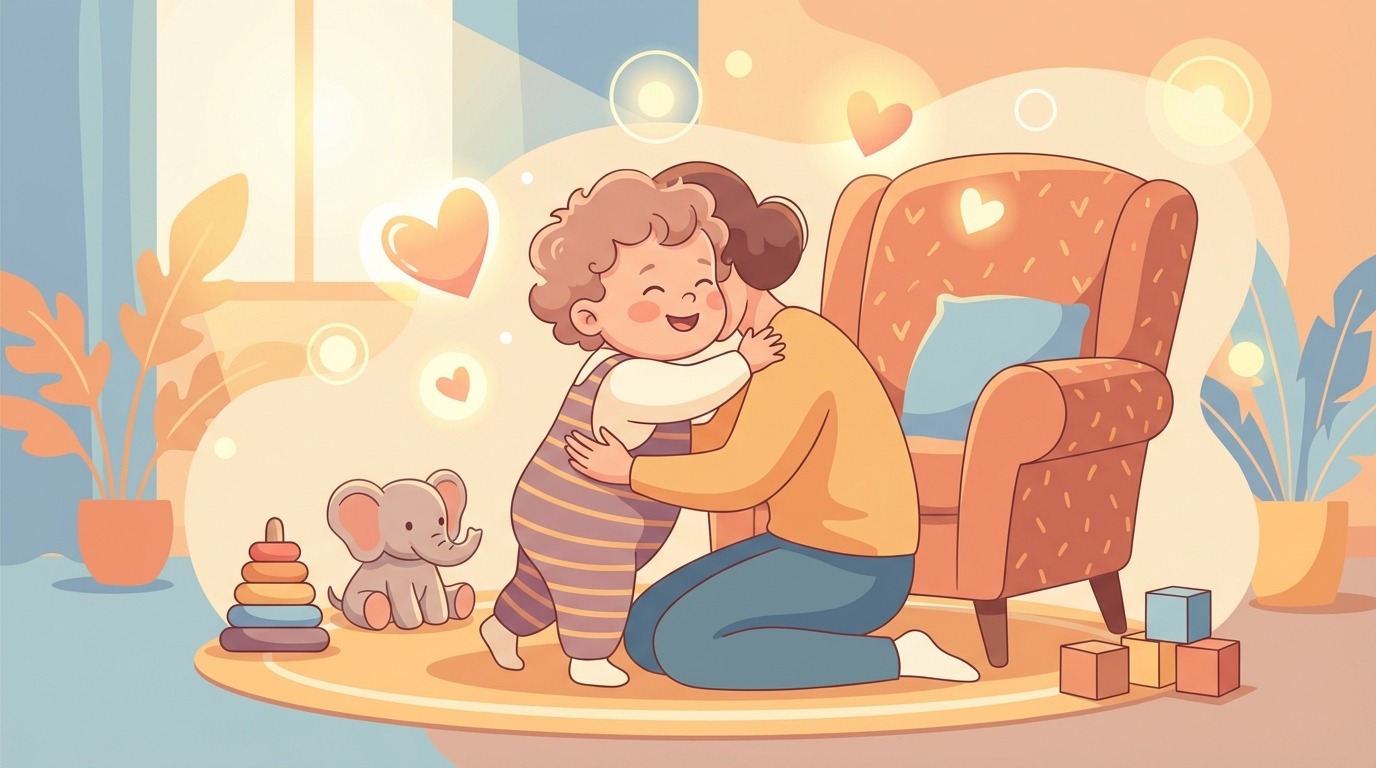
Affective Child: The affective in the child from 13 to 18 months.
| Short on time? Here’s the essentials 🎯 |
|---|
| At 18 months, the child strengthens their attachment and explores further if their emotional security is ensured ✅ |
| Emotional development progresses thanks to play, routines, and non-verbal communication 👀 |
| Naming emotions helps the child recognize and gradually regulate them 🗣️ |
| Clear limits + empathy = fewer tantrums and more autonomy 💡 |
| Avoid screen overload, prioritize interactions and imitation games 🎲 |
Between 13 and 18 months, emotional landmarks become decisive. The child walks, points, mimics, and asserts themselves, but often returns to their reassuring base. This back-and-forth nurtures emotional security and unfolds emotional development. Routines, ritual cuddles, and the parent’s non-verbal communication act like a common thread. Little ones then learn to decode emotions, then share them. This moment remains germinal for trust and self-esteem.
Within this framework, the parent-child relationship plays the role of a compass. Tensions sometimes appear, as the push for autonomy challenges limits. However, the adult can channel without breaking initiative. The child, at 18 months, imitates, experiments, tests. Symbolic play and group care gently shape the emotional and socialize. Through simple gestures and precise words, loved ones strengthen attachment and guide the little one toward clear expression of their needs. This way of acting traces a serene path.
Child’s emotional at 13-18 months: attachment and emotional security
At this age, a secure base is built day by day. Signs of attachment can be seen in the sought proximity, eye following, and exploration within adult reach. When the environment responds consistently, emotional security sets in. The child then dares to distance themselves and returns to check the stability. This loop secures attempts, even when they fall, fail, or get impatient.
Experts describe an emotional circuit where co-regulation opens the way to self-regulation. Concretely, the parent soothes, names, offers an alternative. The child calms faster the next time, as their alarm system feels recognized. A simple “you are angry” puts words in place and lowers the tension. The adult stays firm on the framework, but gentle in tone.
Attachment signals and non-verbal communication
The sensitive speaks before words. Micro-expressions, the smile reappearing at the sight of a familiar face, the hand seeking contact—all reveal non-verbal communication. It precedes language. It shows attunement between the child and their environment. The parent adjusts their voice, rhythm, posture. The child aligns, then goes off to explore.
A concrete example illustrates this. Lina, 15 months old, tenses in front of a stranger. Her mother bends down, smiles, places a hand on Lina’s shoulder. The child’s body relaxes. The posture reassures; no words were necessary. This kind of repeated attunement nourishes a solid foundation. It will later become an internal landmark.
Separation and reunions: routines and landmarks
Separation remains delicate, but it can be ritualized. A short, always identical ritual helps to tolerate absence. A comfort object, a key phrase, a promise of reunion often suffice. The care options also offer adaptation spaces designed to respect each one’s tempo. The clearer the landmarks, the less stress sets in.
In the evening, the joy of reunions repairs the distance. The day is recounted, scenes lived are imitated, laughter erupts. This moment strengthens the emotional. The attachment-exploration-ritual loop closes. Tomorrow, the child will leave with more boldness. This continuity calms the heart and opens the mind.
In sum, a secure base is not a closed bubble. It is a solid launching ramp, allowing momentum and accompanying the landing.

Emotions and emotional development between 13 and 18 months: naming, playing, taming
Emotional development accelerates when the parent names what they observe. Saying “you are frustrated” or “you are proud” gives the young child a readable map. This marking facilitates internal recognition and reduces reaction intensity. The child then learns to tolerate the gap between desire and reality.
Stories and images support this work. Stories to tame emotions offer mirror characters. They allow identifying fear, jealousy, or joy without feeling judged. We read, comment, mime. The message passes through body and voice, well before long speeches.
Naming emotions daily
Upon waking, the adult can describe the child’s internal weather. “You still seem tired,” “You look so happy.” This verbal mirror helps link sensations and words. Little by little, language becomes a regulation tool. Tantrums lessen in intensity as understanding grows.
Mini-scenes of life, like sharing a toy or waiting one’s turn, are learning grounds. Effort is praised. A precise solution is proposed. Initiative is congratulated. Thus, the child associates perseverance and satisfaction. They discover that emotion flows and eventually transforms.
Symbolic play and budding empathy
The child, at 18 months, sometimes begins to pretend. They care for their doll, talk to a plush toy, offer a cup to a stuffed bear. This play reflects internal scenarios. This impulse can be stimulated by construction games inviting the parent to play with the child. Building a kitchen corner, park, or small house feeds the imagination.
Sometimes, an imaginary friend emerges toward the end of this age range. This symbolic companion serves as a transition tool. It helps test roles, manage fears, tame the unknown. The adult respects this play, without forcing or ridiculing it.
For imitation toys, a safe value stimulates autonomy. Real-life objects adapted to toddlers promote confidence. Imitation ranges and child-height spaces, like those designed for daily autonomy, encourage initiative and pride in acting.
This dynamic makes emotion readable, transforms it into a social skill. Empathy appears, still fragile but very much there.
Watching a clear resource before playing can inspire simple rituals. Then, action follows with a short scenario, repeated, then gradually complicated over days.
Parent-child relationship and mindful limits: setting boundaries without extinguishing momentum
Limits do not oppose the emotional. They protect it. A clear framework secures because it makes the world predictable. Saying “touch gently,” “wait by the door,” avoids confusion. Firmness is paired with empathy. Intonation remains calm, instructions stay simple.
Oppositional behaviors exist and remain normal. It is a test of the framework, not a personal attack. Contextual cues help a lot. Understanding typical behaviors between 1 and 3 years reduces guilt. Responses are then proportioned without dramatizing.
Ritualize and co-regulate
Rituals offer anchor points. Before going out, put on shoes, say goodbye to the house, breathe. Before bath time, sing the same nursery rhyme. This repetition soothes emotional load. The child anticipates, cooperates, then enjoys participating.
Co-regulation goes through three steps. Welcome the emotion. Name it. Offer a possible action. For example: “you are angry, you can squeeze the pillow hard, then we breathe together.” This sequence creates an exit route. The body calms, the relationship stays harmonious.
Set clear and kind limits
A consistent framework is built with few, stable, understandable rules. Always explain why, with short words. Accept the child’s frustration and contain it. Frustration leads to maturation if accompanied by listening and a plan B.
Imitation tools and practical-sensory activities channel energy. Setting the table with suitable accessories, sweeping with a small broom, pouring rice, all sculpt attention. The child feels competent. The more they act, the less they explode. Balance sets in.
Parental consistency strengthens the message. When adults align their responses, the child understands faster. They internalize the rule and gain autonomy. Family peace benefits as well.
After a quality video, it remains crucial to return to reality. Choose one rule, one ritual, and maintain it for two weeks. The progress becomes visible.
Exploration, motor skills, socialization: at 18 months, curiosity serves the emotional
When the body frees up, the heart follows. Walking, climbing, carrying open horizons. The child ventures further, then comes back to check the parent’s presence. This back-and-forth strengthens the emotional base and stimulates thinking. The motor and the emotional develop together.
Arranging the home helps a lot. Secure outlets, clear a path, install stable furniture. Motor success feeds joy, then calm. Failure becomes tolerable under the supportive adult’s gaze. Courage grows.
Safe environments and autonomy
Everyday equipment offers great opportunities to act. Toy strollers, small kitchens, sturdy plastic workbenches—all stimulate without danger. Attention is paid to ergonomics and safety. The child, framed and encouraged, gets to work on the world.
Free play retains a central place. The parent observes, comments briefly, then lets go. This explicit trust develops initiative capacity. The child discovers skillfulness. They better tolerate surprises and recover faster after failure.
Outings, group care, and meetings
Parks and care places complement emotional learning. Other children are encountered. Waiting is learned. Different adults are seen. The parent’s gaze remains the guiding mark. The care options structure these experiences and facilitate socialization.
One point of attention is vital today. Researchers warn about sensory overload. Exposure to screens is therefore limited. Active games and human interactions are preferred. To understand the issues, a look at screen use in young children proves useful.
Daily outings, even short ones, are treasures. The world becomes an open book. The parent puts into words, the child points, and emotions connect to discoveries. This emotional map enriches memory and curiosity.
In the end, the more exploration is contained by reassuring presence, the more attachment anchors in active trust.
Concrete tools to nourish the emotional: routines, play, language and budding morality
Short, regular rituals irrigate the day. Keep a morning routine, one for the nap, one for the evening. Each includes a moment of shared attention. Repetition stabilizes mood. The child plans, cooperates, calms down.
An “emotion box” helps verbalize. Choose a few simple cards: happy, angry, sad, surprised. Point to the card, mime, tell a scene. Body and words align. The little one understands and expresses better. Conflicts decrease.
Effective emotional routines
- 🧸 Morning welcome: eye contact, cuddle, reassuring keyword
- 🫖 Calm transitions: sip of water, breathing, short song
- 📚 Bedtime story: emotion story and bedtime ritual
- 🧱 Free play: constructions or imitation, ideally with bricks and figurines
- 🚫 Limited screens: prefer human exchanges; see the landmarks
These landmarks don’t restrict. They guide. The child clings to them when the wave rises. Then, they release and go back to playing more serenely.
Parents’ toolbox
Several tangible levers support the parent-child relationship. The first consists of commenting without judging. Describe the action and observed emotion. The second values effort more than result. The third sets a clear limit with an offered alternative.
One can also link these practices to emerging moral conscience. Around this period, the child gradually distinguishes “allowed” and “forbidden.” The alignment between rule and empathy gives meaning. The child understands that a rule protects.
Finally, external resources inspire. Care places, professionals and peers enrich the idea box. Each then adapts to their home. Consistency does the rest, day after day.
Final key: a clear framework, simple words, and warm presence. This trio opens wide the doors of trust.
“A reassured heart dares, explores, and grows: emotional security makes the inner world blossom.”
{“@context”:”https://schema.org”,”@type”:”FAQPage”,”mainEntity”:[{“@type”:”Question”,”name”:”Comment ru00e9agir u00e0 une grosse crise du2019un enfant de 15 mois ?”,”acceptedAnswer”:{“@type”:”Answer”,”text”:”On accueille lu2019u00e9motion sans du00e9battre, on nomme (u00ab tu es tru00e8s fu00e2chu00e9 u00bb), puis on propose une action concru00e8te (serrer un coussin, souffler trois fois). Quand le calme revient, on reformule la ru00e8gle en une phrase courte. La constance, plus que la force, apaise.”}},{“@type”:”Question”,”name”:”Faut-il su2019inquiu00e9ter si mon enfant ne partage pas encore ?”,”acceptedAnswer”:{“@type”:”Answer”,”text”:”u00c0 13-18 mois, le partage nu2019est pas attendu. Lu2019enfant joue plutu00f4t u00e0 cu00f4tu00e9 des autres. On modu00e8le le geste (u00ab je pru00eate, tu pru00eates u00bb), sans insister. La socialisation mu00fbrit avec le temps, le jeu et la pru00e9sence su00e9curisante.”}},{“@type”:”Question”,”name”:”Quels jouets favorisent lu2019autonomie affective ?”,”acceptedAnswer”:{“@type”:”Answer”,”text”:”Les jouets du2019imitation stables, les constructions simples et les objets du quotidien adaptu00e9s soutiennent lu2019initiative. Ils encouragent la ru00e9ussite, ru00e9duisent la frustration et nourrissent la confiance en soi.”}},{“@type”:”Question”,”name”:”Quelle place pour les u00e9crans u00e0 18 mois ?”,”acceptedAnswer”:{“@type”:”Answer”,”text”:”Mieux vaut u00e9viter avant 2 ans, sauf usage tru00e8s ponctuel et accompagnu00e9. Les interactions humaines, les livres et le jeu libre restent plus bu00e9nu00e9fiques au du00e9veloppement u00e9motionnel.”}},{“@type”:”Question”,”name”:”Comment pru00e9parer une premiu00e8re su00e9paration ?”,”acceptedAnswer”:{“@type”:”Answer”,”text”:”On cru00e9e un rituel bref et ru00e9pu00e9titif, on pru00e9sente le lieu et la personne, puis on respecte un temps du2019adaptation. u00c0 la reprise, on valorise la ru00e9ussite et on raconte la journu00e9e pour boucler la boucle affective.”}}]}How to react to a big tantrum from a 15-month-old child?
We welcome the emotion without arguing, name it (“you are very angry”), then offer a concrete action (squeeze a pillow, blow three times). When calm returns, we reformulate the rule in a short sentence. Consistency, more than force, soothes.
Should I worry if my child does not share yet?
At 13-18 months, sharing is not expected. The child rather plays next to others. The gesture is modelled (“I lend, you lend”), without insistence. Socialization matures with time, play, and reassuring presence.
Which toys promote emotional autonomy?
Stable imitation toys, simple constructions, and adapted everyday objects support initiative. They encourage success, reduce frustration, and nurture self-confidence.
What about screens at 18 months?
Better to avoid before 2 years, except very occasional and accompanied use. Human interactions, books, and free play remain more beneficial to emotional development.
How to prepare a first separation?
A brief and repetitive ritual is created, the place and person are introduced, then an adaptation period is respected. At reunion, success is praised and the day is recounted to close the emotional loop.