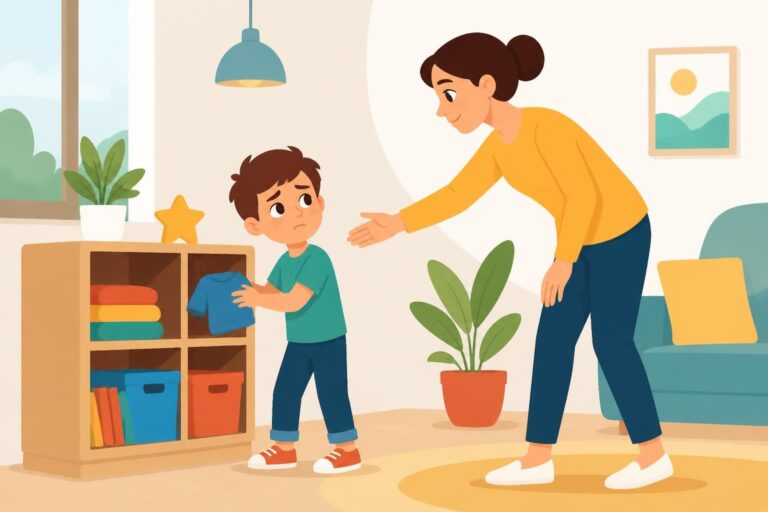
Performance Anxiety: Performance anxiety in children aged 5 to 8 years.
| Short on time? Here’s the essentials ⏱️ |
|---|
| In a child aged 5 to 8 years, performance anxiety manifests as fear of failure, stomach aches, avoidance, and repetitive thoughts before a test or competition 🎯 |
| Persistent school stress, amplified by social pressure, can disrupt sleep, appetite, and motivation 📚 |
| Stable routines, guided emotion management, and valuing effort strengthen self-confidence 🧠 |
| Parents play a key role in parental support with active listening, reassuring messages, and coordination with the school 🤝 |
| If anxiety invades daily life, identifying anxiety disorders and an evaluation by a professional is required 🩺 |
| Main goal: support the emotional development so the child dares to try, make mistakes… and progress 🌱 |
Success is often celebrated, yet the behind-the-scenes work is demanding. Between assessments, friendly competitions, and constant comparison, performance anxiety sometimes sets in early, starting in cycle 2. At this age, a child aged 5 to 8 years already perceives the social pressure and the need to “do things the right way.” When school stress turns into fear of not measuring up, the joy of learning diminishes and curiosity retreats.
The tipping point remains subtle: recurring stomach aches in the morning, restlessness before tests, crying fits over homework, avoidance of new activities. These are not tantrums but signals. Yet, when supported and reassured, most families regain solid balance. Parental support nurtures self-confidence, and emotional routines become springboards. Here, the goal is clear: equip children to tame the fear of failure, transforming anxious vigilance into energy to learn.
Performance anxiety in children aged 5 to 8 years: concrete markers and warning signs
It is helpful to identify what distinguishes useful stage fright from invasive anxiety. Between 5 and 8 years old, thinking organizes, but emotional regulation is still developing. Emotion management is learned, much like reading: step by step.
Differentiating adaptive stress from invasive anxiety
Brief stage fright before a presentation often motivates focus. Conversely, diffuse performance anxiety returns repeatedly, stretches over time, and colors multiple situations. The child dreads failure even before starting, repeats phrases like “I’m going to fail,” or endlessly seeks reassurances. At night, falling asleep becomes difficult; in the morning, school is feared.
Three areas to observe: body, thoughts, behaviors
- 🧩 Body: stomach aches, headaches, rapid breathing, sweaty hands, sleep disturbances.
- 💭 Thoughts: catastrophic scenarios, comparisons with others, focus on mistakes.
- 🏃 Behaviors: avoidance, excessive slowness, refusal to participate, rigid perfectionism.
These signals appear in class, during sports, and at home. Social sensitivity also increases; a clumsy comment can be enough to trigger the alert.
Example: Lina, 6 years old
Lina likes school, but spelling tests tense her. The day before, she complains about her stomach. In the morning, she checks her backpack three times. In class, she constantly erases. During recess, she avoids rule-based games. Here, loss of enjoyment and intrusive thoughts are enough to evoke performance anxiety. With markers, her parents can act.
Some profiles accumulate vulnerabilities. Specific difficulties in arithmetic, for example, increase apprehension toward assessments. To understand these situations, exploring resources on dyscalculia at school can enlighten educational teams and families.
Social shyness, very common, also plays a role: the child fears exposure under others’ gaze and raises the level of expectation. Strategies to help a shy preschooler prove useful in reducing the emotional burden linked to speaking up.
Finally, the history of fears sometimes appears very early. Understanding how fears develop helps adjust parental responses; this guide on fear in toddlers provides markers on alarm mechanisms and calming rituals.
Key idea: mapping signals across these three areas allows targeted actions and prevents escalation.
Origins and contexts: school, home, sports, health, and social pressure
Causes intersect. Rather than finding a culprit, it’s better to identify levers for action in each environment. Thus, the anxiety cycle loses strength.
At school: expectations, assessments, and school stress
School stress arises from repeated testing, grades, but also comparisons. A sensitive child may internalize the “zero mistakes” norm and forbid themselves from trying. Teaching methods that value progress, clear success criteria, and varied assessment methods reduce the burden. Teachers benefit from explaining the right to make mistakes and ritualizing caring feedback.
At home: emotional climate and parental stress
The home acts as a regulator. However, when pressure rises, the child feels it. Working on family balance protects the child. This dossier on parental stress offers simple ways to lower emotional volume at home, which also stabilizes the child before assessments.
In sports: perfectionism and team spirit
Competition can either stimulate or trap. A goal focused on means (breathing, posture, strategy) advantageously replaces obsession with ranking. Coaches and families reinforce well-executed gestures, even when the score is not favorable. In this way, the anxious spiral breaks where it starts: the fear of disappointing.
Health vulnerabilities and transitions
Specific health histories sometimes modulate stress sensitivity. Premature children may need adjustments when starting school; this feedback on prematures in kindergarten illustrates concrete and reassuring adaptations.
Periods of recurrent infections also tire the emotional system. Tips to prepare your child for winter illnesses contribute to preserving sleep and school routines, which mechanically reduces irritability and anxious anticipation.
Final marker: the same message across all environments — “you have the right to try” — strengthens the feeling of security and soothes social pressure.
Acting daily: parental support and emotional management rituals
Emotional routines are powerful buffers. They turn the invisible into simple gestures. When predictable, the child feels safe and dares more.
Morning and evening rituals
In the morning, a “heart weather” with three emojis helps the child name their state. In the evening, a round of pride — three things done well, even small — nurtures self-confidence. These rituals last five minutes and change the tone of the day. They anchor the idea that progress happens step by step, not in leaps.
Emotional toolbox
Build a box with a 4-4-6 breathing card, stress ball, images of strategies (“ask for help,” “take a break,” “reread instructions”) to give immediate empowerment. At school, a discreet signal (a pebble placed on the corner of the desk) reminds permission to breathe before acting.
Soothing communication and grounding list
Formulations matter. Saying “show me your method” rather than “why can’t you do it” shifts attention to the means. To help find bearings, this grounding list is useful before a test:
- 🫁 Breathe 3 cycles of 4-4-6
- 🔍 Reread the instructions once
- ✍️ Start with the easiest question
- 🧩 Return to longer ones last
- 🌟 Check off one pride at the end
Families can also adjust expectations: one less homework during busy periods, a light weekend, calming screen time after effort. The key is to protect recovery.
To close the loop, an emotional logbook tracks triggers, thoughts, and successes. In a few weeks, the curves show progress, and the child feels competent. Let’s insist: modest, repeated gestures build a solid foundation.
Key idea: a reassuring framework, permission to learn, and micro-tools form a winning trio that buffers worry.
Strengthening self-confidence: skills, games, and growth mindset
Self-confidence is built through action. It is not empty praise, but the memory of successful efforts. It is cultivated by giving challenges at the right level, neither too easy nor discouraging.
Stepwise learning and clear feedback
Breaking down a problem into three steps reduces cognitive load. Feedback focuses on the method: “you tried three strategies, and the third worked.” This means-based logic fuels a growth mindset: we improve because we practice.
Games that desensitize fear of failure
Organize “mistake challenges” where each person shares a useful mistake from the week, normalizing failure and fostering humor. Creating a “museum of attempts” at home encourages the child to display a draft, a model, a first draft. The message becomes clear: fear of failure yields when mistakes are permitted and analyzed.
Example: the “20-second challenge”
Propose a short daily action that is a little scary — raise the hand, read a sentence aloud, show a drawing. The limited duration makes the challenge acceptable. Then noting the felt emotion and what helped consolidates the success memory. Add a symbolic reward, not material: a high five, a sticker, a menu of activities to choose from.
When specific obstacles arise, adaptation takes precedence. A child with a fragile math profile will need accessible assessments and encouraging language; this point is detailed in the article on dyscalculia, useful to coordinate parents and teachers. Conversely, a shy child will benefit from practicing first in pairs, then in a small group, as suggested in this guide to support shyness.
Key idea: the more varied the success landscape, the more the child feels capable of daring elsewhere.
When and how to seek help: from detection to anxiety disorders
Sometimes, efforts are not enough. Anxiety overflows everyday life and takes control over learning. In these cases, a professional assessment becomes necessary.
Warning thresholds
Over several weeks, observe high intensity, almost daily frequency, and clear impact: absenteeism, isolation, refusal to attend school, persistent sleep problems. The child is exhausted, and so is the family. It is no longer just contextual performance anxiety but possibly an anxiety disorder to explore.
Graduated help pathway
Step 1: discussion with the teacher to adjust requirements. Step 2: meeting with the school psychologist or primary care doctor. Step 3: brief therapies, notably cognitive-behavioral, with training in graded exposure and emotion management tools. Parent-school-therapist coordination remains key.
Overall family support
Adjusting daily life protects family balance. When adults find outlets, children breathe better. The dossier on parental stress recalls concrete levers to lighten pressure at home during these periods.
Anxiety peaks often coincide with virus seasons or transitions. Anticipating and preparing for infection periods preserves energy and routine regularity. The better basic needs are met, the less anxiety holds on.
Key idea: asking for help is not an admission of failure, but an active strategy to restore the child’s freedom to learn.
“When effort is celebrated as much as the result, performance becomes a path, not a verdict.”
What are the early signs of performance anxiety at this age?
The signs combine physical indicators (stomach aches, sleep disturbances), repeated negative thoughts (“I’m going to fail”), and avoidance behaviors (refusal to present, excessive slowness). If this lasts several weeks and affects school or leisure, it’s time to act.
How to react the day before a test or competition?
Shorten homework, ritualize 5 minutes of 4-4-6 breathing, prepare a simple plan (start with the easiest task), and end with a pleasant moment. The message to give: you are ready thanks to the methods you have practiced.
Should failure be avoided to protect the child?
No. It must be tamed. It can be framed with small challenges, feedback on the method, and constructive analysis of what helped. Thus, failure becomes a learning signal, not a threat.
When to consult a professional?
If anxiety persists for more than a month, intensifies, or is accompanied by school absences, refusal of activities, and major distress, seek an evaluation. Brief approaches like CBT are effective for 5–8-year-olds.
How to involve the school without stigmatizing?
Offer a discreet plan: breathing breaks, adjusted assessments, goals focused on methods, and structured feedback. The teacher becomes an ally and the child retains dignity.