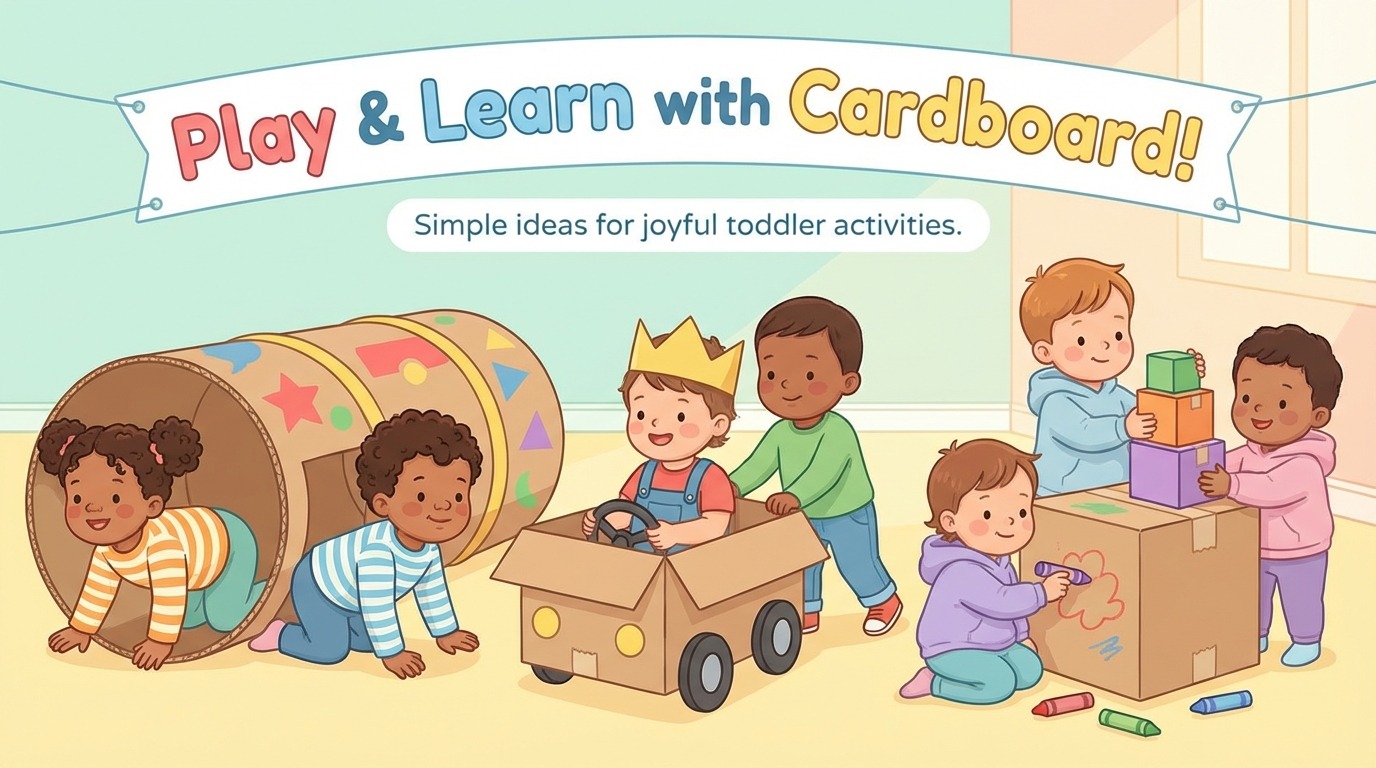
Playing Cardboard Box: Playing with a cardboard box: activity ideas for 1-3 year olds.
| Little time? Here’s the essentials 🎯 |
|---|
| With a cardboard box, children aged 1 to 3 explore motor skills, imagination and sensory play ✋👣 |
| Plan simple, short activities to keep up with toddlers’ rhythm ⏱️ |
| Punching, gluing, cutting provide rich and concrete development 🧠 |
| Golden safety rule: stable cardboard, rounded edges, no staples, constant supervision 🛡️ |
| Alternate active moments (obstacle courses, tunnels) and quiet moments (cabin, theater) ⚖️ |
| Reuse and decorate the same box to boost creativity ♻️🎨 |
| Incorporate music and nursery rhymes to support attention and language 🎵 |
Cardboard, light but sturdy, becomes an unlimited playground as soon as an adult provides a clear and joyful framework. A lid turns into a sensory board, a crate into a tunnel, and an appliance box into a cozy cabin. For 1-3 year olds, these concrete transformations give meaning to everyday gestures. In this way, each action strengthens motor skills and confidence. And above all, imagination flourishes.
These activities require little material: some fabric scraps, masking tape, washable markers, and stickers. Then, the magic happens. Lina, 18 months, loves pulling a ribbon through a hole. Malo, 2 and a half years old, prefers pushing balls through cut slots. Thus, playing with a cardboard box becomes an adventure adapted to each age and temperament, while preserving budget and planet.
Sensory play with a cardboard box for 1-3 year olds: textures, sounds and discoveries
Sensory play helps toddlers organize their perceptions. With a simple box, hands feel, eyes compare, and ears discover. This approach supports language development because naming what is felt structures thought. Step by step, the adult sets up a clear and safe space.
Explore with hands and feet: touch, pull, pass through
Punch wide holes, then thread ribbons, scarves or soft brushes. The child pulls, pushes and manipulates. They observe cause and effect. Lina slips a sponge into a round hole and retrieves it elsewhere, which strengthens her coordination. Also, gluing contrasting materials inside (bubble wrap, felt, aluminum) enriches sensations. Bare feet can brush a soft or rough surface.
Then, add smaller nesting boxes. The child searches, hides, finds again. This back-and-forth nurtures object permanence. Finally, offer a narrow slot to slide cardboard cards. The pinching gesture engages fine motor skills, essential between 1 and 3 years.
Stimulate listening and attention: musical boxes and rain of seeds
Glue a roll inside and create a “sound rain” with rice. Tip, listen, compare. Malo shakes, then stops to hear differences between rice and semolina. This attentive pause prepares for simple instructions. To vary, seal small boxes filled with plastic beads or jingle bells. Shake gently, classify from low to high pitch.
To support this approach, a step-by-step video can inspire the right gesture and rhythm of activity.
Key reminder: better few stimuli, but well chosen. This way, the child self-regulates more easily and feels competent.
Fine and gross motor skills: obstacle courses, tunnels and safe cardboard cabins
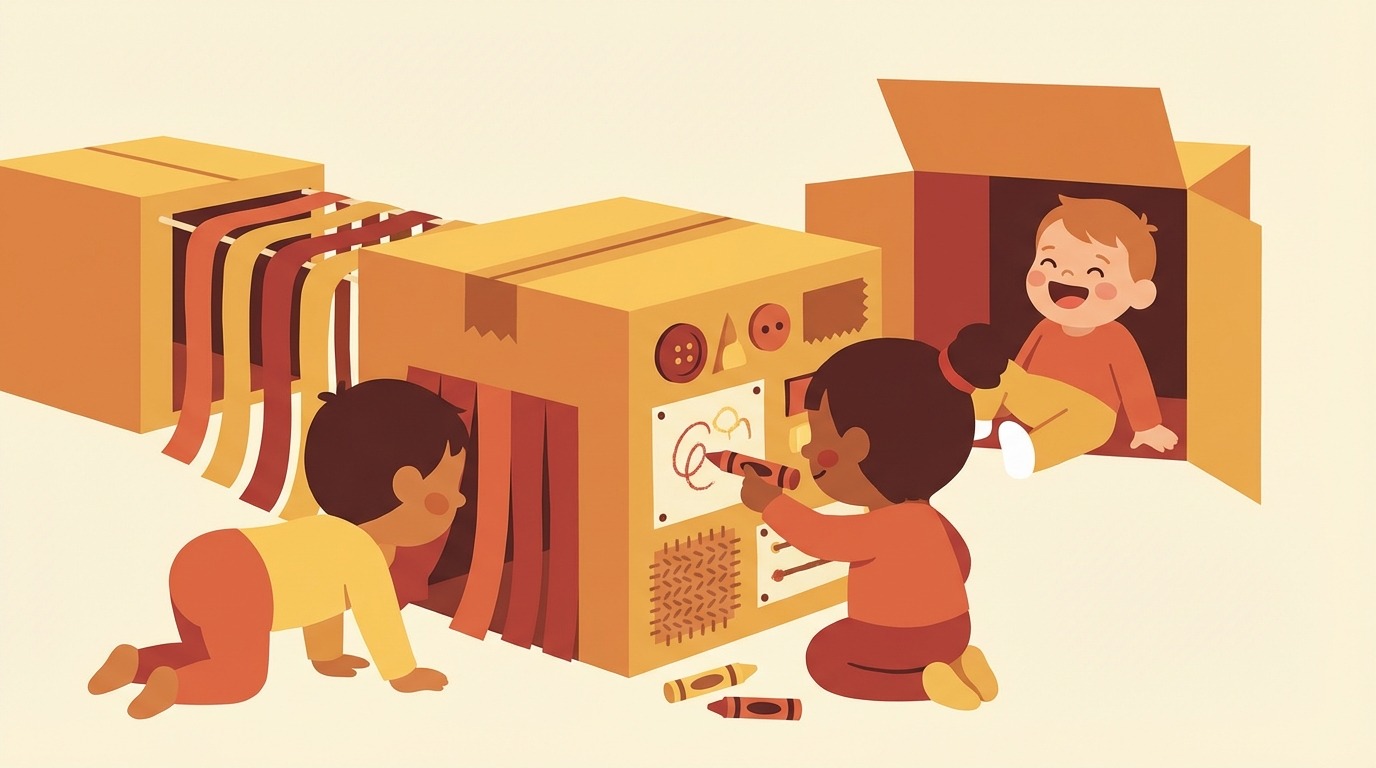
The cardboard box invites climbing, crawling and pulling up. A tunnel made with two large crates lines up short and joyful motor challenges. Start with a simple passage, then add a light foam obstacle. Thus, the child chains successes and strengthens postural stability. The space remains clear and bright.
Progressive courses: advance, go around, push
Arrange several boxes on a non-slip mat. The child pushes a small crate like a wheelbarrow, goes around a big one, then crosses a low reinforced cardboard bridge. These smooth sequences train anticipation and motor planning. Between each try, there is a breath. A balance of action and pause supports attention.
Quiet cabin and retreat spaces
Turning an XXL crate into a cabin offers a sensory refuge. Curtains made of scarves, colored tape garlands and cushions on the floor compose a soothing corner. When an emotion rises, this cocoon helps to refocus. To go further, emotional climate markers and simple strategies are detailed here: learning to calm a child. This resource complements cabin use.
Before each session, check these safety points:
- 🔎 Rounded and taped edges, no visible staples
- 🧼 Clean, dry surface, dust and odor free
- 🧱 Stable box, no risky height
- 🧒 Constant supervision and clear instructions
- ⏳ Short durations, hydration and cuddle breaks
Final tip: a short, repeated course is better than an overly ambitious maze. Success feeds the desire to play.
Imagine and tell stories: theater, kitchen and cardboard cars
Between 1 and 3 years, symbolic play blooms. A cardboard box becomes an oven, car, store, or puppet stage. The setting is minimal, but creativity overflows. Draw a window, glue a steering wheel made from a paper plate, and the story begins. Adults lend their voices, then let the child take over.
Table theater and nursery rhymes
Cut an opening in the center. Place figurines or sock puppets. The child learns to wait their turn to speak. Attention lengthens thanks to the story. To enrich language, combine a playlist of nursery rhymes and children’s songs. The rhythm supports memorization and pronunciation.
A video demonstration of a mini-theater will help visualize setup and play.
Kitchen and garage: pretend play to grow
A drawn oven, buttons made from caps, and here is a kitchen. The child “takes” a spoon, “stirs”, “serves”. These scenarios train planning and action vocabulary. On the other hand, a car garage cut out from a cereal box encourages grasping and wrist rotation. For more creative ideas, check this selection of manual activities for children.
Conclusion of this part: storytelling with simple objects structures thought and nourishes imagination.
Educational crafts: sorting, counting, naming colors and shapes
Educational activities with cardboard consolidate concrete skills. Create color-coded slots to slide lids, then name the shades. This perception-motor-language loop proves very effective at this age. “Mailbox” boxes encourage posting cards, counting to three, and saying “again.”
Sorting, matching and first numbers
Set three colored rings around slots. The child sorts cardboard circles. They check, correct, and rejoice when everything “matches.” Then, offer a short sequence: one, two, three. The gesture accompanying the word fosters the meaning-movement link. For younger ones, guidance on milestones can help choose challenges: development 10-12 months.
Sounds, letters and names: gentle awakening
Glue foam letters on a lid. The child touches and names if they want. No performance is demanded. Pleasure comes first. Besides, cardboard tubes form a “telephone” that invites whispering. Listen, repeat, laugh. Here is a healthy foundation for future language.
Essential point: learning happens through action and surprise. Cardboard, the “magic material,” makes this adventure concrete and joyful.
Calm and cooperate: gentle rituals, emotions and two-player games around cardboard
Life with toddlers alternates bursts and storms. The same box serves for calming rituals. Lights go down, enter the cabin, then breathe together. A visual timer or a soft song marks the transition. Little by little, the child anticipates and self-regulates.
Cooperative games: pass, build, tidy up
A sorting box turns into a two-player game. One holds the box, the other slips cards inside. They swap roles. This back-and-forth establishes listening and cooperation. In case of tension, cues on 2-year-old crises shed light on needs and adjust adult attitude.
Stories and comfort objects: the box becomes a living book
Paste animal pictures inside. Invent a “little mouse’s house.” The child puts their comfort object to bed, whispers, caresses. This scenario reassures. To broaden the symbolic universe, a sweet story can inspire special moments like this tale about a tiny friend: a very sweet friendship. Relying on stories facilitates emotional expression.
Final point of this section: a clear, repeated and warm routine turns the cardboard box into a real soothing tool.
“With a simple box, a child doesn’t just play: they build their world, one gesture at a time.” 🌟
Quel matériel privilégier pour démarrer ?
Un gros carton propre, du ruban de masquage, des feutres lavables, des rubans/tissus, des ciseaux pour adulte et quelques couvercles en plastique. Ajoutez des coussins pour amortir et un tapis antidérapant.
Combien de temps proposer une même activité ?
Entre 5 et 15 minutes selon l’intérêt de l’enfant. Mieux vaut des séquences courtes, répétées sur plusieurs jours, avec de petites variantes pour maintenir la curiosité.
Comment sécuriser les bords du carton ?
Arrondissez au ciseau les arêtes, puis scotchez-les avec du ruban de masquage. Retirez toutes les agrafes et vérifiez la stabilité de la boîte avant chaque utilisation.
Que faire si mon enfant ne s’y intéresse pas ?
Présentez l’activité en la rendant visible, testez-la vous-même, puis laissez-la accessible. Proposez une variante sensorielle (texture, couleur) ou changez l’objectif (de la fente à la fenêtre).
Comment intégrer la musique et le langage ?
Associez une comptine simple au rituel de la cabane ou du théâtre. Répétez des mots clés en gestes: tirer, pousser, dedans, dehors. La musique soutient l’attention et la mémorisation.