
Asthma Humidity Molds: Asthma, humidity, and molds
| Short on time? Here’s the essential ⭐ |
|---|
| 🌧️ Beyond 60% humidity, molds proliferate and worsen asthma. |
| 🫁 Fungal spores trigger respiratory inflammation and allergies. |
| 🏠 Major causes: condensation, rising damp, leaks, poor ventilation. |
| 🔧 Key solutions: maintained MVHR, airing 2×10 min, wall sanitation, safe cleaning. |
| 👶 Children are more vulnerable; aim for an air quality with humidity between 40 and 60%. |
| 🧪 Damp homes increase asthma risk by 40 to 70% according to studies. |
Asthma, humidity, and mold form a discreet yet formidable trio. In homes, the air seems clean, yet indoor pollution often exceeds that of the street. When humidity levels rise, fungi colonize corners, release spores, and trigger coughs, wheezing, and fatigue. The issue is no trivial matter: in France, around 4 million people live with asthma that worsens with every humidity peak. Peaks of allergies fluctuate throughout the seasons, but damp walls do not take holidays.
This dossier gathers concrete benchmarks: biological mechanisms, warning signs, home diagnostics, and an action plan. It details validated prevention strategies, from ventilation to safe cleaning habits. Each section offers everyday examples, checklists, and useful links for deeper exploration. Because a well-ventilated apartment, maintained MVHR, and dry surfaces transform a stifling room into a breathable cocoon. Air quality is not a luxury: it is a pillar of health.
Asthma, humidity and molds: understanding mechanisms and real risks
When humidity rises above 60%, it nourishes molds and increases the allergenic load in the air. Black or greenish spots on walls release invisible spores. These particles reach the bronchi and trigger respiratory inflammation. The result: hyperreactivity, dry cough, wheezing, and more frequent asthma attacks. The recommended threshold of 40 to 60% remains a simple and reliable benchmark to limit these chains of events.
In children, the effect is more pronounced. Sleeping in a damp room significantly increases the risk of allergies and asthma. Recent epidemiological studies show a risk increase between 40 and 70% in damp housing. This is not just a number: it translates into disrupted nights, school absences, and increased dependence on bronchodilators. In adults, evidence of a link also exists, especially if mold is visible, even on small surfaces.
The impact is not limited to breathing. A room saturated with humidity also promotes dust mites and amplifies rhinitis. Between April and September, certain respiratory sensitizations flare up depending on the allergens present. However, off-season attacks should alert about the air quality of the dwelling. Lingering bronchitis or rhinitis are not normal when a part of the wall remains sticky.
What happens in the bronchi? Fungal spores stimulate receptors and activate immune cells. Mucus thickens, bronchial lumen narrows, and respiratory effort increases. This physiology explains rapid breathlessness in a poorly ventilated bathroom. It also justifies clear improvement after sanitation: fewer spores, less respiratory inflammation, better exercise tolerance.
Warning signs not to ignore
Concrete indicators help to act early. A smell of wet earth, persistent condensation on windows, darkening seals, and peeling paint form a cluster of clues. Recurring symptoms, upon waking or after showering, increase suspicion. A hygrometer confirms the situation with a figure, useful for guiding actions.
- 🔎 Dark or greenish spots on walls and ceilings
- 😮💨 Wheezing, nocturnal cough, chest tightness
- 👃 Repeated rhinitis, itchy eyes, blocked nose
- 🌫️ Condensation on windows, poorly drying laundry
- 🧪 Hygrometer test > 60% for several days
At this stage, diagnosis is not just visual. It must aim to identify water sources and restore effective ventilation. A good starting point, simple and useful: measure, air out, then treat the dominant cause.
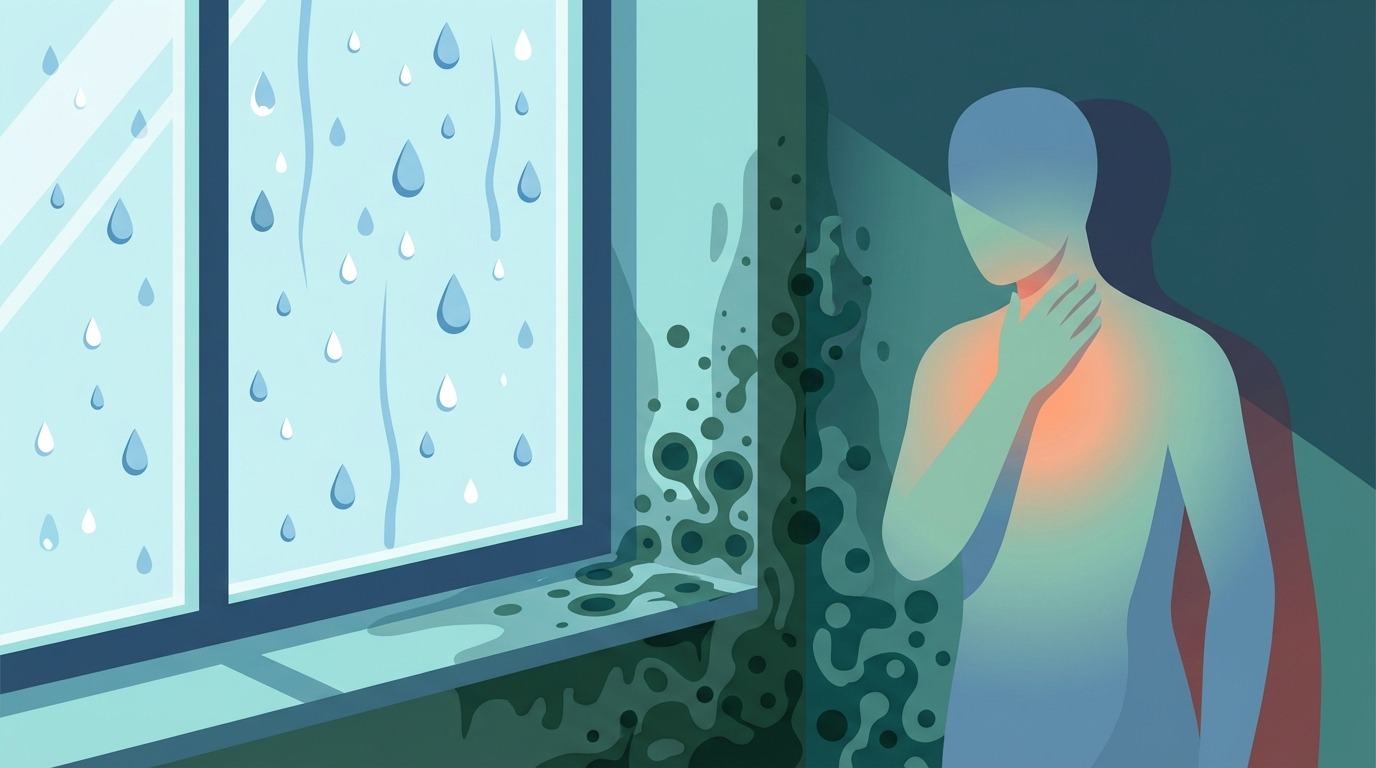
Identifying domestic humidity sources to slow fungi and protect the bronchi
It all starts with the origin of the water. Without diagnosis, solutions prove incomplete. The same stain can come from interior condensation, rain infiltration, or rising damp. Each cause calls for a distinct response. Isolating the dominant scenario saves time and money.
Condensation: excess vapor and cold surfaces
Condensation appears when vapor-laden air meets a cold wall. It first beads on the windows, then seeps into seals and baseboards. Kitchens and bathrooms are often on the front line. Too low an extraction rate, clogged vents, or a stopped MVHR are enough to trigger the vicious circle.
The simple test? After a shower, check if the fog lingers for more than 20 minutes. If yes, ventilation must be strengthened. Manual airing for 10 minutes morning and evening helps but does not replace continuous extraction.
Rising damp: water climbs up walls from the ground
In old or stone houses, water migrates by capillarity. It sometimes rises more than a meter above the floor. Saltpeter leaves a fragile white deposit, then paint bubbles. Molds follow, especially behind furniture. Peripheral drainage, a damp-proof treatment, and breathable coatings become necessary.
Infiltrations and leaks: a continuous drip causes definite damage
A displaced tile, a pierced gutter, or a worn shower seal are enough to maintain a high humidity level. Stained ceilings and dark corners tell the story. Targeted repairs followed by accelerated drying using a dehumidifier limit fungal colonization. Ignoring these micro-leaks prolongs airway damage.
Layout errors: furniture stuck to walls and thermal bridges
A closet pushed against a north wall creates a cold pocket where air stagnates. Spores feast there. A simple 5 cm gap and air circulation often suffice. Similarly, poorly installed insulation creates thermal bridges. A light thermal assessment guides useful and lasting corrections.
Identifying the dominant cause allows building a credible action plan. To go further into family and health issues, this guide on air quality and respiratory health offers a clear and practical overview.
Once the cause is identified, the next step is to combine immediate measures and structural corrections. The goal: stabilize humidity levels and dry walls permanently.
Air quality, allergies and indoor pollution: the domino effect on asthma
Indoor pollution does not come only from molds. It mixes volatile compounds from cleaning products, cooking particles, and live allergens. In this ecosystem, fungi act as the conductor. They worsen bronchial sensitivity and amplify reactions to dust mites and irritants. From then on, the tolerated dose of an allergen drops, and the attack happens faster.
Domestic allergens and harmful synergies
Dust mites, molds, pet hair, and cockroaches form a volatile cocktail. A damp carpet doubles the dust mite load. A shower without extraction adds vapor. The sum causes hyperreactivity. This synergy explains why some families notice a clear improvement after a major textile declutter and MVHR adjustment, without additional medication.
Masked seasonality and persistent symptoms
Many allergies manifest more between April and September. Yet, rhinitis or active asthma off-season point to an indoor problem. A child’s room with a cold north wall becomes a spore greenhouse. Damp bedding increases nasal irritation. Measuring at night and comparing week after week documents progress.
To deepen protection for the youngest, this practical dossier helps to protect a child from indoor pollutants. Recommendations align with humidity benchmarks and regular maintenance habits.
Resource benchmarks and care pathways
When symptoms persist despite sanitation, an allergological assessment refines management. An exposure diary noting humidity peaks and frequented places guides testing. For other common health questions, a directory of useful health resources facilitates reliable research. And if a food allergy coexists, learning to manage a food allergy clarifies the overall picture.
Mastering air quality reduces respiratory inflammation and improves quality of life. It is also an investment that pays off: fewer absences, more energy, and peaceful sleep.
Ventilation and prevention: from diagnosis to effective and measurable solutions
Prevention begins with air circulation. A well-sized and maintained mechanical controlled ventilation (MVHR) stabilizes humidity. In an apartment, a humidity-controlled MVHR adapts flows to needs. In a house, a well-set double flow recovers heat while ensuring continuous air sweeping. Without maintenance, even a good system fails.
Maintenance and settings that make all the difference
Cleaning vents every two to three months and dusting ducts once a year prevents clogging. Filters in double flow units are replaced according to the manufacturer, often twice a year. A simple smoke test checks suction at the vents. When air circulates, vapor stagnation decreases and molds retreat.
Domestic habits with strong impact
Daily, wide opening for 10 minutes morning and evening, including in winter, renews air without cooling the thermal mass. Cooking with hood in extraction mode, covering pots, and drying laundry outdoors when possible reduce vapor. Moving furniture away from cold walls and favoring breathable paints strengthens the effect.
Cleaning without overexposure
Before treating a contaminated surface, protect yourself: gloves, goggles, and FFP2 mask. Moistening a microfiber cloth and using a soap-based detergent to capture spores. Avoid dry brushing to prevent spores from becoming airborne again. After cleaning, restart ventilation and monitor humidity for the next 72 hours with a hygrometer.
Dehumidification and wall sanitation
A portable dehumidifier stabilizes an overly humid room. However, it does not replace correcting the cause. For rising damp, structural treatment is necessary. After work, a progressive drying period remains normal. Monitoring for stain recurrence ensures long-term success.
By combining these levers, the environment becomes breathable again. It’s measurable, motivating, and lasting. Breath improves, and so does the home.
Practical cases, budget, and intervention checklist against molds
Let’s illustrate with the A. family, two children, including Lina, asthmatic. Their windowless bathroom smelled musty. The hygrometer displayed 72%. The walls showed black spots near the ceiling. Action plan: safe cleaning, MVHR restarted, vent replaced, kitchen hood repaired, and bi-daily airing. Three weeks later, 56% humidity. Lina’s wheezing mornings had dropped.
Order of priorities and indicative costs
Each home is different, but a logic applies. Start with ventilation maintenance, airing, and leak hunting. Then correct structural causes if needed. Finally, sanitize walls and adapt layout. This sequence minimizes unnecessary interventions and maximizes impact on air quality.
- 🪟 Airing 2×10 min/day: no cost, fast effect
- 🧼 Safe cleaning microfiber + detergent: low cost
- 🌀 MVHR/vent maintenance: moderate, high impact
- 💧 Leak/roof repair: variable, priority
- 🏗️ Damp treatment/drainage: long-term investment
Step-by-step intervention checklist
This list helps to forget nothing and track improvement week after week. It structures action to avoid backtracking and incomplete care. Use a notebook or an app to check off steps and note humidity.
- 📏 Measure humidity morning/evening over 7 days
- 🔍 Inspect walls, ceilings, carpentry, and baseboards
- 🧯 Hunt leaks and prioritize repairs
- 🧽 Clean contaminated areas with protection
- 🌀 Check and maintain ventilation
- 🧺 Reduce vapor sources (laundry, cooking)
- 🪑 Move furniture away from cold walls (≥5 cm)
- 📉 Follow humidity and adapt if > 60%
To strengthen health culture at home, a detour to these practical pages highlights good habits: understand air quality and respiratory health and consult useful health resources. These benchmarks guide technical choices and effective daily habits.
“Sanitizing air makes every breath easier than one more treatment.”
What is the right humidity level to limit asthma and mold?
Aim for 40 to 60%. Below 60%, fungi and dust mites struggle to develop. A reliable hygrometer placed at human height allows for simple and comparable monitoring over time.
Is natural ventilation enough?
Opening windows for 10 minutes morning and evening helps, but a maintained MVHR remains key in wet rooms and the kitchen. Without continuous extraction, vapor accumulates and condensation reappears.
How to clean a moldy surface safely?
Wear gloves, goggles, and an FFP2 mask. Use a microfiber cloth moistened with a soap-based detergent. Avoid dry brushing. Air out during and after cleaning, then monitor humidity for 72 hours.
When should major works be considered?
If stains return quickly, if a low wall remains damp, or if saltpeter deposits appear, it may be rising damp or infiltration. Specialized diagnosis guides drainage, waterproofing restoration, or damp-proofing cuts.