Well-being Video for Children: Activities for the well-being and relaxation of children.
In a daily life paced by school, homework, back-and-forth trips, and screens, many children struggle to settle down. Yet, offering short moments of targeted pause changes everything. With suitable videos, sensory games, and simple rituals, children’s well-being becomes concrete, visible, and measurable. Active pedagogies have long shown that: when a child regulates their breathing, moves their body with gentle movements, and finds a space for their emotions, their brain learns better. Above all, they rediscover the joy of exploring without tension. Teachers and parents also observe that in five minutes, a hyperactive group can regain stable concentration, provided they use playful, structured, and progressive relaxation techniques.
The key is the multimodal approach: short versions of children’s yoga, guided imaginative breathing, attractive visual supports, materials to touch, and a quiet corner designed for autonomy. A guiding thread also helps: a little story, a character, or a mission. Milo, 7 years old, refocuses with his “magic balloon” before the dictation; Lina, 5 years old, goes “into a turtle” to regain her security; and Madame Reyes’s CE1 class alternates mini sun salutations and “inner weather” coloring. These micro-rituals activate children’s stress management, support working memory, and soothe relationships with others. At home as at school, consistency of instructions and regularity create a reassuring framework, without performance pressure but with clear landmarks.
| Little time? Here is the essential ⏱️ |
|---|
| ✅ 3 to 5 minutes are enough for real child relaxation 🌿 |
| 🎯 Choose 2-3 daily rituals: children’s breathing, zen posture, coloring 🎨 |
| 🧘 Short videos = a reliable guide for children’s relaxation and attention 👀 |
| 💡 Adapt to age: 3-6 years through play, 6-9 simple rules, 9-12 precision |
| 📦 Create a personalized “calm box” for autonomy 💛 |
Children’s well-being video: why the image guides calmness and concentration
Children’s relaxation and children’s meditation videos provide a clear framework: a soft voice, a steady tempo, coherent images. This combination reduces cognitive load, reassures, and offers a unique instruction to follow. Children benefit from external scaffolding: they don’t have to “invent” calm, they imitate it. Thus, the teacher or parent becomes an emotional landmark, while the video carries the sequence and regulates the rhythm.
The power of mental imagery also matters. When the video suggests “inflating a balloon,” the child visualizes a precise internal gesture. They become active in their children’s breathing, feel their belly move, and notice that their heart rate slows down. This awareness, even brief, establishes a skill of self-regulation. Over repetitions, it becomes an automatic behavior available in class, after school, or before sleeping.
Documented and easy-to-measure benefits
Three simple indicators reassure adults. First, an observable return to calm: relaxed shoulders, softer voice, steady gaze. Next, longer attention on a single task. Finally, better tolerance to frustration. In practice, it is often noted that a 4-minute video ritual before a reading session halves interruptions. The cause is mechanical: slowed breathing, relaxed muscles, available brain.
Selected playlists gain effectiveness if adapted to age. Young children enjoy illustrated scenarios (flower, candle, turtle). Older children prefer measured challenges or progressive series. A golden rule applies: favor content without visual overstimulation. Soft colors, slow background sounds, and calm transitions support the objective.
Getting started, simply
A clear space is enough: two cushions, soft lighting, a distant screen. Announce: “4-minute calm pause, then next activity.” A visual timer can help structure anticipation. To guide content choice, a useful resource gathers yoga and relaxation adapted for children practices. Finally, introducing a recurring little character (a turtle, a tree, a cloud) promotes adherence, as the child finds a familiar story.
To start without fumbling, this video search can support the selection and inspire a short session adapted to kindergarten or cycle 2.
After two weeks of regular use, classes and families notice a common base: more serenity, less underlying agitation. This is the realistic promise of children’s activities oriented toward well-being: aligning body, breath, and attention, then transferring this calm to learning. This anchor prepares the next step: learning to breathe in full autonomy.
Guided breathing and relaxation techniques: 5 express rituals for child relaxation
Breathing rituals establish internal calm control. They form the basis of a true children’s personal development. In less than five minutes, the chemistry of stress calms: long exhalation stimulates the vagal brake, the body reads “all is well.” Here are five tested, progressive formats easy to anchor in daily life.
1) “Balloon” breathing 🎈 and 2) Square breathing ▢
“Balloon” breathing anchors the breath in the belly. Hands placed, inhale through the nose as if inflating a big balloon, then exhale through the mouth to “deflate” it. Two minutes are enough. In a group, everyone chooses the balloon’s color: imagination increases engagement. Square breathing structures the rhythm: 4 counts inhale, 4 hold, 4 exhale, 4 hold. Tracing an imaginary square helps maintain the sequence. This exercise suits before an evaluation or an activity requiring attention.
3) Adapted 4-7-8 breathing 🌙
Inhale 4, hold 7, exhale 8. For younger children, pause times are shortened. This method promotes falling asleep and reduces rumination. In story form, the bird spreads its wings (4), glides (7), then lands (8). Included in an evening ritual, it prepares more stable sleep, useful when bedtime shifts. Additional clues are found in this article about bedtime landmarks and late sleep.
4) Candle and flower 🕯️🌼
Smell the flower while slowly inhaling, then blow out the candle very gently. This sensory game makes breathing visible. With a LED candle and a real flower, the body records a multisensory experience. In kindergarten, this combination works in less than a minute after intense recess.
5) Progressive muscle relaxation with playful images
Progressive muscle relaxation teaches to tense and then release. For children, it passes through play: squeezing “lemons” in the hands, doing the turtle that retracts its head, or the hedgehog that raises its spines then relaxes. Metaphors support body awareness without jargon. A guided demonstration helps integrate the method step by step.
To go further, a practical guide compiles simple and transferable relaxation techniques for children. Useful tip: post a “Choose your breath” card in the calm corner. The child picks the ritual that speaks to them, without external pressure.
- 🧭 Age advice: 3-6 years = play and imitation; 6-9 years = short rules; 9-12 years = rhythm precision.
- 🗓️ Frequency: 2 cycles per day during agitated periods; then 1 maintenance cycle.
- 🎵 Memory aid: slow music or soft metronome to keep tempo.
After a few days, the child identifies their favorite exercise and uses it alone. This is a sign that emotional autonomy progresses and that calm becomes a skill transferable to other moments.
Children’s yoga and gentle movements: simple postures to soothe and strengthen attention
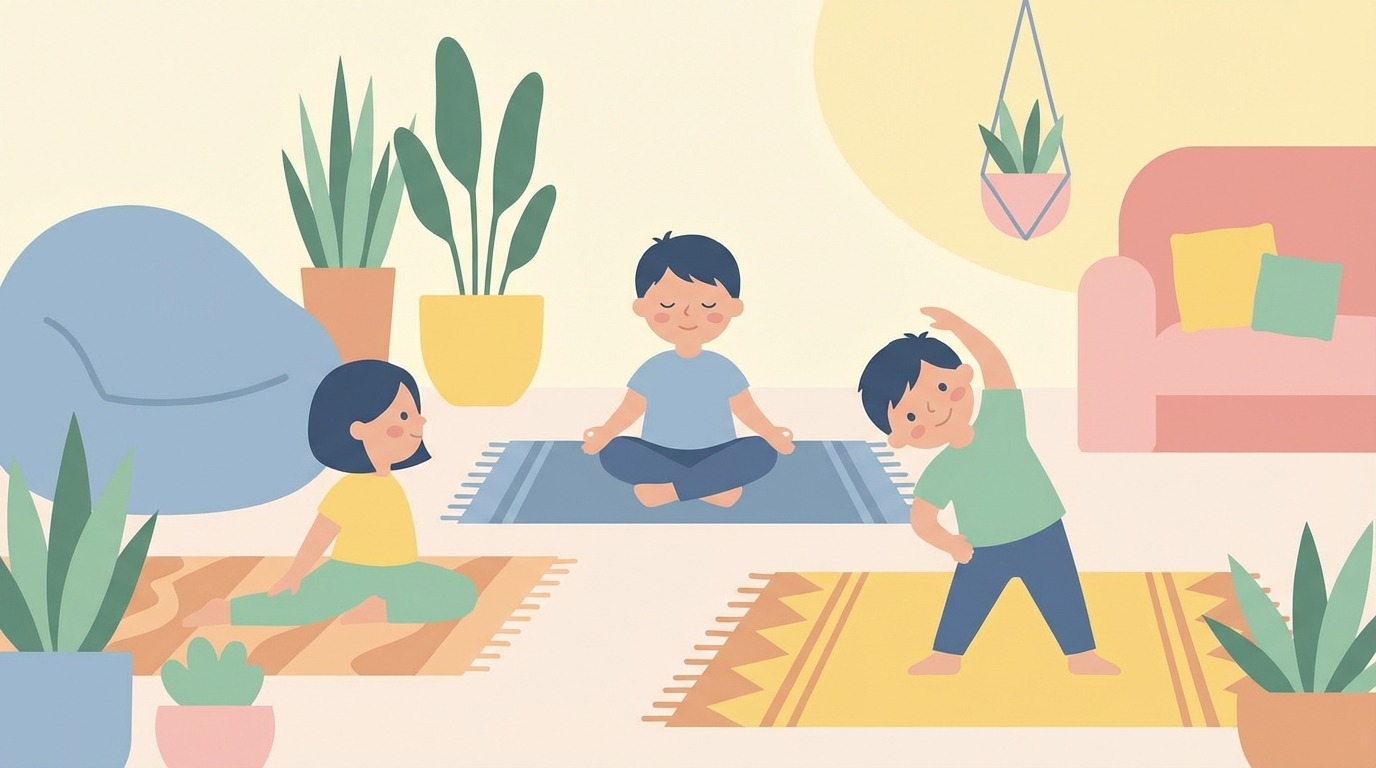
Children’s yoga improves coordination, installs body awareness, and promotes listening. Its effectiveness rests on a winning trio: stable posture, steady breath, focused attention on a point. Short postures, narrated with images, hold curiosity and calm nervousness.
The child-turtle, the tree, and the cat-cow
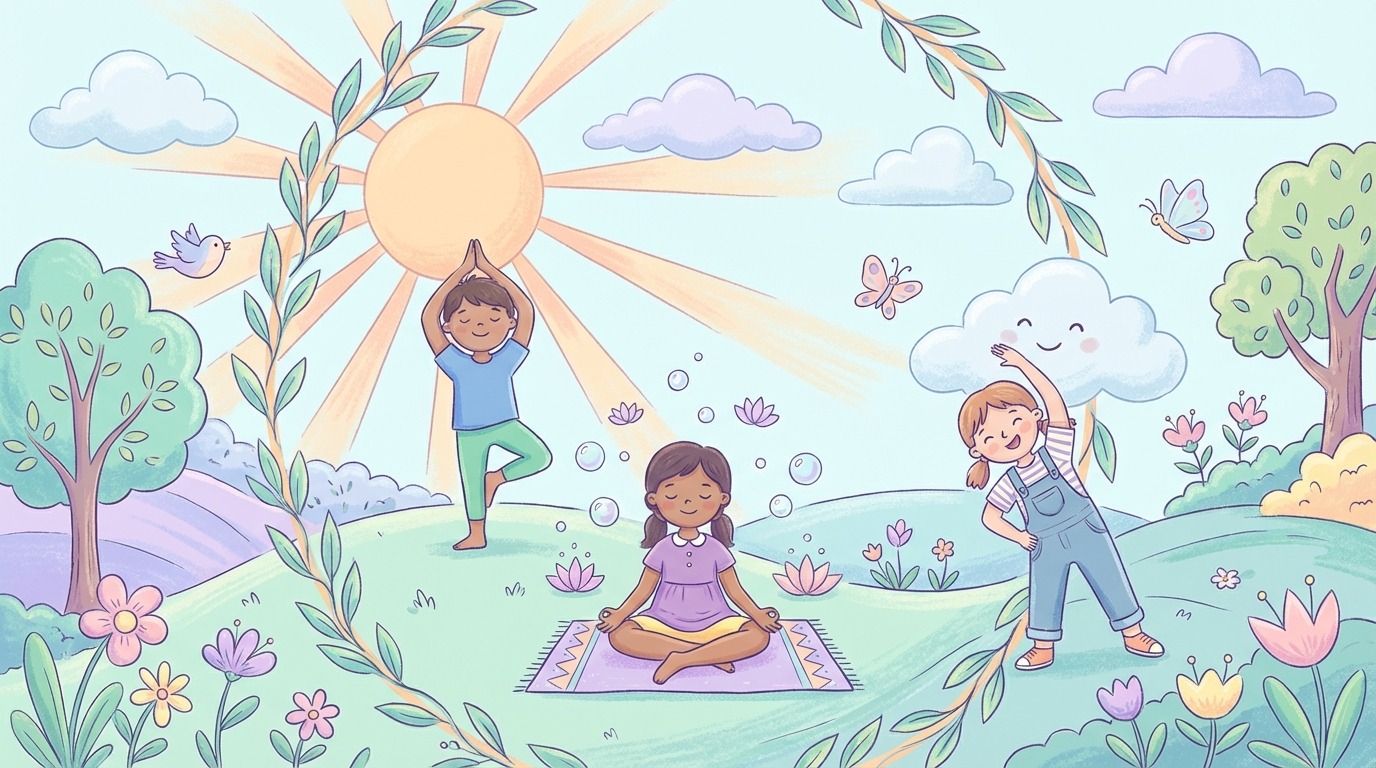
The “child” posture calms instantly. Kneeling, forehead resting, arms stretched or along the body: the child becomes a “turtle in its shell.” Thirty seconds to two minutes, slow breathing. The “tree” develops balance and confidence: one foot resting against the opposite leg, hands joined. Fixing a point favors stability. Allowing the tip to touch the ground to start avoids frustration. The “cat-cow” duo then mobilizes the spine: arch the back on inhale, round on exhale. In three cycles, the neck relaxes, agitation decreases.
Mini sun salutation and express stretches
In the morning or before a task requiring cognitive endurance, a simplified sun salutation energizes without exciting. Raise arms, touch the floor, straighten up while breathing synchronously. Three to five cycles are enough. Adding a stretch of the arms forward, hips back, prolongs the sensation of length in the back. One can narrate: “we catch the sun,” “we greet the earth.” This narrative varnish makes the exercise attractive in a group.
Concrete organization and safety
A mat, floor markings, and a clear rule: each in their bubble. Postures are chosen according to space. In class, lateral arches and balances are done near tables. At home, the living room becomes a studio, with a stable piece of furniture as support. Before any session, reminding instructions avoids collisions and reassures the most hesitant.
During periods of fatigue or nervousness, it is better to reduce the catalog and repeat three favorite postures. Repetition gives a sense of mastery. It also supports confidence, because the child perceives their progress. A complementary resource details safe methods to preserve the environment: consulting these everyday safety tips helps anticipate the unexpected while keeping a positive framework.
Expected result: a child who is more energetic yet calm, capable of maintaining attention longer. It is a precious foundation for all school and family activities.
Sensory and creative workshops: mandalas, bottles, and origamis to tame stress
When hands move repeatedly and pleasurably, the brain calms down. Sensory and creative workshops channel energy and improve gestural precision. They constitute an effective way of children’s stress management without relying solely on verbal means.
Glitter bottle and “zen” tray
The sensory bottle is made with water, glitter, and a bit of liquid glue. The child shakes it, then observes the slow fall. Their breathing naturally aligns with the movement. Making the object themselves adds a soothing appropriation dimension. The “zen” tray consists of rice, water beads, or beans: pour, sort, hide small treasures. The sound and texture invite slowing down. This activity suits kindergarten age.
Mandalas and mindful coloring
Coloring concentric shapes stabilizes attention. The rule: no quest for perfection, only the pleasure of the gestures. Slow music can support the pencil’s pace. Distributing short formats after recess transforms scattered energy into calm concentration. At home, placing a small “mandalas” basket near the calm corner encourages autonomy.
Origamis and quick puzzles
Origami develops patience and fine motor skills: boat, heart, simple crane. Step by step, the child follows a model. The satisfaction of the final shape nurtures confidence. Short puzzles and memory games with gentle illustrations stimulate working memory without overstimulation. Five minutes are enough to reboost attention without fatigue.
Because lifestyle influences underlying agitation, a focus on diet proves useful. Reducing fast sugars at sensitive times decreases bursts of excitement and facilitates the return to calm. Concrete guidelines are offered in this guide about foods to limit for children. These adjustments strengthen the effect of relaxing rituals. Together, they weave an environment conducive to lasting calm.
- ✨ Minimal materials: sheets, pencils, empty bottles, rice or water beads.
- 🧩 Duration: 5 to 10 minutes, with a pre-announced end for security.
- 🗂️ Ritualized tidying: end with “we tidy, breathe, smile” to close positively.
This palette of activities makes progress visible: more precise gestures, more regular breath, steadier gaze. The child learns that calm is built like a fold of origami.
Nature immersion and soothing routines: mindful walking, inner weather, and calm box
Nature offers an open-air relaxation room. Walking slowly, listening, smelling, watching, everything becomes a support for children’s meditation. Children name five sounds, describe three smells, identify two textures. In forest or park, this sensory treasure hunt anchors the present moment. It also works in the city by focusing on faint signals: wing rustling, reverberations, wind’s breath.
Mindful walking, inner weather, and minute garden
Mindful walking is done in pairs or small groups. Each step counts, the gaze rests two meters ahead, breath guides the rhythm. On return, the “inner weather” accompanies identifying emotions: blue sky, clouds, showers? Using simple words demystifies emotional storms. A “minute garden” completes this trio. Planting a seed, watering, observing: patience literally grows. Responsibility soothes because it offers an active and gentle role.
Calm box and time structuring
The “calm box” contains objects chosen by the child: anti-stress ball, small plush toy, mini-book, breathing card, glitter bottle. It must remain accessible without being associated with punishment. The time timer or a visual timer helps estimate effort and break. The “child Pomodoro” method works well: 10-15 minutes of activity, 2-3 minutes of calm break. This rhythm avoids saturation and prevents overflow.
Rituals anchored in the day
Transitions are ideal to ritualize. Morning: “balloon” breathing and mini sun salutation. After school: sensory tray and mandala. Evening: 4-7-8 breathing and inner weather. This framework ensures continuity without rigidity. During change periods, such as moving, these landmarks cushion the emotional shockwave. Concrete tips to support a transition appear in this guide on moving with toddlers.
Finally, don’t forget play. The “Simon says” version oriented toward attention mixes slow instructions and broad gestures. It channels a group while keeping smiles. The challenge remains constant: associate calm and pleasure so that the child wants to return.
- 🌅 Morning: 2 minutes breathing + 2 minutes movement.
- 🎒 After school: 5 minutes sensory/creative.
- 🌙 Evening: 3-5 minutes long breathing.
The final objective is clear: a child who knows when and how to calm down, alone or accompanied. It is a life skill, transferable and robust.
Video-practice bridge: typical scenarios, checklists, and effect evaluation
Transforming videos into concrete rituals involves three levers: scripting, checking adherence, and measuring effects. A “typical scenario” avoids wavering: recall the goal, start the video, practice, then anchor with a short question. This loop reinforces integration and opens the door to autonomy.
Ready-to-use key scenarios
Before math homework: two “candle/flower” cycles, then 3 mini-postures (tree, cat-cow, back stretch). After running to the park: mindful walk home, drink water, 4 minutes of mandala. Before bed: 4-7-8 breathing and inner weather, soft light, no screens. If falling asleep remains difficult, adjust evening hygiene and be inspired by this file on bedtime landmarks to secure the transition to night.
Quick checklists
- 🪑 Calm space ready: cushion, soft light, timer.
- 📺 Short playlist validated in advance: no last-minute searching.
- 🔁 Ritual announced: duration, instruction, next sequence.
- 📝 Simple record: sticker “I feel calmer,” or weather color code.
Evaluate and adjust without pressure
Observation comes first: slower breathing, less abrupt gestures, gaze that fixes better. Older children can rate their “calm meter” from 1 to 5 before and after the session. If a format bores, vary the narrative dressing, not necessarily the mechanics. For example, children’s breathing “square” becomes “castle window,” or “steady robot.” The essence stays identical, the form renews.
To keep a joyful dimension, integrating affective contact suitably helps seal the ritual. Ideas on playful and caring interactions are offered here: playing with affection without overstimulation. The important thing is to combine calm, safety, and pleasure. That’s how the child spontaneously chooses their soothing children’s activities when needed.
Over weeks, this fine control builds solid reflexes. It prepares the child to mobilize their calm during evaluations, minor conflicts, or big celebrations. Emotional stability becomes a foundation for lasting confidence.
How long does a good relaxation session for a child last?
Between 2 and 10 minutes are enough. Younger children handle very short and playful formats better; 9-12-year-olds can go up to 8-10 minutes, especially in creative or calm reading contexts.
What is the best time to practice?
Transitions work very well: morning before school, after recess, and evening before bedtime. Following short breath + gentle movement optimizes availability.
Is specific material needed?
No. Most rituals use everyday objects: paper, pencils, empty bottles, rice. A visual timer helps structure. The calm box makes the child autonomous.
What if the child refuses?
Never force. Offer a short choice, tell a mini-story, change the angle. Leaving for another moment can be enough. Pleasure remains the best adhesion driver.
“When the child learns to breathe their calm, they discover a gentle strength that accompanies them everywhere.”