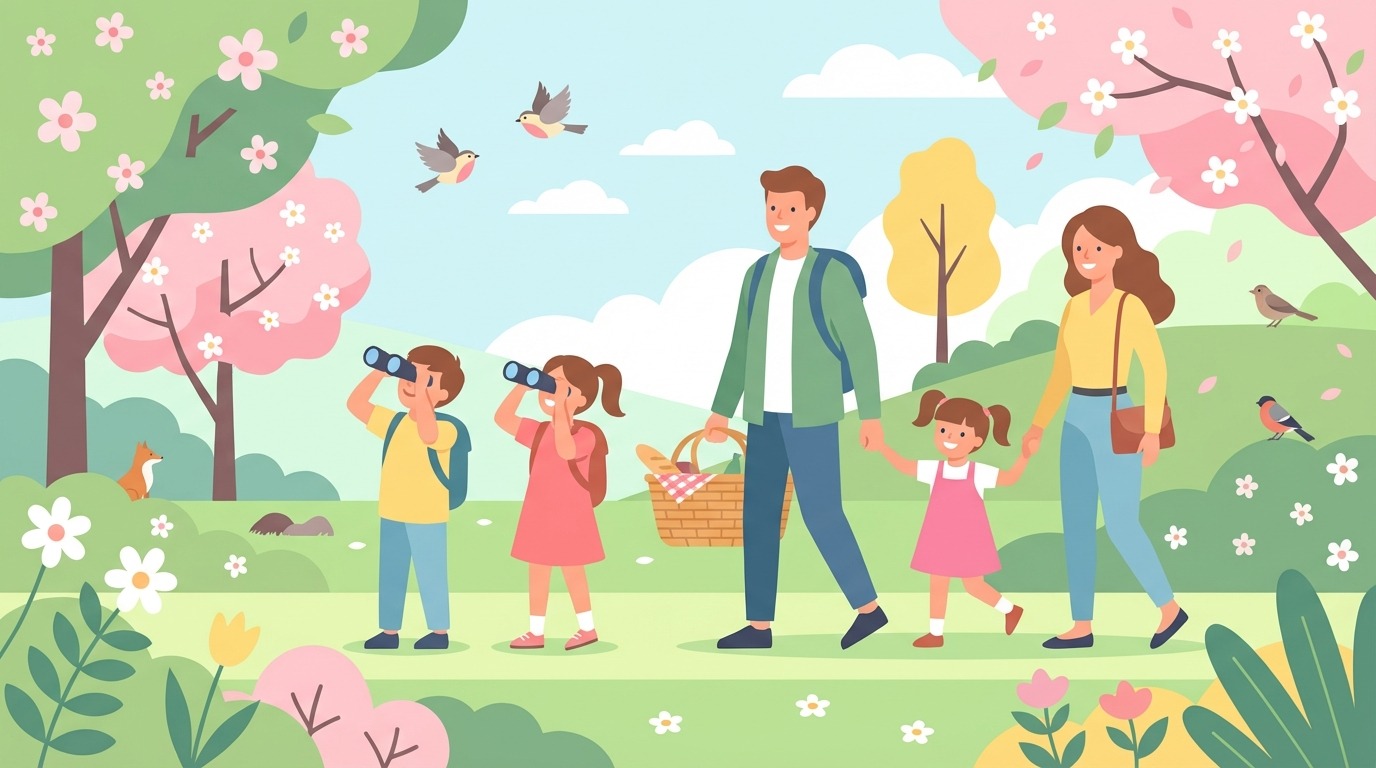
Spring Activities: Activity ideas to celebrate spring with family.
| Short on time? Here’s the essentials ⏱️ |
|---|
| Organize a simple picnic, pair it with a short nature walk, and finish with a mini birdwatching session 🐦. |
| Launch creative workshops with pressed flowers, stickers, or a recycled DIY ♻️. |
| Start an easy potted gardening project and follow the life cycle of a seed 🌱. |
| Reinvent the egg hunt as a cooperative trail and add a color hunt 🎯. |
| Stay focused on outdoor exploration, inclusion of all ages, and sun safety 🧴. |
Beautiful days awaken the desire to open windows, feel the grass under sneakers, and dare new family activities. Spring invites slowing down without giving up play, stimulating the senses while strengthening bonds. Between a nature walk around the corner, a micro-adventure in the forest, and flower-inspired creations, every outing becomes an excuse to learn, laugh, and marvel. The ideas that follow are designed for various age groups and adapted to real schedules, even when your calendar looks like Tetris.
The key? Stay flexible. A picnic can turn into a sensory lab, a hike into a sound safari, a balcony corner into a mini educational farm. And because weather sometimes plays spoilsport, clever creative workshops step in indoors. Underneath it all, a clear goal: learning to observe, touch, compare, name. Spring is not just a season; it’s a giant classroom open free to all, every day.
Nature walks and outdoor exploration: spring activities that bring people closer
To anchor lasting memories, nothing beats a well-planned outdoor exploration. Some rules help turn a simple outing into an adventure. Set a precise sensory goal: listen to three bird songs, spot five shades of green, smell two aromatic plants. This way, the nature walk gains intensity while staying accessible to little ones.
Sensory picnic in the park
A picnic becomes an educational ritual when you include playful steps. Offer a “senses bingo”: crunch something crispy, smell cut grass, touch a velvety leaf. To lighten the setup, simple equipment ideas are gathered here: inspirations for equipping without breaking the bank. At the end of the meal, take out a magnifying glass and let children observe twigs, insects, or leaf veins. The park becomes an open-air laboratory.
Hiking and micro-safaris at child height
The hike benefits from being broken into “discovery stages.” Mark observation breaks: a stump, a stream, a rocky outcrop. Introduce the “clue quest” with picture cards: tracks, feathers, bark. The little ones lead the investigation; the older ones make hypotheses. To channel energy, alternate walking and mini-games: “move like a fox”, “jump like a frog”. Boredom disappears, curiosity grows.
Birdwatching for beginners
Starting birdwatching doesn’t require expertise. Choose a fixed spot, early in the morning. Bring a simple entry-level pair of binoculars and a notebook. Ask: “What size? What song? What behavior?” The children compare, draw, describe. Then, validate together with a digital guide. Sometimes, fewer birds are identified than expected; nonetheless, learning to observe better is the key.
To maintain momentum, set a weekly challenge: three species encountered, one recognized song, one feather found. After a month, perception changes. Nature is no longer crossed; it is read.
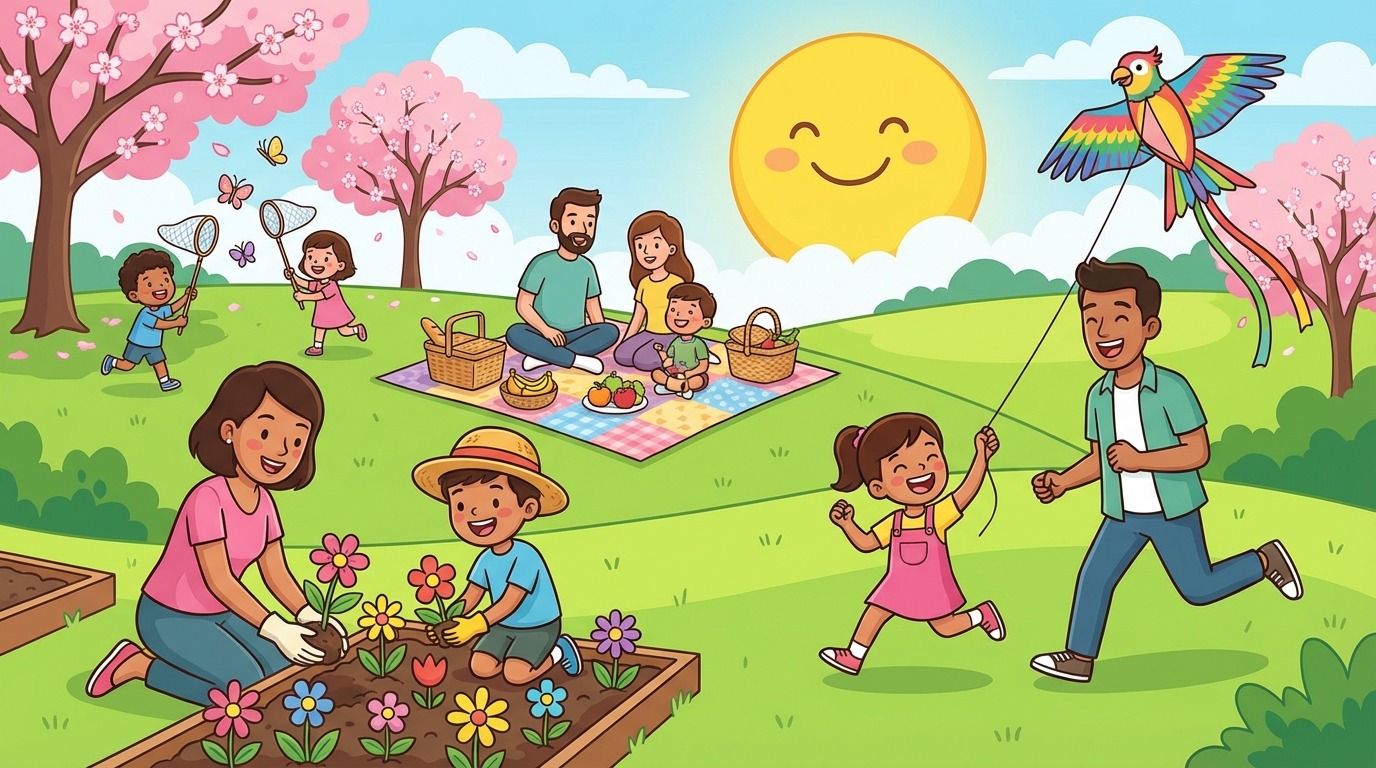
Seasonal creative workshops: easy, beautiful, and educational DIY
When rain arrives, creative workshops keep the connection to the season alive. The idea is not to accumulate materials but to highlight what nature and the home already offer. Emotions deepen when a creation tells the story of a recent walk: collected leaf, pressed flower, veined stone.
Pressed flower board and recycling art
Gather pressed flowers, popsicle sticks, a sticky film, and create a transparency frame. This work teaches assembly, symmetry, patience. It documents the season: “When did we find this daisy?” Take inspiration from simple and effective resources like these ready-to-use craft printables. The artistic gesture becomes a family story, then a memory hung on the wall.
Fork painting, smart stickers, and paper magic
Offer a “tulip meadow” with paint and a fork. The repeated strokes develop fine motor skills and coordination. Stickers introduce spatial concepts: inside, outside, left, right. Finally, the “magic coloring” on blotting paper amazes, showing how water spreads color. These micro-experiences anchor knowledge without formal teaching.
Quiet corner, clear instructions, and kindness
Provide a tidy space, brief instructions, a visual step timeline. Avoid cognitive overload. If attention wanes, offer sensory breaks: knead dough, smell an aromatic herb, listen to a river sound. For more ready-to-use ideas, explore these creative activities at home. Creation remains play, not a test.
In the end, the workshop reveals a useful truth: beauty doesn’t require perfection. It arises from a right gesture, a color choice, a shared memory. And it makes you want to go out again as soon as the storm clears.
Family gardening: seeds, life cycles, and small spring vegetable gardens
Gardening connects the hand, the eye, and patience. A balcony or windowsill is enough. Start with a winning trio: basil, chives, mint. These plants grow fast, smell good, and can be tasted. Each watering becomes a lesson in observation: soil color, stem elasticity, direction of the light.
Seed cycle and mini home labs
Germinate lentils on cotton to visualize the radicle, then the stem. Ask simple questions: “What happens if we change its place?” “What if we water less?” Children formulate hypotheses and keep a growth journal. The scientific approach sets in without ceremony: observe, describe, compare, conclude.
Living herbarium, bouquets, and gentle sciences
Create a progressive herbarium with leaf, name, place, date. Classification builds up. Meanwhile, an improvised bouquet crosses arts and botany: choice of heights, color harmonies, string wrap. Aesthetic relates to nature and precise gestures like cutting at an angle or changing water.
Practical checklist for quick successes
- 🌱 Choose 3 “easy” plants and note watering days.
- 🪴 Use pots with drainage holes and a saucer to avoid excess water.
- ☀️ Turn pots a quarter turn daily for straight growth.
- 🧪 Test one seed to germinate each week and compare speeds.
- 📸 Photograph before/after to measure progress.
The victory of the vegetable garden is not the size of the harvests but the attention cultivated. In spring, this school of patience becomes serious play that pleases everyone.
Spring games and outdoor celebrations: from egg hunts to cooperative treasure hunts
Spring gatherings benefit from mixing movement, cooperation, and puzzles at children’s level. A successful egg hunt offers pictorial clues, short motor challenges, and a shared reward to avoid sterile competition. On the same principle, the color hunt transforms a walk into an explorer mission.
Fun and inclusive hunts
Set up a treasure hunt in zones: green corners, sandy nooks, benches. Vary challenges: count daisies, find a soft object, imitate a bird song. To feed imagination, you can include a thematic cooperative game like this little ship game for children. The group story stimulates motivation and mutual aid.
Mini camping in the garden and screen-free evening
A tent in the garden, some lanterns, a sleeping bag, and the adventure begins. If the chill persists, go inside to sleep warmly but keep the storytelling evening. Children love “constellation challenges”: spotting Orion, counting imaginary shooting stars, listening to the night. The magic comes more from rituals than equipment.
Practical table for stress-free planning
| Activity 🎯 | Duration ⏳ | Materials 🧺 | Benefit 🌟 |
|---|---|---|---|
| Cooperative egg hunt | 45 min | Clues, baskets | Team spirit, navigation |
| “5 senses” nature walk | 60 min | Sensory cards | Attention, sensory vocabulary |
| Birdwatching | 30 min | Binoculars, notebook | Patience, classification |
| DIY flower workshop | 40 min | Flowers, adhesive | Fine motor skills, aesthetics |
If a child tires, convert the mission into “observer role.” Inclusivity guarantees joy until the end. And the party becomes a collective memory, not a solitary treasure hunt.
Safety, rhythms, and inclusion: succeeding in every spring family activity
A successful outing respects everyone’s rhythms. Babies, mixed-age siblings, sensitive skin: these realities require anticipation, not complication. Plan short loops with fallback options, a shaded spot, water, and snacks.
Confident toddlers outdoors
Adapting games for toddlers doesn’t mean giving up outdoors. A basket of safe natural objects, a thick blanket, smooth paths suffice. For concrete references, this practical guide helps frame without restricting: playing outside with baby. The goal: stimulate without overstimulating.
Fragile skin, sun, and comfort
In spring, the sun surprises. Hat, sunglasses, suitable cream, covering textiles make the difference. Skin prone to irritation requires gentle textures and a clear protocol; this file highlights good reflexes: managing child eczema. Better to prevent than “repair.”
Smart budget, gear, and logistics
Favor modular gear: lightweight ponchos, foldable bags, water bottles, compact mats. A “must-have box” stays near the door: wipes, bandages, packets, markers. Logistics fade in favor of play. And when specific needs arise, draw on inspiring resources like these family activity ideas.
Calming and structuring rituals
Each outing benefits from starting with a simple ritual: weather update, daily goal, rallying cry. And ends with a “treasure moment”: everyone shares their favorite part. Words are put down, tensions released. Rituals encourage listening and help children calmly anticipate the next adventure.
- 🧭 Set a single goal per outing (observe, smell, classify).
- 🧃 Space hydration and snacks every 45 minutes.
- 🧣 Favor layering to manage temperature changes.
- 🧸 Plan a “soft role” during tired moments (notebook keeper, photographer).
- 💬 End with a 3-sentence debrief: I saw, I learned, I want to do it again.
Safety is the condition of freedom. A solid base allows boldness, and boldness nurtures joy.
“In spring, curiosity is a seed: water it with play, it becomes a memory.”
How to start birdwatching without expensive equipment?
Choose a quiet park, early in the morning. Settle for 20 minutes in the same spot. Note size, dominant colors, and behaviors. An entry-level pair of binoculars is enough. Then supplement with an identification app to validate your intuitions.
What spring activities to suggest when it rains?
Focus on creative workshops inspired by nature: pressed flowers, fork painting, spotting stickers. Use ready-to-use printables to save time and maintain a link with the outdoors by telling the story of the last walk.
How to make an egg hunt inclusive for different ages?
Provide pictorial clues for little ones and riddles for older kids. Focus on cooperation: each egg contains a piece of the puzzle to assemble. Offer a shared reward at the end to avoid competition.
Which vegetables or herbs to choose for a first balcony vegetable garden?
Basil, chives, mint, and radishes are good: fast growth, pleasant taste, simple care. Moderate watering, pots with holes, and indirect light ensure quick and motivating successes.
How to occupy a baby during a nature walk?
Offer a safe sensory basket (sterilized feathers, brushed pine cones, textured fabrics). Provide times on the ground on a blanket, then held moments to vary points of view. Short sessions, lots of verbal descriptions.