Autonomous Feeding: Autonomous feeding in babies (0-12 months).
| Short on time? Here’s the essentials ⚡ |
|---|
| Baby-led weaning values the initiative of the 0-12 month old baby, stimulates fine motor skills and facilitates food transitions towards varied baby meals 🍽️. |
| Waiting for signs of readiness (sitting up, advanced gag reflex, interest in food) strengthens food safety 🛡️. |
| Offer appropriate foods in soft sticks, rich in iron, and easy to grasp; provide water and stay present 👀. |
| Food autonomy does not oppose the spoon; the BLW/spoon mix can work according to the child’s pace 🔁. |
| Calm routines, modest portions, and positive repetition build confidence and diversify tastes 🌈. |
Between six and twelve months, a turning point begins in the plates of little ones. Baby-led weaning appeals because it combines sensory discovery, confidence building, and the emergence of true food autonomy. Parents observe a greedy curiosity, a thirst for imitation, and a nascent dexterity of the hands. The table then becomes a learning ground where textures, colors, and smells sculpt taste.
However, enthusiasm is not enough. Success depends on rigorous food safety, appropriate foods, and patient attention during each baby meal. Between food diversification and self-feeding, a balance is invented daily. Recent data, experiences, and careful observation of signs of readiness trace a clear path. This guide offers concrete benchmarks, step by step, to nurture adults’ confidence and children’s pleasure in exploring, without confusing speed and haste.
Baby-led weaning for babies 0-12 months: principles, benefits, and concrete benchmarks
Baby-led weaning is based on a simple idea: when the child grasps, examines, and brings food to the mouth, he learns. This approach respects the internal rhythm, supports self-feeding, and strengthens regulated appetite. It does not exclude the spoon, but it places the child’s hand at the center of the game. Why does it work so well? Because action guides understanding and satiety is better expressed when the adult observes rather than imposes.
The benefits are quickly observed. Fine motor skills progress thanks to palm grasp then thumb-index pinch. Attention lengthens when textures vary. Tastes open up, as the friendly repetition of a vegetable over several days often overcomes reluctance. In the long term, the child gains confidence, which smooths future food transitions.
Signs of readiness to respect
Three markers guide the start. First, the child sits with good head support. Then, the mouth willingly opens toward the food object. Finally, the gag reflex moves to the back of the tongue, making exploration safer. Meeting these criteria reduces risks and makes the moment pleasant for everyone.
Some infants show marked interest around six months; others take two or three more weeks. Nothing alarming. The 0-12 month old baby progresses at their own pace. Parents benefit from closely observing signals and offering short trials, outside of major hunger episodes.
BLW, spoon, or mixed approach?
Opposing BLW and purees doesn’t help anyone. Many households combine soft sticks and spoonfuls rich in iron to secure intake. This hybrid strategy values food autonomy while ensuring appropriate nutritional density. It adjusts to busier days.
An example speaks for itself. Maëlys’ family offers steamed sweet potato pieces at dinner and, alongside, two spoonfuls of red bean puree. The child explores, tries grasping, then accepts the spoon without tension. This flexibility maintains pleasure, a key to consistency.
Nutrition quality and useful benchmarks
Rapid introduction of iron-rich foods remains strategic. Very tender minced meats, well-cooked lentils, eggs, tofu, flaked fish and fortified cereals support growth. For practical reminders on young children’s needs, a visit to this article on key principles for young children can enrich reflection: key principles for young children 🔎.
Quality fats (rapeseed oil, olive oil, butter in small amounts) facilitate the absorption of fat-soluble vitamins. Multiple fruits and vegetables, offered often, shape a broad taste map. Small sips of water complete the picture, especially during texture-rich meals.
In short, baby-led weaning wins when it combines fine observation, sensory variety, and nutritional rigor. This trio creates calm and effective meals.
Food diversification and food transitions month by month
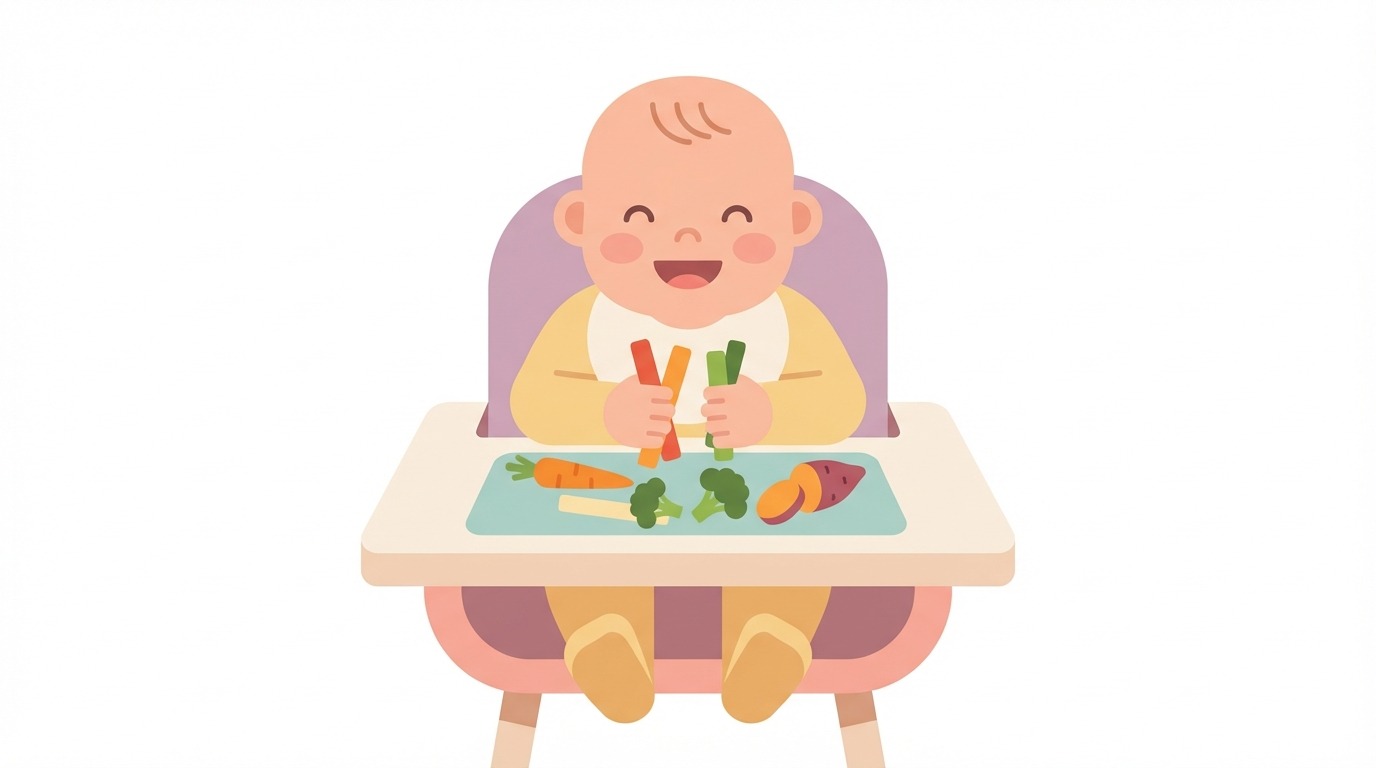
Food diversification advances in stages. Each step adjusts textures, sizes, and frequencies. Between six and nine months, soft stick-shaped pieces dominate. Then, around nine to twelve months, the child chews better and tries smaller shapes. Each age has its strategy, without rigidity but with coherence.
A calendar helps busy families orient themselves. It does not replace observing the child, but it marks baby meals. In doubt, a professional reviews the proposals to personalize them. A reading on development around 10-12 months can clarify some motor and social milestones: development 10-12 months 📚.
Textures, sizes, and concrete examples
The safest guideline: tender, slippery between fingers, easily mashable between tongue and palate. Steamed carrot sticks, ripe pear in thick quarters, soft polenta, or al dente broccoli are suitable. Proteins are introduced flaked, finely chopped or in soft patties.
Below, a synthetic benchmark to adjust offers according to motor progression. Emojis indicate quick points of attention. Appropriate foods evolve, but listening remains key.
| Age ⏳ | Texture/shape 🍽️ | Examples 🥦 | Warning ⚠️ |
|---|---|---|---|
| 6-7 months | Very soft sticks, large pieces easy to hold | Steamed sweet potato, half banana, broccoli floret | Avoid hard slices; monitor sitting posture |
| 8-9 months | Soft pieces, soft patties, semolina | Thin omelet, well-cooked lentils, polenta, flaked fish | Limit dry textures; offer water regularly |
| 10-12 months | Smaller sizes, mix of soft textures and light crunches | Well-cooked mashed chickpeas, small pasta shapes, ripe fruits | Beware of whole spherical pieces (grape, cherry) |
Lila’s day, ten months, illustrates these stages. At lunch, small al dente pasta with smooth vegetable sauce, and tender turkey meatballs. At snack, thick wedges of ripe peach and whole yogurt. In the evening, carrot-cereal patties, soft cheese, and zucchini sticks. This rhythm alternates nutritional density and discovery.
What counts is regularity. Repeating a vegetable in different forms increases acceptance. Varying mild seasonings (herbs, mild spices) maintains curiosity. Food transitions then gain fluidity and serenity.
Food safety and risk prevention in self-feeding
Food safety remains non-negotiable. A stable seat, upright sitting posture, and appropriate pieces reduce incidents. The difference between gag reflex and choking must be understood by all adults present.
Gag vs choking: knowing how to react
The gag is a protective reflex. The child coughs, grimaces, makes a sound, then spits out. Choking manifests as sudden silence, difficulty breathing, and possible bluish tint. Knowing these signs changes everything.
A video resource can help visualize the right gestures and proper piece sizing. The following search guides you to useful demonstrations.
Training loved ones creates a safety chain. A memory poster near the table reminds key elements. Parents also consult infant first aid modules to strengthen their confidence during baby meals.
Safety checklist to apply to each meal
- 🪑 Stable seat, adjusted harness, table at elbow height.
- 🔪 Appropriate sizes: long sticks at first, then smaller pieces around 10-12 months.
- 💧 Water available; avoid double dry + dry texture.
- 👐 An attentive adult, no screen, no racing against time.
- 🥜 Allergens introduced gradually, in small amounts, one by one.
- 🧼 Washed hands, clean surface, cold chain respected.
Introduction of major allergens (egg, peanut, milk, fish, sesame, etc.) is done early, in minimal and stable doses over time. This approach, validated by many teams, reduces allergy risk in infants not at high risk. In case of severe family history, medical advice is mandatory before first trial.
For developmental benchmarks related to the 10-12 months period, this guide provides concrete milestones on motor and social skills: benchmarks 10-12 months. Better understanding these changes helps adjust the environment and anticipate difficulties.
Ultimately, safety is never compromised. A clear framework frees curiosity and establishes lasting pleasure.
Fine motor skills, sensory pleasure, and lasting food autonomy
Fine motor skills flourish at the table. Grasping, releasing, aiming for the mouth, dosing force: each gesture sculpts the brain. The child experiments with the “raking” pinch, then the thumb-index pinch around 9-10 months. This precision later serves drawing, object handling, and eye-hand coordination.
Texturing the experience to learn better
Alternating soft, juicy, slightly grainy, or smooth textures feeds curiosity. The contrast between the softness of a pear and the firmness of a cereal cake triggers chewing and tongue movement. Self-feeding transforms the table into a gustatory science workshop.
Language also benefits from these stimulations. Moving tongue and jaw strengthens future articulation. Naming foods and describing sensations creates a rich language environment. Soothing rituals, like a short breath before the meal, increase attention. For wellness ideas, this file offers simple tips: little relaxation rituals 🌿.
Shared spoon, free tray: the winning combination
A bowl of enriched bean puree and, beside it, squash sticks. This combination optimizes iron intake while maintaining initiative. The child picks, tastes, then accepts a few offered spoonfuls. The adult describes, encourages, without rushing.
A video search can inspire suitable presentations and simple dexterity games to redo at home.
A compartmentalized tray sometimes helps to separate textures. However, the family table remains an excellent social school. The child watches, imitates, then innovates. This virtuous circle establishes a food autonomy that radiates beyond meals.
Key message: nourishing the senses nourishes confidence. Each bite safely explored weaves a life skill.
Organizing baby meals, family rhythms, and daily consistency
Organization often weighs more than theory. Regular slots, anticipated cooking, and simple rules bring valuable stability. Baby meals benefit from aligning with family schedules, without overly delaying naps or bath time.
Planning without rigidity
A weekly schedule lightens the mental load. Just list three proteins, five seasonal vegetables, two fruits, and two varied starches. Then assemble according to the day’s mood. A batch of soft patties freezes very well for busy evenings.
Nap time influences appetite. A meal moved forward by fifteen minutes can save a day’s end. Resources on sleep complement this organizational aspect, especially during growth spurts: sleep and co-sleeping benchmarks 😴.
Portions, expectations, and emotional climate
The rule “small but often” reassures. Offering very small quantities, then replenishing if interest persists, avoids waste and tension. The adult decides the what and when; the child the how much. This division of roles protects the relationship with food.
A calm climate promotes attention. Turning off the TV, slowing the pace, and establishing a ritual to open the meal transform the atmosphere. The example of older siblings counts as much as the plate; they shape gestures and choices, day after day.
Practical tools to stay on track
Three practices simplify life: a notebook of already tested foods, “rescue” menus in 10 minutes, and rotation of mild spices to vary without complicating. When the day overflows, a duo of “iron-rich puree + steamed sticks” ensures the essentials.
Finally, nothing replaces coherence. Repeat, adjust, smile. Baby-led weaning is not a performance, it is a journey. It is woven into a living routine, serving connection and shared pleasure.
“Nourishing today’s explorer is freeing tomorrow’s gourmet.” ✨
At what age should baby-led weaning begin?
Around 6 months, when the child sits up, shows interest in food, and has a receded gag reflex. These signs take precedence over exact age to guarantee safety and pleasure.
Should one choose between BLW and purees?
No. A mixed approach works very well: soft sticks for self-feeding and a few spoonfuls rich in iron to secure intake. The essential thing is to listen to the child and ensure safety.
Which foods should be offered first?
Appropriate foods, soft and rich in iron: well-cooked lentils, eggs, flaked fish, very tender minced meats, tofu, fortified cereals. Add a variety of vegetables and fruits to awaken taste.
How to avoid choking risks?
Adjust posture, stay present, offer mashable pieces, avoid unmashed spherical shapes, and learn to distinguish gag from choking. First aid training is strongly recommended.
What to do if the child refuses a food?
There is no obligation to like a food immediately. Calmly offer it again later, in a different form or with different seasoning. Gentle repetition promotes acceptance without pressure.