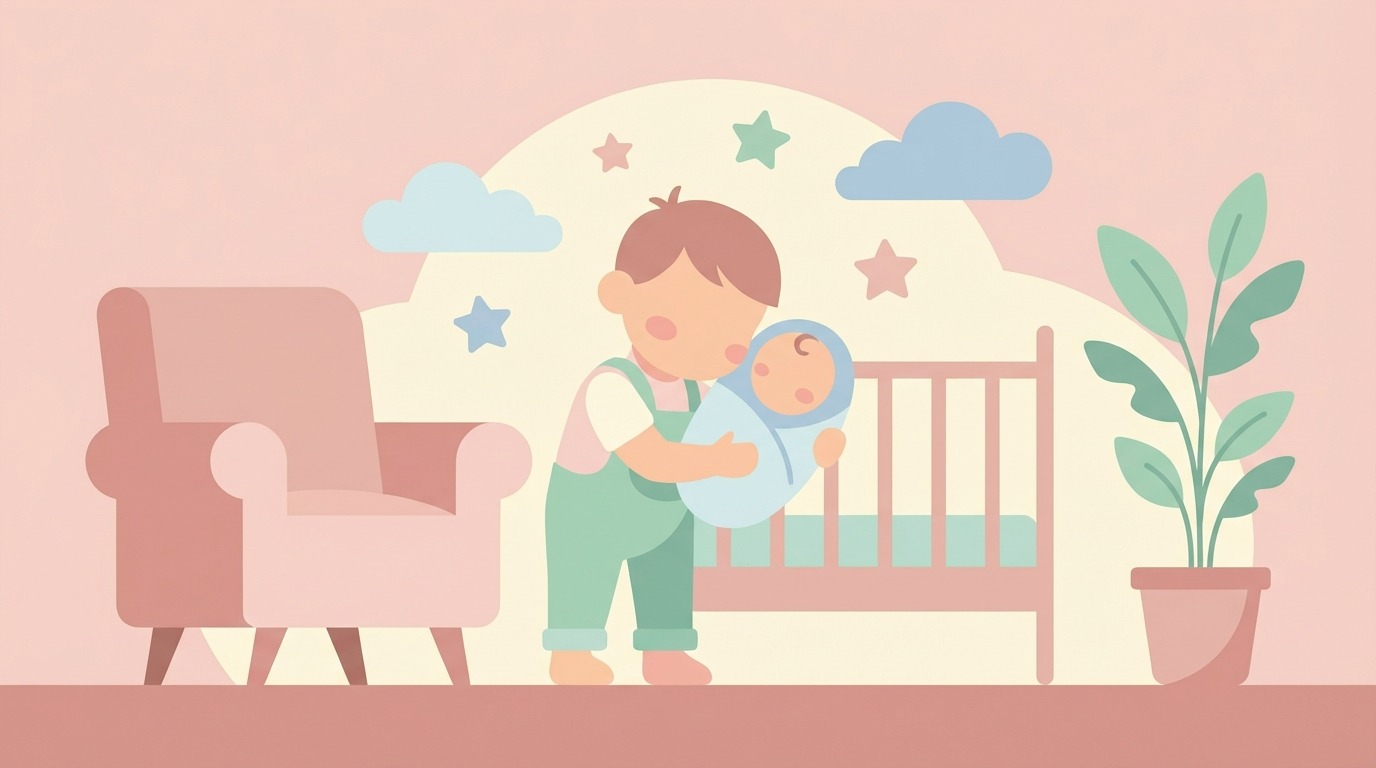
Child Baby Jealousy: Managing the child’s jealousy when a baby arrives (1-3 years).
| Short on time? Here is the essentials ✨ |
|---|
| 😊 Child jealousy after the baby’s arrival is normal between 1 and 3 years old: it is a signal of emotions and needs. |
| 🧩 Searching for the hidden need behind the child’s behavior (to be seen, play, be reassured) helps faster than a long speech. |
| ⏱️ Offering short daily exclusive rituals secures the child’s adaptation and reduces siblings rivalry. |
| 🧸 Symbolic games, puppets and books nurture emotions management and fraternal relationship. |
| 🆘 Consult if aggression lasts, if sleep/meals deteriorate strongly, or if the child isolates for several weeks. |
When a baby appears, the household changes its rhythm, and the eldest child’s heart changes too. Parents often notice an alternation of intense cuddles and emotional storms, sometimes with sudden regressions. This yo-yo is not a tantrum: it is a normal response to a massive change, especially between 1 and 3 years old. The baby’s arrival reactivates the need for security and space. The child seeks to verify if the parental attention remains solid, and if their status in the sibling group remains protected.
Good news: child jealousy can become a lever for emotional growth. By reading it as a message about specific needs, everyone breathes easier. Parents then gain clarity to build soothing rituals and adjust the framework. Concrete tools, like puppets, stories or cooperative games, also facilitate emotions management. And because life doesn’t stop with a newborn, micro-dose attention tips, two minutes here, three minutes there, lighten the load. This guide proposes a pragmatic path: transforming siblings rivalry into alliance, supporting child adaptation daily, and strengthening the fraternal relationship without exhausting oneself.
Child jealousy and a baby’s arrival: understanding the roots between 1 and 3 years old
In this age group, the social brain explodes with curiosity, but emotional regulation is still under construction. Thus, child jealousy works like a radar: it detects a perceived risk of loss of love. A bottle given to the baby, attention focused for a long time at the changing table, and the alarm is triggered. Rather than labeling it as a “tantrum,” it is strategic to decode the message: “Reassure me about my worth.”
For Lina, 2 and a half years old, the baby’s arrival of her little brother Jules triggered new behaviors: she sometimes throws her crayons and scribbles on the wall during bath time. The sign is clear: she demands to be seen. This type of child behavior often signals a need for belonging and playful attention. By naming the emotion, then proposing a short and rewarding activity, the tension decreases. Bath time can become a “bubble mission” for Lina, responsible for the foam toys for a few minutes.
Signals and hidden needs
The most frequent signals: repeated opposition, regression (bedwetting, thumb sucking), verbal collisions or rough gestures toward the baby. Behind this: need for exclusive affection, need for control, need for sensory play to unload, need for predictability. It is useful to set this compass: “What is he trying to get? What does she need here, now?” This stance transforms the moment. Energy is redirected towards a clear framework: “I listen, you are angry, and we protect Jules’s body.” Then a door opens: “Come, it’s your turn to choose the lullaby.”
Because language remains limited at this age, behaviors speak for the child. Hence the interest in symbolic supports: reading a book about emotions, making a stuffed animal speak. Puppets, for example, allow the child to show the storm without drowning in it. To get inspired, a detour through concrete ideas on symbolic play can help: the power of puppets to free speech.
Differentiating jealousy and need for recognition
Sometimes, what looks like jealousy is primarily a quest for place. Between 1 and 3 years, children love to “copy.” We then confuse confrontation and imitation. By entrusting small responsibilities, we nurture competence and protect the fraternal relationship. Holding the clean diaper, pressing the night light switch, bringing the evening book: these micro-tasks reduce tension as they provide a clear role.
A decisive reminder: jealousy is neither parental fault nor child defect. It informs. By relying on this reading, the path ahead becomes simpler: prepare before birth, then orchestrate some markers after returning home. This understanding will serve as a compass for the next stage.
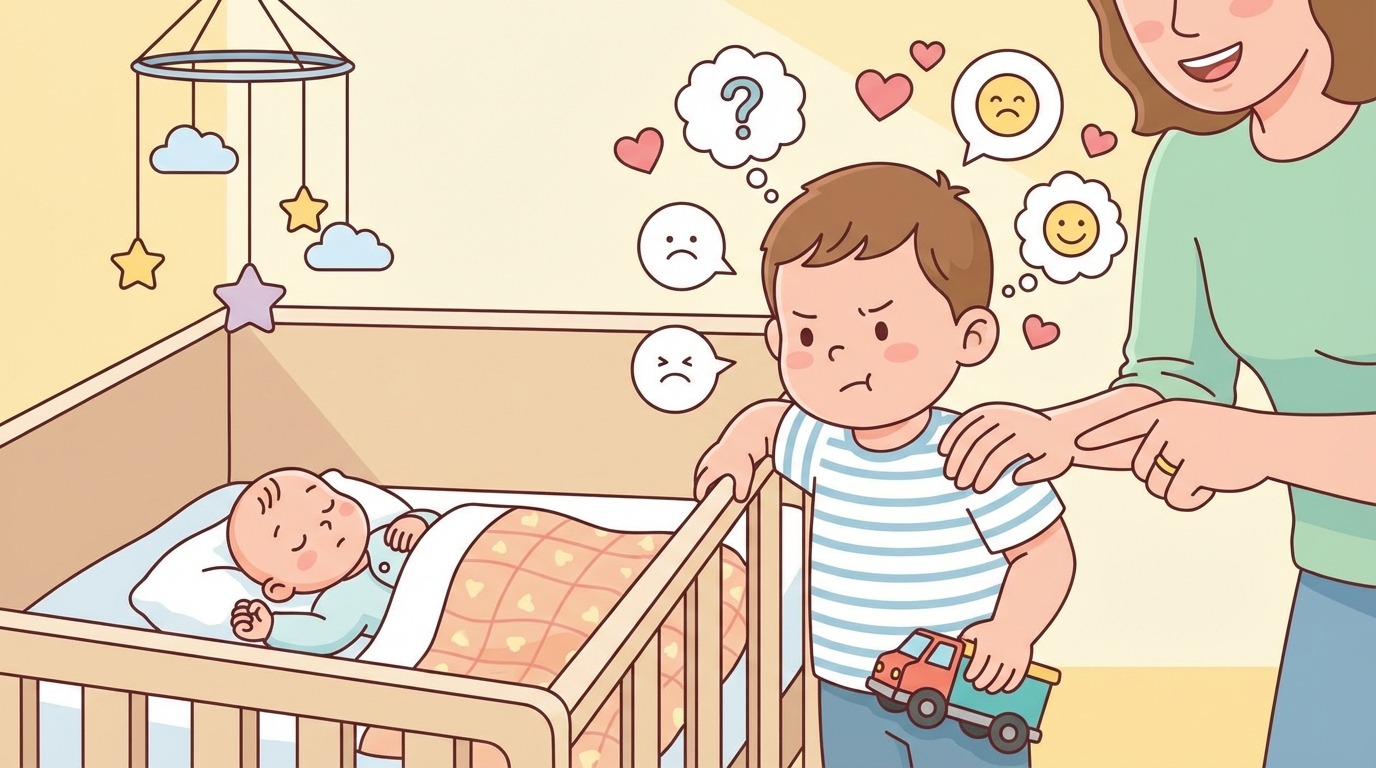
Preparing the sibling group before the baby’s arrival: rituals, words and games that soothe
Anticipating is already calming. The preparation does not aim to convince, but to create reassuring mental images. First, simple, concrete words related to everyday life are explained. Then, exclusive moments are sculpted, short but predictable. Finally, this future is staged with symbolic games that warm the imagination and strengthen emotions management.
Rituals and playful scenarios
A pictured calendar can show the approach of the due date, with small pictures: “Today, we choose a song; tomorrow, we pack a keepsake box.” Puppets and stuffed animals act out the hospital, the lullaby, the return home. This theater prepares without dramatizing. Several families also appreciate personalized stories; for example, a tale that talks about the house and each person’s place, like here: a tender story to talk about one’s family.
For words, the golden rule rests on three axes: describing reality, validating feelings, ensuring the permanence of the bond. “The baby will need arms, and you will need cuddles too. We will prepare a king’s cuddle together.” This approach can be reinforced thanks to well-designed digital supports: the Naître et grandir app offers reliable and age-appropriate content.
- 🧸 Express exclusive rituals: 3 minutes “peekaboo-cuddle” after daycare.
- 📚 Thematic reading: albums on sibling groups and rivalry.
- 🎭 Role-playing games: jealous stuffed animal, mediator child.
- 🧩 “Big brother/big sister” missions adapted: press, bring, choose.
- 🎶 Code song: a chorus just for you to reconnect quickly.
To go further, a useful resource on the experience of “being the big sister of the little brother” can trigger beautiful exchanges: dialogue around roles in the sibling group. And as books are remarkable emotional bridges, practical markers here: the benefits of shared reading 📖.
Arrange the space and time
A “big” corner values the eldest: activity box out of the baby’s reach, personal shelf, basket of books “alone with mom/dad.” Times benefit from being bookmarked: a ritual “five minutes just for you” after work avoids many storms. The brain loves knowing what is coming.
In short, preparing means making each person’s place visible. The transition calms when roles are clear and the child feels still seen.
These ideas plant seeds. The rest plays out daily, after returning home, with realistic logistics and a lot of flexibility.
Daily life after birth: managing emotions and parental attention without exhaustion
Days with a newborn resemble a marathon in stages. The secret: multiply micro-connections rather than aim for a long perfect session. Two minutes of full presence are worth more than a distracted quarter hour. Parental attention is dosed like a vitamin: regularly, in small quantities.
Exclusive moments with high emotional value
“Capsules” are established daily: a morning eye contact ritual, a “hide-hand” game when getting out of the stroller, a code song before bedtime. These moments become anchors. We can also delegate and automate: a basket ready with quiet activities to take out during feeding, stickers to stick on a notebook. Quality digital supports provide reliable ideas: the Naître et grandir app lists concrete age-appropriate ideas.
Reading is a bond accelerator and an emotional soother. An album placed near the breastfeeding chair creates a tender break for the eldest. Need arguments to convince those around you? Here are good reasons to ritualize stories: reading and child development 📚.
Responding to behaviors without getting stuck
When the eldest hits or pushes, three key gestures: protect without judging, name the emotion, redirect with a concrete alternative. “You’re angry, it’s too much for you. Bodies are precious; come crush the modeling clay.” The brain learns through physical experience. Offering to blow slowly while watching a feather fall transforms excitement into regulated play.
The parental couple can also establish a relay code. If one manages the baby, the other opens an “exclusivity window” for the eldest. And when that’s not possible, verbalize: “I’m finishing this bottle, and it’s your moment. Look, I put the teddy bear in your box to tell you I’m not forgetting.” The symbol reassures as much as the act.
Finally, tenderness for oneself matters. Child adaptation accelerates when adults feel supported. A network of close ones, a neighbor, a grandparent can make a difference. Moreover, reflecting on everyone’s place helps smooth the organization: involving a grandparent or great-grandparent can be precious.
With this support, the journey becomes smoother. What’s left is turning frictions into cooperation within the sibling group.
Siblings rivalry: transforming conflict into cooperation from 1-3 years
Siblings rivalry has a function: it tests limits and roles. The goal is not to eradicate it, but to tame it. A firm and warm framework acts like rails: “We can be angry, but we cannot hurt.” Clarity about what is allowed cuts misbehavior in half.
Non-negotiable framework and active mediation
In the first months, the eldest cannot “resolve” a conflict with an infant. It is up to adults to play translators. Comparisons are prevented because they ignite jealousy. Better to talk about needs: “Jules cries because he’s hungry; Lina wants to play because she’s bored.” This lexical shift defuses a lot. Cooperation is also encouraged by ritualizing “together but separate” moments: the eldest does an activity within sight while the baby is on the floor, each has their space.
Mediation can be done using third-party objects. A mirror on the floor, for example, catches the infant’s attention while the eldest builds a tower; here we are inspired by inputs on the mirror and child development. The adult guides the interaction: “You can show your tower to Jules, he is watching you.” The eldest feels like an expert, thus less in competition.
Cooperative games and role valorization
We favor games where the eldest helps safely: passing a rattle, choosing the song, sticking a label on the family notebook. To ritualize, creating a “cuddle tutor diploma” with a weekly sticker amuses and structures. Even better, integrate micro-scenes “us against the hourglass”: for 60 seconds, everyone tidies up to music. The collective victory strengthens the fraternal relationship.
And if tension rises, the adult acts as a bumper: separate calmly, breathe, offer a sensory break (clay, cushion, bubbles). These repeated transitions sculpt a cooperation reflex. The final message is stable: we belong to the same team, every emotion has its place, and each finds a safe path.
When to consult and how to mobilize the entourage without guilt
Most families go through this period with ups and downs. However, some signals invite seeking professional advice. It’s not about labeling, but about obtaining tailor-made tools. The sooner you adjust, the faster the spiral calms.
Warning signs to watch
Consultation is recommended if aggression lasts and intensifies despite a clear framework, if sleep or eating disorders worsen markedly, or if the child isolates from social play for several weeks. A child psychiatrist, early childhood psychologist or a PMI consultation can propose a simple plan. Attachment-based approaches and parental tools yield excellent results for emotions management.
Sometimes environmental adjustments suffice: lighten fatigue, protect a regular exclusive slot, involve a reliable relative. A story, a game, a park visit with a dedicated adult can rekindle curiosity and nourish child adaptation. Relying on tales and mediator objects, as mentioned above, helps enormously.
Support network and role of relatives
Choosing allies within the family avoids overheating. A grandparent can hold the “Wednesday story” ritual or manage the trip to the playground. Explicitly thinking about everyone’s place secures everyone: this guide on involving eldest children and elders can inspire calm arrangements: clarifying the place of step-grandparents. Giving a concrete role to relatives avoids abstract advice and strengthens the team around the children.
When in doubt, better a short check than long worry. The goal remains constant: offer the eldest a solid emotional base so they learn to love without fearing loss. This simple conviction guides solid decisions.
Practical tools to keep the course daily
To memorize the essentials amidst the whirlpool, this mini-reminder helps set concrete priorities.
| 🧭 Key pointers to keep in mind |
|---|
| Name the emotion + set the framework + propose an alternative = winning trio 💡 |
| Plan 2 exclusive capsules/day (2-5 minutes) ⏳ |
| Avoid comparisons, favor the language of needs 🤝 |
| Use symbolic games, puppets, shared books 🎭📚 |
| Ask for help early: PMI, psychologist, relatives, parental network 👥 |
“Jealousy calms down when everyone’s place becomes visible, loved and useful.”
How to react when my child hits the baby ?
Protect without shouting: gently block the hand, state the rule (“we protect bodies”), name the emotion (“you are angry”), then offer a safe discharge action (modeling clay, cushion to squeeze). Finish with a positive micro-connection with the eldest to recharge their need for attention.
Should jealousy be punished ?
No : jealousy is an emotion, not a fault. Dangerous actions are firmly framed, but the cause is addressed by nourishing the need: exclusive attention, valued role, predictable rituals. A clear framework + concrete alternatives is better than punishment.
How to share parental attention with a newborn ?
Aim for frequent micro-connections: 2 to 5 dedicated minutes, twice a day, with a fixed ritual (song, finger play, quick reading). Prepare an activity basket for the eldest during the feeding, and use a symbol (stuffed animal totem) to signal “soon your moment.”
When to consult a professional ?
If aggression increases, if sleep/eating troubles worsen, if isolation persists for several weeks, or if you feel overwhelmed despite an established framework. Early support quickly provides effective strategies and eases the family load.