Mirror Child Development: The mirror and the development of the child
The mirror fascinates, questions, and illuminates the inner path of little ones. Thanks to this simple object, reflection becomes a tool for learning, gradually revealing self-awareness, coordination, and an initial outline of identity. In a living room or a daycare room, a mirror placed in the right spot transforms a room into a discreet development laboratory. Observing a baby who smiles at their double, touches their nose, or hides to reappear, tells a precise story of child psychology. It reveals how the child builds their body, mind, and relationships.
This exploration is nothing anecdotal. It contributes to cognitive and social development, while opening the door to language, imitation, and self-perception. At each age, different interactions with the mirror offer reliable benchmarks. For example, trial and error stimulates executive functions, while self-recognition refines the emotional axis. What if this mundane scene became an intelligent, reassuring, and joyful daily ritual? In 2026, early childhood teams multiply these micro-experiences to weave solid skills, gently. The fictional story of Lila and Noé, two playmates, illustrates here how, step by step, a mirror can guide the great achievements of the early years.
| Short on time? Here’s the essentials ✨ |
|---|
| 🪞 The mirror supports self-awareness from the very first months. |
| 🧠 Reflection games nourish cognitive development and language. |
| 💬 Naming emotions in front of the mirror strengthens self-perception. |
| 🎯 Brief daily rituals guide learning without overstimulation. |
| 🤝 The mirror favors identity and emerging social skills. |
Mirror and child psychology: from reflection to self-awareness
The mirror is not a decorative accessory. It acts as a development trigger that connects body, gaze, and affect. Very early, the baby seeks stable visual landmarks. Thus, the image reflected by the mirror becomes a regular anchor point.
Between two feedings or after a nap, placing the child facing a reflective surface stimulates alertness. It also nourishes eye-hand coordination because the hand follows the perceived face.
Key markers of self-recognition
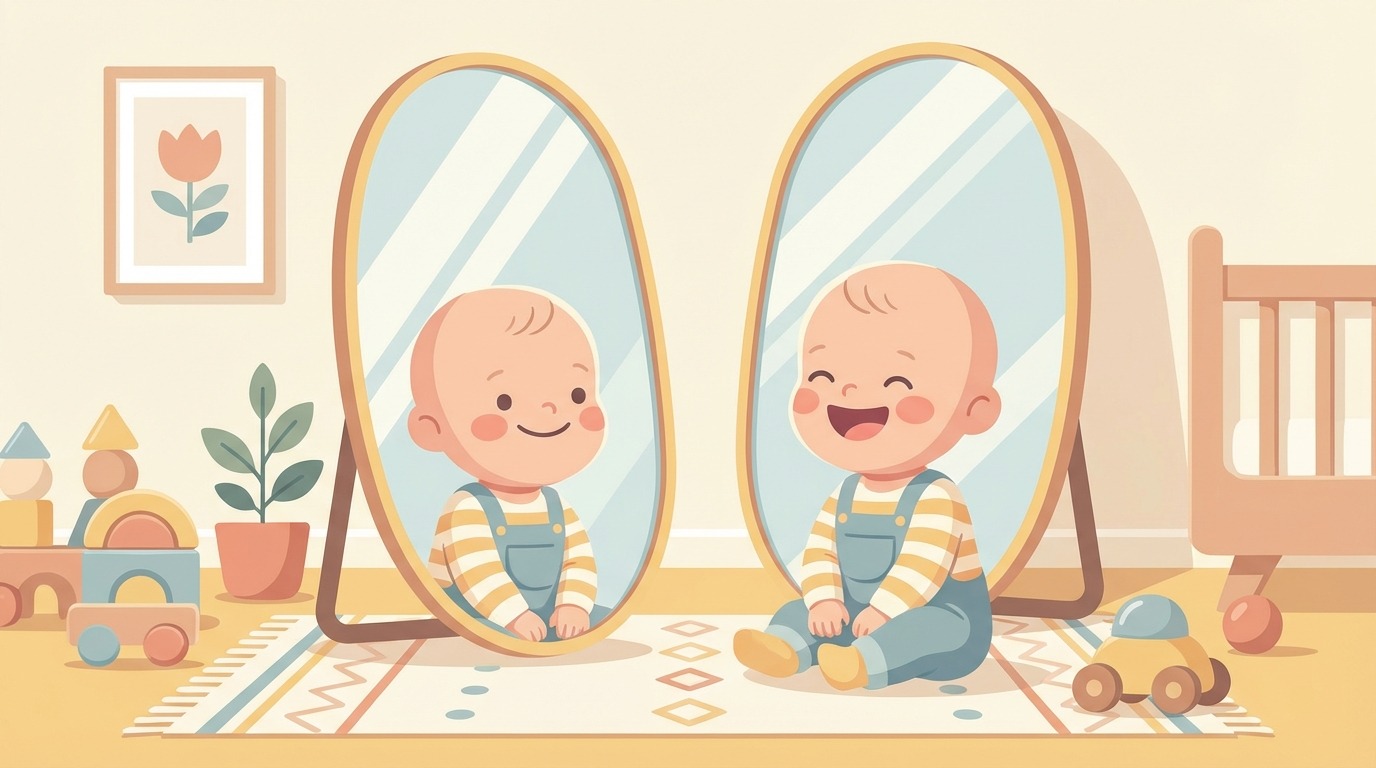
Around 6 to 9 months, the figure in the mirror intrigues. Yet, it is first treated as a virtual friend. Lila babbles at her reflection and laughs out loud. This play supports her sociability without constraint.
Then, around 15 to 24 months, a well-known milestone arises. The famous forehead spot test shows emerging self-awareness. Noé touches his skin, not the glass, revealing a step towards identity.
This awakening fits within modern child psychology. It articulates body perception, memory, and emotion. Besides, the alternation “I see you/you are gone” refines object permanence.
Why the mirror motivates exploration
Reflection makes the invisible visible. A smile crackles, a grimace becomes funny, a gesture produces an effect. Consequently, learning is reinforced by immediate feedback and surprise.
This visual feedback influences cognitive development. It strengthens attention while inviting repetition. It is a discreet training of executive functions.
For the very young, a mirror on the floor accompanies “tummy time.” This moment supports head control and curiosity. For more, see this practical guide on tummy time.
This setup complements other basic rituals. For example, care and close observation lay a reassuring foundation. Also read: newborn care and development.
All in all, the mirror acts as a mediator. It transforms a trivial moment into a precise workshop of joyful self-perception.
Cognitive development and identity: what play in front of the mirror reveals
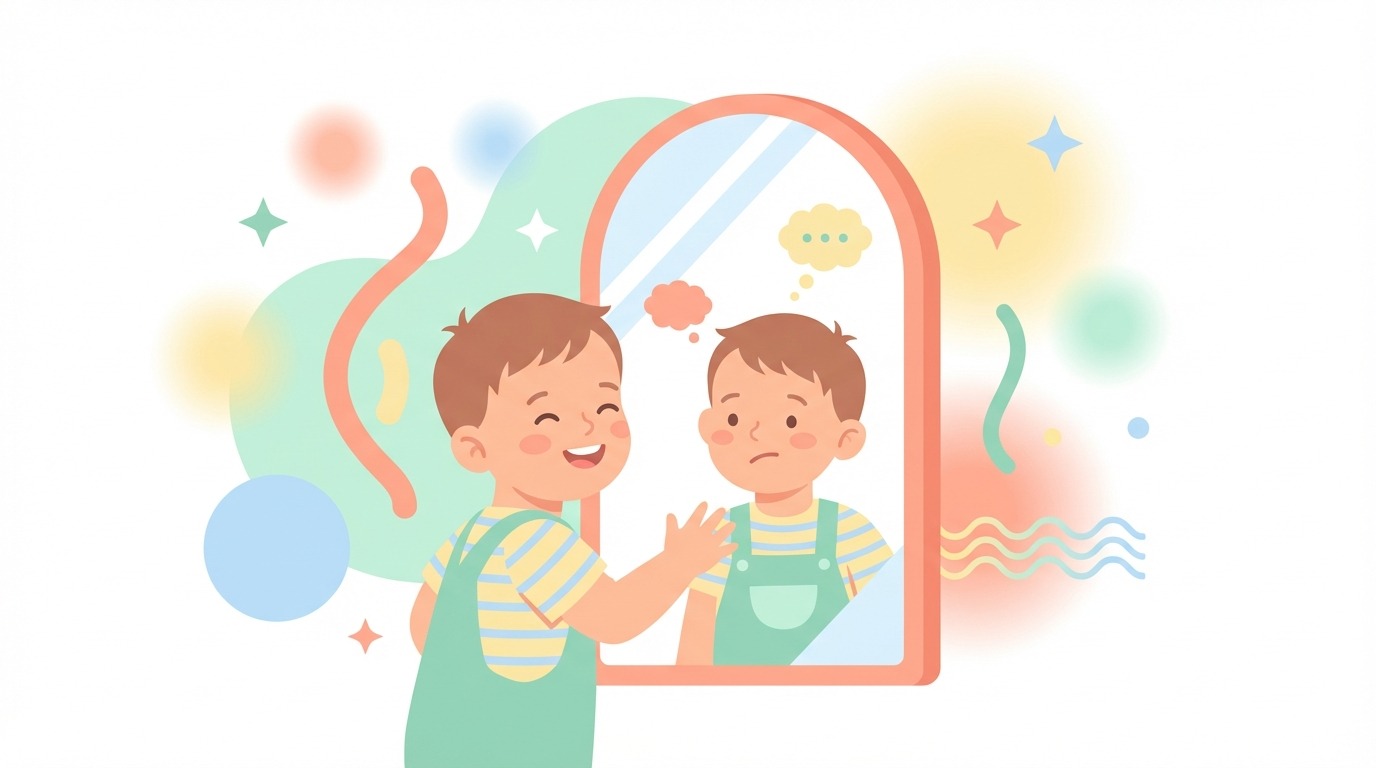
When Lila imitates a pout seen in the mirror, she trains her brain. This back-and-forth between action and image develops inhibition, working memory, and flexibility.
Thus, the mirror serves as an internal dashboard. It stages the emerging identity through several controlled micro-challenges.
Executive functions and directed imitation
Comparing a real gesture and its visual copy requires divided attention. The child must slow down, observe, then correct. It is a powerful adjustment loop.
Moreover, naming the action helps structuring. “Open your mouth, close your mouth” becomes a script, almost musical. The brain associates sounds, images, and sensations.
This coupling fosters autonomous learning. Noé blows on an imaginary candle following his reflection. He strengthens buccofacial motor skills useful for language.
The mirror also introduces early social codes. Looking, waiting, then responding builds turn-taking. This choreography nourishes joint attention and shared emotions.
Ultimately, identity gains coherence. The child perceives that the same body performs various roles. They become the actor of their own story.
Language, emotions, and self-perception
Facial expressions form an affective dictionary. Saying “you look happy” or “your forehead is wrinkled” creates concrete semantic links.
Step by step, self-perception sharpens. The child links internal sensation to a visible configuration. This is crucial for regulating and asking for help.
In some sequences, humor soothes. Lila discovers her tongue. She relaxes, laughs, then repeats. Positive emotions mark the memory.
Be careful, however, of fatigue. Breaks prevent overstimulation. It is better to have brief, paced, daily sessions.
At the heart of this scenario, the mirror reveals a living map of cognitive development. It harmonizes perception, motor skills, affect, and language.
Supporting the child step by step: simple activities with a mirror
Short rituals are better than a long session. Two to five minutes suffice, several times a day. Pleasure guides learning.
To organize the space, first secure the mirror. Choose an unbreakable and stable model. Position it at eye level.
From 0 to 6 months: sensory awakening and coordination
- 🍼 Lay on the tummy near a mirror on the floor: strengthen head control and curiosity. See the explained tummy time.
- 🎵 Play with slow sounds and gestures: combine listening, sight, and touch.
- 🌈 Soft contrasts and black/white mobiles: stimulate without exciting.
- 🖐️ Touch the face while naming it: “your cheek,” “your nose,” to connect word and sensation.
These micro-activities activate orientation and shared attention. They prepare eye-hand synchronization. Repetition reassures.
From 6 to 24 months and beyond: imitation, language, and symbolic play
- 😛 Guided grimaces: widen expressions and enrich emotional vocabulary.
- 🔎 “Where is the spot?”: introduce body mapping and self-awareness.
- 🧣 Simple dress-up: identify the other and self, then compare.
- 🧩 Animal family games: extend imitation beyond the mirror, for example with this 7 families game.
For outdoor sessions, protect sensitive skin. This reminder of prevention is necessary from the sunny days. A useful resource: sunscreen and children.
These proposals remain adaptable. We follow the mood, availability, and curiosity of the day. The mirror becomes a companion, never an exam.
In reality, two principles suffice: regularity and freedom. The guidance remains warm, the instructions clear and brief.
Little by little, identity is woven. The child gains confidence to shift toward autonomous imagination.
Emotions, separation, and emotional security facing the mirror
Curiously, the mirror can amplify joys and fears. A shared laugh multiplies itself. Conversely, a surprised face can worry for a few moments.
The adult’s role is to contain these waves. Presence, voice, and gaze act as a safety barrier.
Laughter, apprehensions, and emotional regulation
When Noé gets agitated, his gestures speed up in the reflection. The adult’s tone slows the dance. They offer a breath and a pause.
Nevertheless, a hint of the unknown feeds learning. The child tames this other presence. They will learn that it belongs to them.
Naming the emotion in front of the mirror clarifies self-perception. Saying “you are surprised” turns the storm into a light rain. The tension organizes.
This regulation proves useful daily. During a new caregiving situation, the mirror becomes an ally. It serves as a stable landmark in a different place.
For smooth transitions, concrete tips exist. See: first separation with the nanny.
Separation, jealousy, and graduated autonomy
Between 18 and 36 months, tantrums occur. The reflection “taking” the toy can trigger a sharp reaction. This is normal and temporary.
A predictable framework soothes. Brief autonomy rituals value competence. An inspiring suggestion: little playful autonomy certificates.
If a crisis erupts, the adult proposes a short mirror sequence. First breathe, then make a grimace, and end with a hug. The mood shifts.
For oppositional phases, landmarks help. A useful read: the 2-year-old tantrum explained. It enlightens the contradictory needs of control and security.
Meanwhile, the mirror supports inner speech. “I am angry, but I can breathe” imprints, gesture by gesture. Identity gains stability.
Ultimately, the mirror becomes a mediation space. It connects emotion, body, and thought in a tamed scene.
Practical advice and observation benchmarks for parents and professionals
Assessing development with the mirror requires benchmarks and caution. It is about observing, not judging. Comparisons between children weaken.
Consistency of the framework prevails. Same room, same moment, same instructions. The brain likes predictability.
Positive signal checklist
- 🌟 Sustained gaze toward the reflection for a few seconds.
- 🖐️ Touches the real face after seeing the area in the mirror.
- 🎭 Varies expressions and imitates them on simple request.
- 🗣️ Babbles or names body parts while looking.
- 🤗 Laughs, calms down, then resumes exploration without surge.
These indicators are not medical exams. They guide a caring watch. Pleasure remains the compass.
| Age benchmark ⏱️ | Observed behavior 🪞 | Adult tip 💡 |
|---|---|---|
| 0–6 months | Fixes, smiles at the reflection | 2 min sessions, soft voice 😊 |
| 6–12 months | Touches the glass, babbles | Name gestures and sounds 🗣️ |
| 12–24 months | Imitates, looks for a spot | Playful grimace games 🎭 |
| 24–36 months | Recognizes self, names parts | Label simple emotions 💖 |
When one of these milestones is delayed, no panic. Observe over several days. Adjust duration and atmosphere.
If the child systematically avoids the mirror or freezes, a consultation may reassure. Team-family collaboration is precious.
In addition, short educational videos help visualize postures. They inspire adapted variants for each living space.
In the end, a well-used mirror becomes a companion on the journey. It naturally supports self-awareness and daily learning.
Bonus resource for future moms and loved ones
To prepare a rich and serene environment before birth, a prevention article can help. Priority reading: support for pregnant women. It facilitates anticipation of arrangements, including safe play areas with mirrors.
“In the gaze that the child casts on themselves, the world comes to be reflected… and that is how they learn to find their place in it.” 🌟
At what age do children generally recognize themselves in the mirror ?
Many children show clear signs between 15 and 24 months, for example by touching their face rather than the glass during the spot test. However, interest in the reflection starts much earlier and already feeds attention, motor skills, and sociability.
How long should the mirror be proposed each day ?
Short sequences, 2 to 5 minutes, repeated one to three times depending on mood, are sufficient. The goal is pleasure, not performance. Stop as soon as excitement or fatigue appears.
Can the mirror scare a toddler ?
Yes, sometimes. A calm voice, reassuring contact, and simple games (peekaboo, grimaces) help to tame this presence. Respect the rhythm and try again later if needed.
Do you need a special mirror ?
An unbreakable and stable mirror at eye level is enough. Secure models for early childhood are ideal. Regularly check the mounting and surface condition.
How to integrate the mirror into other routines ?
Associate the mirror with already ritualized moments: after naps, during diaper changes, or before reading. Name a body part, an emotion, then close with a tender gesture to anchor emotional security.