Cardboard Character DIY: DIY: making a cardboard character with the child aged 3 to 5 years.
| Short on time? Here’s the essentials ⏱️ |
|---|
| ✅ Use recycled cardboard and rolls for a simple, economical, and eco-friendly kids’ craft ♻️ |
| 🖐️ Focus on fine motor skills, cardboard cutting, and the creativity of 3-5 year olds ✂️ |
| 🎭 The cardboard character becomes a base for stories, symbolic play, and language 💬 |
| 🎨 Prefer washable children’s paint, markers, googly eyes, and pipe cleaners to make a fun character |
| 📚 Extend the craft activity with rhymes, books, and puppets to nurture imagination 🌟 |
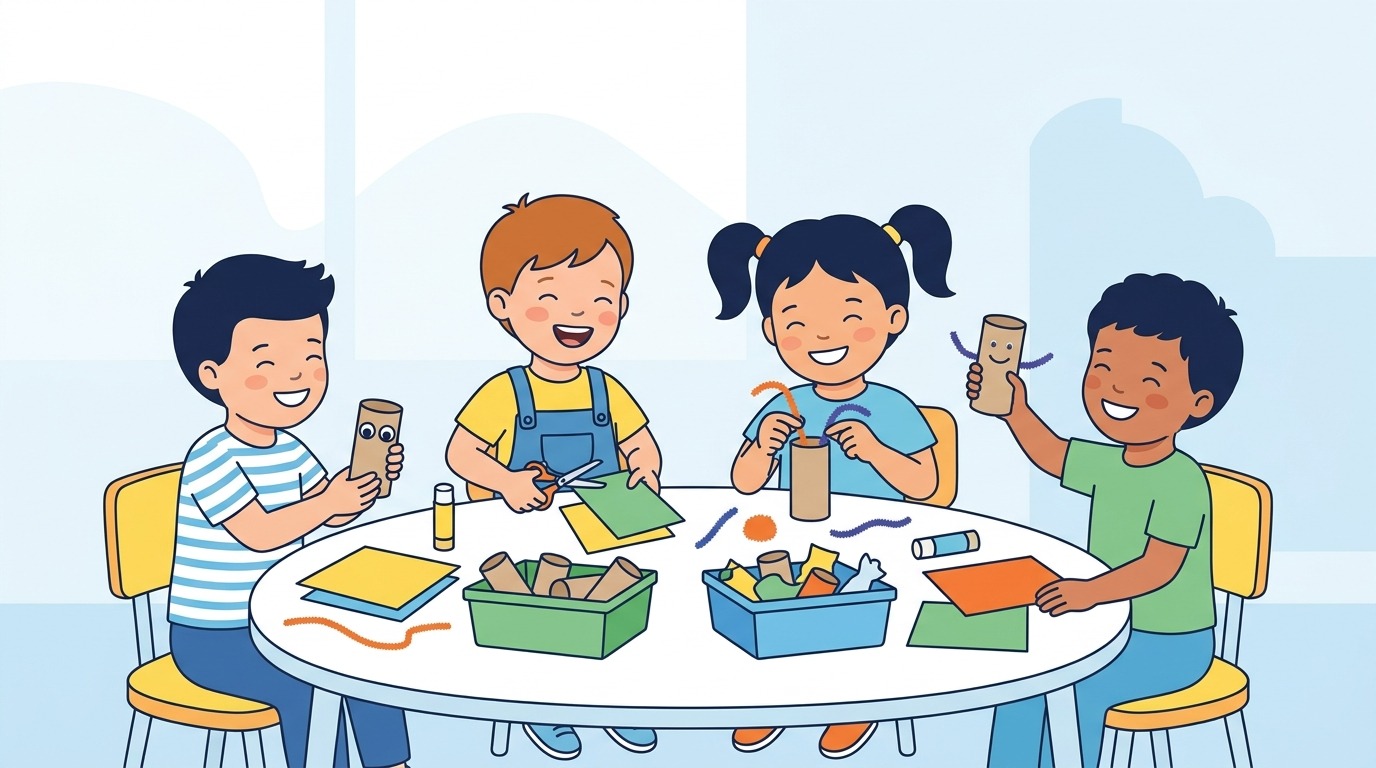
Creating a cardboard character with a 3- to 5-year-old is much more than a craft. This hands-on activity transforms a simple roll into a story hero, a play companion, and a reason to talk, laugh, and experiment. Both families and preschool teams embrace it because it ticks all the boxes: quick to set up, very economical, and ideal for recycling recycled cardboard stored in a collection bin. Children gain concrete sensory experience: cutting, gluing, painting, crumpling, pressing, squeezing. Adults find a rich educational space to work on movement, vocabulary, autonomy, and confidence.
Throughout the session, each child brings forth a unique idea: spiky blue hair, a yellow bow tie, moving arms, a big red smile. Nothing is fixed: the same base serves to reinvent a thousand variations. The workshop becomes a springboard for mini-scenes played on a felt board, an improvised set on a biscuit tin, or an entire collection of characters displayed on a shelf. And if the 2026 trend for eco-friendly creative leisure is booming, this craft is the perfect illustration.
Crafting a character with the recycling bin: developmental benefits for 3-5 year olds
At preschool age, gestures become more precise, attention span lengthens, and symbolic thinking blossoms. Building a cardboard character naturally involves all three dimensions. The child cuts thin fringes for hair, adjusts two googly eyes, presses the glue, thereby strengthening the hand and wrist. These micro-actions train grasping and prepare for writing. The connection with speech follows: by naming the character’s colors, shapes, and emotions, the child enriches their vocabulary.
Neuroscience reminds us that learning anchors better when pleasure is present. Here, pleasure stems from the power to act: making a character, deciding its style, giving it a name, then playing with it. This continuum fosters intrinsic motivation and attention. To go further, a look at the benchmarks of development in 3-5 year olds highlights milestones: eye-hand coordination, motor control, autonomy, and early social play scenarios.
Symbolic play immediately follows creation. A child turns the roll into a mechanic, a shy dragon, or a reassuring parent. This shift stimulates theory of mind and emotion regulation. The benefits of play are well documented; they deserve to be recalled through this clear resource on benefits of play for children. By offering a brief but regular hands-on activity, the adult provides gentle and deep training of executive functions.
Language also unfolds through narration. After crafting, some children tell how their character lost its hat, others invent a visit to the vet. Inviting to “say what your character likes” triggers complete sentences and temporal connectors. Associating a short story read aloud enhances this effect. A look at the benefits of reading shows the synergy between oral skills, listening, and story emergence.
Finally, the socio-emotional impact deserves emphasis. A child who dares to choose a very bright green and stars, then patiently waits for drying, practices boldness and patience. Characters staged together open a miniature theater where negotiation, turn-taking, and respect for ideas are learned. This sum of micro-victories nurtures confidence. The key message: crafting is not incidental, it structures major acquisitions.
Making a character from recycled cardboard: materials, safety, and setup at home or in preschool
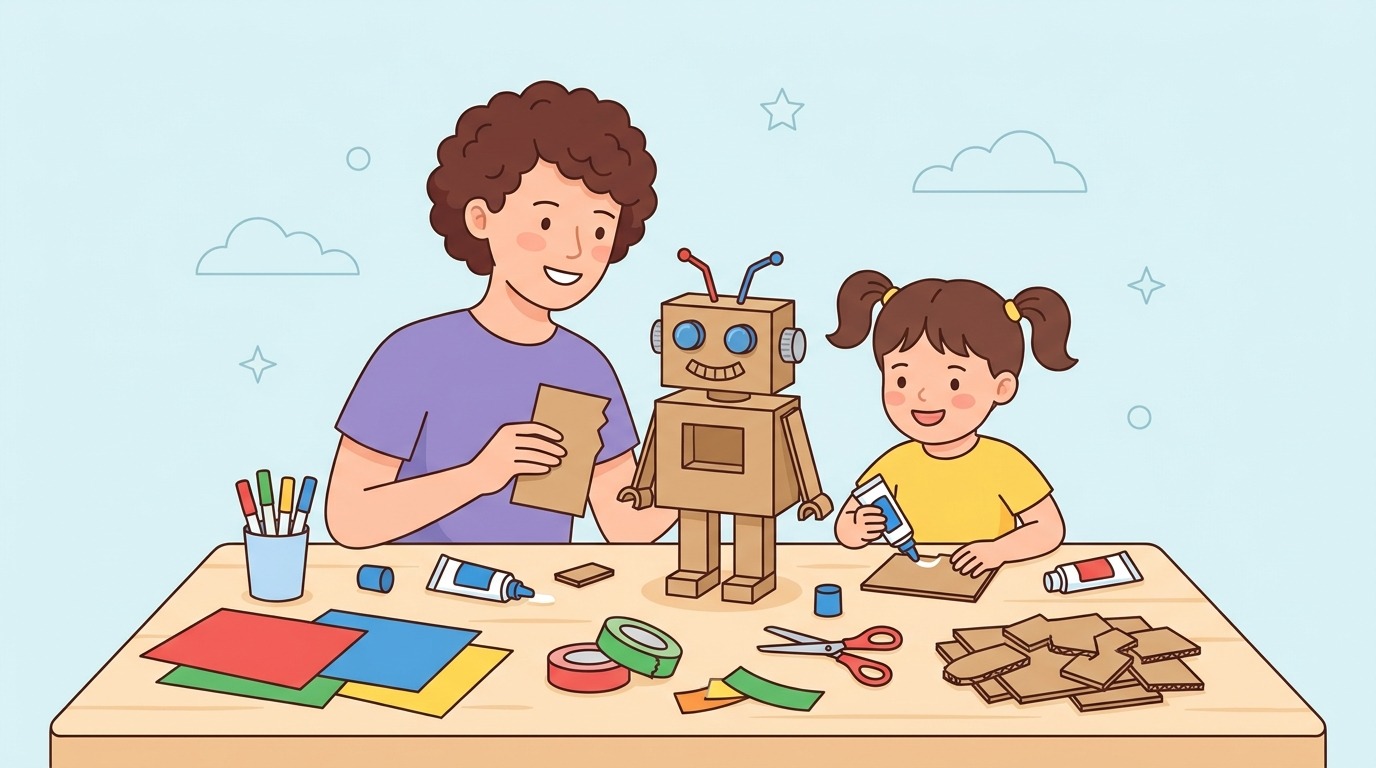
Success begins before the first cut. A well-prepared tray reassures, guides, and reduces frustration. For this creative workshop, it’s better to place each element in a bin, with a visible example. Nothing imposed, however: the model inspires without confining. The child must retain some choice margin on colors and details.
Simple and effective materials for a successful kids’ craft
- ♻️ Rolls in recycled cardboard (toilet paper, paper towels): body base
- 🖍️ Colored sheets, scraps of wrapping paper: clothes, hair, accessories
- 👀 Googly eyes and pipe cleaners: expression and articulated arms
- 🖊️ Washable children’s paint and markers: patterns, buttons, rosy cheeks
- ✂️ Scissors for small hands: safety and gesture control
- 🧴 White glue and glue sticks: clean bonding, fast setting
The table deserves a protective cloth. A damp dish towel within reach avoids long pauses for washing hands. Preparing a few pre-cut shapes (circles for eyes, triangles for bow ties) supports younger children without stifling their creativity. For classes, providing trays for pairs streamlines exchanges.
Safety and ergonomics: gestures that reassure and structure
Rounded-tip scissors are a must. A clear instruction suffices: hold in the dominant hand, turn the paper rather than force the blade, put scissors away closed with the tip down. The adult supervises at child height, knees bent, eyes level with the tray. This posture reduces incidents and encourages immediate verbal praise.
Children’s paint must be non-toxic, washable, and odorless. A small amount in an egg carton cup limits waste. For glue, a wide brush encourages broad, smooth gestures. Introducing the notion “a little is enough” makes the child responsible for material care. Finally, allowing drying time at the end of the workshop avoids tears at playtime.
Organization and ecology: the recycling bin as a playground
A “treasures” box dedicated to recycled cardboard changes everything. Bottle caps, small packaging cartons, shiny papers, wool strands become potential accessories. This habit raises awareness of reuse and nourishes the project’s aesthetics. Everyone understands that creating doesn’t require costly purchases; it mostly takes an idea, intention, and a bit of boldness.
The optimal time often ranges between 20 and 35 minutes. Beyond that, fatigue sets in. It’s better to plan two light sessions: crafting then decorating and playing. In a school, displaying steps on the wall with pictograms guides autonomous children. At home, a basket dedicated to “Wednesday crafts” establishes an endearing ritual. The essential: a clear framework, simple rules, and the freedom to invent.
Cardboard cutting and easy steps: complete tutorial for 3-5 year olds
The step-by-step reassures the youngest and frees the imagination. The following structure adapts according to age. An adult can pre-cut some pieces, but the child keeps control over assembly and decorative choices. This balance optimizes engagement because the child immediately sees the effect of their gestures.
Essential steps to make a unique character
- 🔹 Ready base: choose a recycled cardboard roll, well cylindrical. Check it stands upright. It’s the body.
- 🔹 Funny hair: cut a paper strip, then fringe it without cutting all the way up. Glue at the top of the roll, press gently.
- 🔹 Expressive eyes: glue two googly eyes. If they’re not aligned, all the better: the expression becomes comical.
- 🔹 Happy mouth: cut a red smile and glue it. A black marker adds dimples.
- 🔹 Articulated arms: cut a pipe cleaner in two, glue on each side. Fold to wave or clap.
- 🔹 Personal details: bow tie, buttons, stars, name written underneath. The child chooses and already tells a story.
This process sets a rhythm: quickly achieving the silhouette, then taking time for details. Sometimes gluing the arms is tricky. Holding pressure for a few seconds stabilizes the piece. To gain autonomy, provide a clothespin as a “helping hand.” Children love these concrete solutions.
Creative variations and sensory extensions
Variations feed the enchantment. Wool hair, string braids, a hat cut from a cardboard plate: everything becomes possible. Adding a cape from fabric scraps makes the character nimble. Painting the roll with glittery children’s paint transforms its look with a few strokes. To train thumb-index pincer grip, gluing mini stickers along a “path” drawn with a marker sharpens precision.
A simple set maximizes theatrical effect. A shoebox becomes a stage; a magnetic biscuit tin holds metal accessories; a felt board retains pieces with Velcro. These supports enhance symbolic play, a catalyst for language. To stimulate rhythmic ear, suggest a thematic rhyme. This resource page on rhymes and songs offers age-appropriate ideas.
The video demonstration helps adults less confident with crafting. Children like to watch a specific step again. A short pause to observe, then a calm restart, maintain concentration. Golden rule: let the child take the lead, guide with open questions, and value the attempt more than the result.
From crafting to symbolic play: inventing stories and developing language with a cardboard character
Once the cardboard character is finished, the stage opens. The child gives it a name, sometimes an entire family. A shoebox becomes a house, a book serves as a bed, a scarf shapes the sea. This shift to the imaginary, key to development, activates effortlessly. The character embodies emotions: courage, jealousy, pride. Words follow, precise, nuanced.
Organizing a small puppet theater enhances this dynamic. A slot in a cardboard, two hanging sheets, and the story begins. Asking questions stimulates narration: “What does your character want? Who helps them? What obstacle do they face?” To enrich this play, an inspiring look at the power of puppets with children shows how the mediating object frees speech and channels attention.
The social dimension is finely worked by two or three children. Each speaks for their character and learns to listen to the other. Turns take place. Scenario conflicts are settled by compromise. It’s a school of cooperation. The rules framework remains simple: speak in turn, let the other finish, build on by adding an idea.
Supporting rituals inspire: describing the hero’s mood, summarizing the episode, announcing what will happen “next.” The child then masters temporal and causal connectors. Reading a picture book extends the pleasure. A short story, read before playing, provides structures and mental images. The benefits accumulate with this resource on benefits of reading.
The play can mix other supports. A magnetic board hosts sets, a felt board receives silhouettes on Velcro. “Emotion” cards help name what the character experiences. For groups, a character family game, inspired by classics, gives a shared playful goal. This approach echoes the richness of simple games like the Kangaroo 7 families game, stimulating attention and working memory.
After the session, a photo of the child-character duos captures the moment. A “heroes gallery” display in the hallway or living room values each creation. This visible acknowledgment of effort strengthens self-esteem. In short, crafting is already playing; playing is learning to speak, negotiate, feel. The virtuous circle needs nothing more than a cardboard roll and some shared time.
Organize a mini visual arts project: from a one-time creative workshop to a mini-exhibition
Turning the workshop into a mini-project provides motivating direction. A guiding theme facilitates progression: “characters from a tale,” “city professions,” “fantastic animals.” Each session sets a clear step: make, decorate, invent a set, perform in front of a small audience. This structure reassures both children and accompanying adults.
Typical two-week progression
Week 1: collect materials from the recycling bin, sort by texture and color, create bases with rolls. Week 2: accessories and children’s paint, story rehearsals, and display. Each session lasts 30 minutes, with a welcome period and a tidying ritual. Evaluation remains qualitative: more assured gestures, more spontaneous ideas, increased cooperation.
Photo documentation plays a key role. Gluing some images in a “making notebook” for each child helps verbalize the process: “at first, there was only a roll,” “then the arms moved,” “in the end, my character found a friend.” This making story nourishes ownership and creates a shared memory.
Group management tips and differentiation
In kindergarten or at home with siblings, differentiation prevents boredom. Offer challenges to choose from: “voluminous hair,” “raised buttons,” “reversible cape.” More skilled children explore curved cutting, others reinforce straight lines. Sensory-sensitive children appreciate soft materials; those who love detail prefer small shapes to sort. All progress, each at their own pace.
For shy children, linking the story to a song guides intonation. Resources on rhymes and songs help structure a mini musical scene. Some children become strongly attached to their creation; this relates to the imaginary friend theme, a bridge to emotional autonomy. Rather than minimizing this attachment, it’s wise to welcome it and make it a language vector.
Logistics checklist and eco-friendly habits
- 🧽 Ready washable wipes, clearly marked “paper” bin
- 🗂️ Labeled boxes “eyes,” “wires,” “papers” for autonomy
- 🖼️ Exhibition wall with names and titles chosen by children
- 📦 “To keep” bin to continue creative hobbies at home
- 🌱 Reuse scraps in a final collective collage
Closing with a small family exhibition reinforces the project’s meaning. Inviting children to “present their character” before two or three caring adults creates a first successful public speaking experience. The final insight sums up in one phrase: the simpler the stage, the more the child shines.
“A cardboard roll today, a world of stories tomorrow.”
Quel âge pour commencer ce bricolage de personnage en carton ?
Dès 3 ans avec aide pour le découpage cartonné et le collage. Vers 4-5 ans, l’enfant gagne en autonomie et peut choisir, tracer, puis assembler seul des éléments simples.
Comment sécuriser le matériel sans brider la créativité ?
Privilégier des ciseaux à bouts ronds, une peinture enfant lavable et non toxique, et une colle facile à étaler. Installer une nappe protectrice, montrer les gestes clés, puis laisser l’enfant expérimenter.
Quelles variantes rapides avec du carton recyclé ?
Cheveux en laine, cape en tissu, chapeau en assiette en carton, bras en fil chenille, yeux dessinés si on n’a pas d’yeux mobiles. Chaque ajout crée une nouvelle personnalité.
Comment prolonger l’activité après la fabrication ?
Mettre en scène le personnage sur un tableau de feutre ou une tôle à biscuits, inventer une histoire, chanter une comptine, ou créer une petite exposition. Les bénéfices du jeu symbolique sont durables.
Combien de temps prévoir pour un atelier créatif 3-5 ans ?
Compter 20 à 35 minutes selon l’énergie du groupe. Pour éviter la fatigue, scinder en deux temps : fabrication puis décoration et jeu.