Battery Safety: The button battery: a danger to children’s safety
| Short on time? Here’s the essentials ⏱️ |
|---|
| Button batteries represent a major danger to child safety: an accidental ingestion can burn the esophagus in less than 2 hours ⚠️ |
| Every year in France, 1,200 emergency visits are related to button batteries, especially in children aged 0 to 5 years 🏥 |
| In case of suspicion: call 15 or a poison control center, do not induce vomiting, do not give anything to drink or eat 📞 |
| Prefer devices with a screw compartment and keep every small battery out of reach, even used ones 🔧 |
| Not all packaging is reliable: in 2023, 14/21 tested batches showed insufficient resistance 🧪 |
Everywhere in homes, the button battery quietly hides inside remote controls, car keys, or night lights. Yet, this small battery concentrates an invisible but formidable risk for child safety. In just a few minutes, an accidental ingestion can turn into a serious poisoning, causing internal burns and bleeding. Poison control centers emphasize a stubborn reality: more than 1,200 annual emergency visits in France concern this type of domestic accident, mainly between 0 and 5 years old.
This danger, often underestimated, is not only about choking. The lithium in certain batteries triggers an electrochemical phenomenon in the esophagus, causing sometimes deadly lesions within less than two hours. The absence of loud symptoms deceives those around: the child may simply seem grumpy, cough a little, or refuse to eat. Faced with this issue, the requirement must be twofold: active prevention daily and clear emergency reflexes. Between equipment control, rigorous storage, and choice of better-designed devices, every gesture counts. And if doubt arises, one rule prevails: act immediately, without attempting to feed or induce vomiting, by contacting 15 or a poison control center.
Button battery and internal burn: understanding the immediate danger to child safety
The button battery is not just a compact energy source. When in contact with a moist mucous membrane, it can create a reaction producing caustic hydroxide ions. These ions attack tissues and sometimes perforate the esophagus. The danger does not depend solely on size: battery voltage and contact time also play a crucial role.
Unlike a swallowed candy, a battery can remain stuck in the esophagus. Meanwhile, the chemical reaction progresses. Thus, lesions begin in less than two hours. Beyond that, the risk of internal bleeding or perforation increases significantly. This reality explains the need for immediate care.
Why symptoms deceive those around
At first, the signs remain discreet. Unusual salivation, refusal of food, or even a light cough can be mistaken for a cold. By confusion, some adults give something to drink. However, this initiative must be avoided. Liquids do not stop the chemical reaction and may worsen the situation.
A story illustrates this trap well: Lina, 2 years old, was playing near a cracked remote control. Within the hour, she became irritable and refused her yogurt. No witness saw the battery go missing. The parent hesitated because Lina had neither high fever nor obvious respiratory distress. The poison control center alerted: urgent X-ray. The battery was lodged in the esophagus. The quick action prevented deep burns.
Numbers that should raise an alarm
Every year, more than 1,200 emergency visits are associated with incidents involving button batteries. In 9 out of 10 cases, it is an accidental ingestion. Toddlers explore by mouth and grasp these shiny objects. This normal behavior in children requires heightened vigilance.
In this context, official sources remind us of the severity of the phenomenon. At home or with relatives, domestic accidents often occur in the absence of an adult less than a meter away. Hence the importance of anticipating: protect, check, and keep anything containing a small battery out of reach.
Errors to absolutely avoid
Certain reflexes worsen lesions. Do not induce vomiting. Do not give anything to drink. Do not wait for obvious signs to appear. The only priority is to call 15 or a poison control center immediately. Meanwhile, finding the packaging or the device concerned will help medical staff identify the model and size.
In short, the burning mechanism is silent but rapid. That is why vigilance must remain constant, even when the child seems to be “doing rather well.”
Where are small batteries hidden at home? Everyday objects and packaging to watch
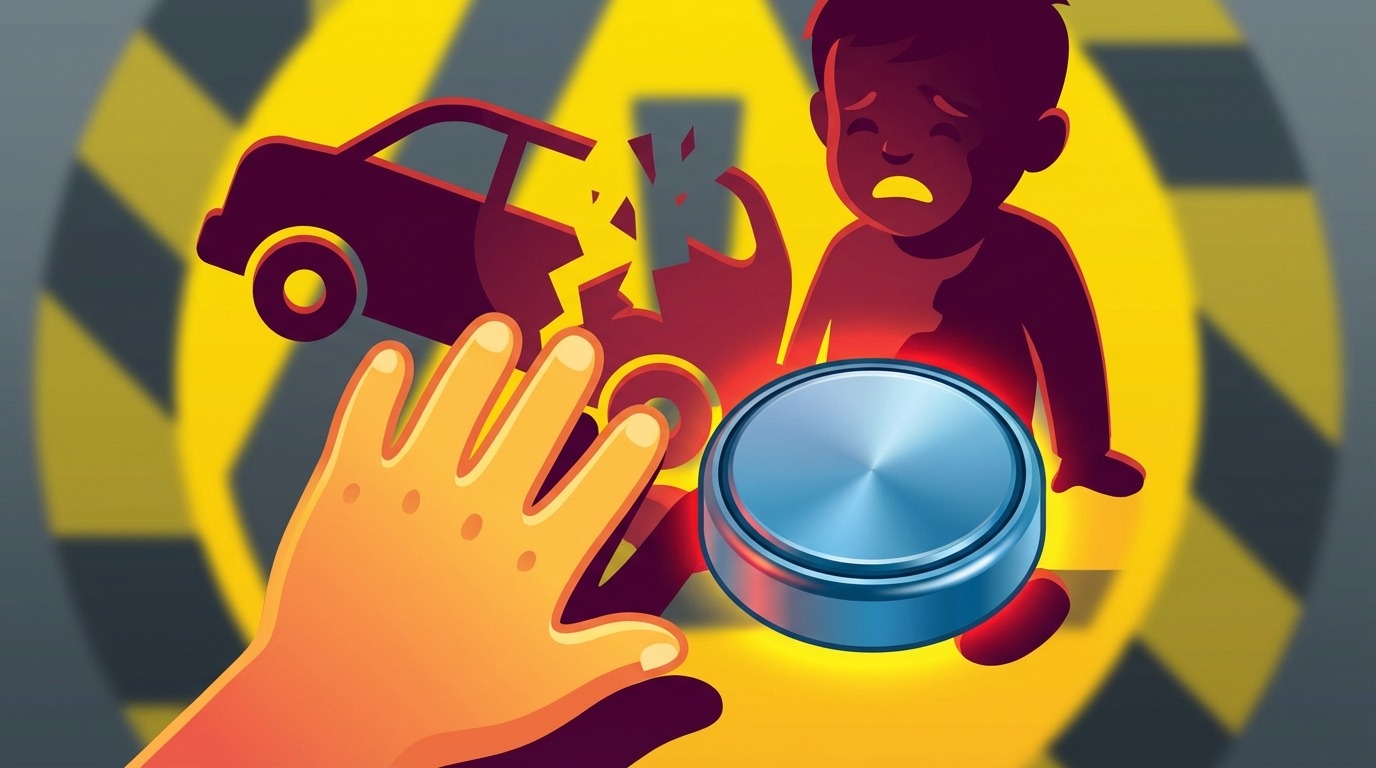
Sources of accidental ingestion are not limited to toys. Certainly, the latter comply with strict standards regarding battery inaccessibility. However, many objects not intended for children escape these constraints. Remote controls, scales, watches, LED candles, car keys: the button battery hides quietly inside.
On a couch, a cracked flap opens under the pressure of a cushion. On the floor, a used battery falls during a quick replacement and goes unnoticed. These common scenarios are enough to trigger a domestic accident. Good practice is to check every compartment after use and throw used batteries into a closed container before recycling.
Packaging: what inspections reveal
The issue of packaging is not trivial. A survey conducted in 2023 highlighted major shortcomings. Of 21 products tested, 14 showed insufficient resistance. Among 81 establishments checked, 13 had shortcomings in information regarding danger. Simply put, access to this energetic pill remains too easy for curious small hands.
Facing these findings, favoring blister packs truly resistant to children becomes crucial. A simple test applies when buying: does the container open without scissors? If it gives way with a slight fold, the risk of manipulation by a child increases.
Mapping risk areas in the home
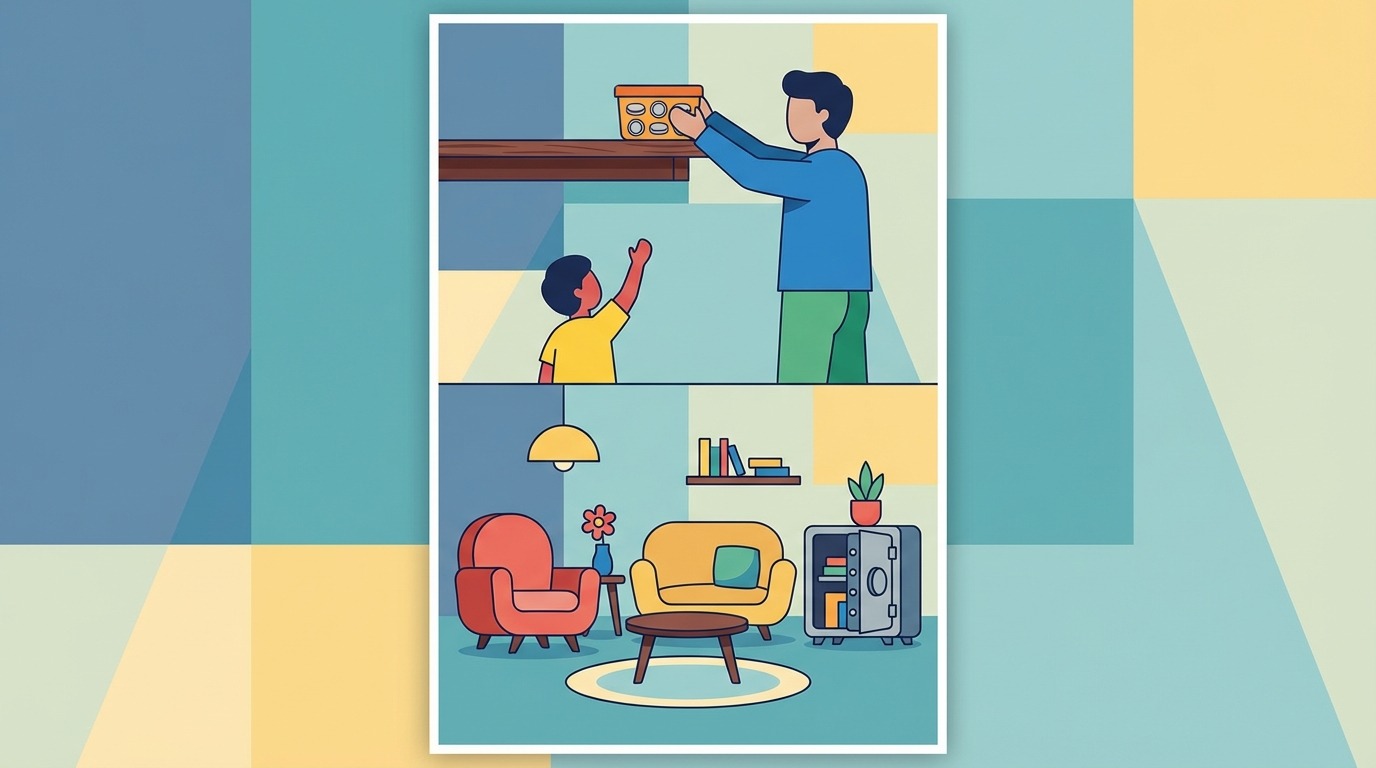
The living room concentrates remote controls and LED candles. The kitchen holds scales and timers. The child’s room may contain a battery-powered night light. Even the car is not neutral with keys and trackers. A weekly control route helps anticipate. In practice, a closed basket placed high up centralizes new and used batteries.
To reinforce these reflexes, clear and practical child safety tips help structure the approach. When buying, aim for devices with a screw compartment, or requiring two independent maneuvers, shutting the door on risky exploration.
Toys and gifts: buying better
Holidays and birthdays multiply luminous and sound objects. Yet, a poorly designed toy can expose unnecessarily. To sort effectively, referring to reliable benchmarks and learning to read instructions proves valuable. This reading guides toward better-secured and age-appropriate devices.
Before confirming a purchase, it is useful to consult resources on how to choose a safe toy. Vigilance at this stage prevents makeshift repairs and fragile flaps. Ultimately, the initial decision weighs heavily in the balance of prevention.
Daily, a simple promise guides each action: if an object contains a button battery, then it must be thought of as potentially dangerous for a child.
Active daily prevention: routines, checklists, and battery-free alternatives
The best strategy combines organization and repetition. A weekly routine reduces exposure. High and closed storage becomes an effective barrier. Then, labeling “New batteries / Used batteries” avoids confusion and limits unnecessary handling.
Young children’s development amplifies curiosity. Between 31 and 36 months, the desire to explore accelerates. This phase invites rearranging the environment. Concrete points around curiosity between 31 and 36 months shed light on typical behaviors and help anticipate.
The rule of 3 actions
Three reflexes form a daily shield. First, check battery compartments every week. Then, lock with a screw or reinforced tape while awaiting a permanent repair. Finally, keep away every small battery, even used, in a closed container and out of reach.
Prevention checklist to stick near the workspace
- 🔒 Screw compartment: demand this standard when buying
- 📦 High storage: closed boxes for new and used batteries
- 🧰 Repair cracked flaps as soon as possible, replace if needed
- 🧽 Weekly check of living room, kitchen, bedroom, car
- 🎁 Inspect gifts that are luminous or musical before giving
- 🚮 Recycle used batteries without leaving them around
- 📞 Post 15 and poison control center numbers visible for everyone
Battery-free activities that really engage
Batteries-free alternatives reduce the risk while nurturing creativity. Symbolic play, building blocks, or movement courses keep children occupied for a long time. On rainy days, simple ideas last without batteries or unnecessary screens.
For example, suggestions of indoor games for 1 to 3 years old offer playful and safe scenarios. A cardboard house built together, inspired by this type of cardboard house DIY, becomes an adventure ground. At the same time, strengthening intellectual development without batteries excludes neither pleasure nor autonomy.
These habits, enthusiastically supported by caregivers, weave a robust safety net. And if a relative watches the child, passing on this guide ensures continuity.
Watching a concise resource or a demonstration often helps anchor these automatisms, especially for people less comfortable with first aid.
Ingesting a button battery: emergency protocol minute by minute and signs to watch
When doubt arises, every minute counts. The first action is to call 15 or a poison control center. During the call, prepare the suspected packaging or object. This element helps quickly identify the size and type, which directs medical care.
Then, a red line applies: do not give anything to drink or eat. Also, do not induce vomiting. These actions are contraindicated and do not stop the caustic reaction. Instead, reassure the child and keep them sitting to limit discomfort and the risk of aspiration.
Which symptoms should alert immediately?
A child may present excessive salivation, difficulty swallowing, unusual cough, chest or abdominal pain, or a sudden refusal to eat. Sometimes, the signs resemble a simple ENT infection. This mimicry delays calling for help, while the two-hour window is critical.
If a presentation suggests a cold—for example a stuffy nose or a cough—but occurs right after a metallic noise or handling a remote control, it is better to suspect the battery. In this doubt, an X-ray will settle the matter.
At the emergency department: what actually happens
After the call, referral to emergency is without delay. The team quickly performs imaging to locate the battery. If it is in the esophagus, endoscopic removal takes place as soon as possible. The longer the battery stays in place, the worse the lesion becomes.
After removal, monitoring is necessary to detect any late complications. Even quick action can leave marks. The body needs time to heal, which requires appropriate follow-up.
Documenting for better care
Bringing the packaging, specifying the presumed time of accidental ingestion, describing signs, and reporting any treatments help medical staff. These details speed up differential diagnosis and optimize strategy.
Finally, upon returning home, securing all involved equipment avoids recurrence. Repairing or replacing the responsible object closes the breach in daily life.
Reviewing the key steps calmly allows caregivers to integrate good automatisms and act without hesitation at the next doubt.
Buying better, training the circle, acting together: the winning strategy against domestic accidents
Lasting protection relies on three levers: safe equipment, trained adults, shared messages. Every purchase becomes a vote for responsible design. Choosing a product with a screwed battery compartment encourages manufacturers to maintain this standard. An email to customer service, a public review, or a report in-store: these gestures push the market in the right direction.
The packaging aspect also deserves ongoing attention. Results from 2023 showed clear shortcomings, with 14/21 blister packs too easy to open. Strengthening parental demands changes the game. Eventually, the normalization of genuinely secure blister packs will significantly reduce children’s exposure.
Training relatives and professionals
Grandparents, nannies, babysitters, teenage siblings: everyone must know the right reflexes. A memo near the phone, displayed numbers, and a quick demonstration of battery flaps are enough to align practices. In childcare settings, integrating regular toy and device checks into internal protocols secures heterogeneous age groups.
To complete this network, resources such as complementary child safety advice guide families. Professionals can draw inspiration to lead short workshops with parents and spread the right messages.
Report, recycle, replace
A device with an unstable flap should be set aside then repaired or discarded. Used batteries are recycled through dedicated channels, but the collection container must remain closed and out of reach. Reporting to store or merchant websites when packaging opens too easily provides valuable field feedback.
Finally, communicating with relatives transforms individual experience into a common good. Telling the story of Théo, 3 years old, who tried to open a night light during a nap, can be enough to change habits around. A vigilant community protects better than isolated monitoring.
The guiding thread of prevention
Consistency, more than perfection, seals success. Repeating right actions, checking weaknesses, buying better, and sharing around truly reduces the risk. Every screwed flap, every battery set aside, every message passed builds an extra barrier between the child and the danger.
In the end, the safety chain holds thanks to daily links: choice at purchase, control routine, educating the circle, and immediate call when in doubt.
What are the first signs of button battery ingestion?
Excessive salivation, difficulty swallowing, unusual cough, chest or abdominal pain, sudden refusal to eat. Sometimes, the child just seems grumpy. At the slightest doubt, call 15 or a poison control center.
Should something to drink or eat be given to “make it pass”?
No. Do not give anything to drink or eat and do not induce vomiting. These actions do not stop the caustic reaction. Contact emergency services immediately and prepare the packaging or device concerned.
How to reduce the risk at home?
Choose devices with a screw compartment, store batteries (new and used) high up in a closed box, check flaps each week, inspect luminous gifts, recycle without leaving batteries lying around, and display emergency numbers.
Are toys safer than other objects?
Overall yes, as they comply with strict requirements. However, remote controls, car keys, LED candles, and scales escape these standards. Checking and securing them remains essential.
What to do after hospital removal?
Follow medical recommendations, monitor for signs of pain, bleeding or fever, and immediately secure involved objects to prevent recurrence. Follow-up may be necessary depending on lesion severity.
“Tiny in size, the button battery becomes giant in risk: a quick action saves what the moment neglects.”