Child Sunscreen: Sun and sunscreen: protecting the child.
| Short on time? Here’s the essentials ⏱️ |
|---|
| Broad-spectrum SPF 50+ for any children’s sunscreen 👶🧴 |
| Priority to covering clothing, hat, and sunglasses 😎 |
| Reapply every 2 hours and after each swim 🌊 |
| Avoid sun exposure between 11 a.m. and 4 p.m. ☀️ |
| Prefer mineral filters for sensitive skin of little ones 🛡️ |
| Never “total protection”: aim for sunburn prevention ✅ |
Between beach cravings, park games, and daily trips, a child’s skin encounters more intense rays than it seems. The children’s UV do not spare cloudy days nor minutes spent behind glass. The good news lies in a simple, coherent, and repeatable strategy. It combines a suitable sunscreen, smart clothing, and clever habits.
Families seek concrete and current guidelines. Sun care evolves in 2026, with better-tolerated formulas and more practical formats. Yet, the fundamentals always hold. A high protection factor, generous application, and regular timing truly protect. The goal is not to stress but to equip. Every outing then becomes an opportunity to learn, anticipate, and enjoy the sun without worries.
Children’s sunscreen and UV: understanding sensitive skin to act better
Nothing replaces knowledge of the mechanisms. UVB burns quickly and causes sunburn. UVA penetrates deeper and silently damages cells. For an immature child’s skin, these aggressions accumulate effects over summers, hence a sun protection without compromise from the first sunny days.
Baby skin contains less melanin. It dehydrates faster and reacts more strongly. Unlike adults, a single erythema leaves a lasting mark. This explains why a high protection factor is essential and why clothing remains the first barrier.
Why sensitive skin requires strict boundaries
The hydrolipidic film stabilizes with age. Before that, it poorly filters aggressions. A light wind, warm sand, or salty water suffice to worsen damage. A wide-brimmed hat and anti-UV t-shirt immediately reduce the risk. Children’s sunscreen completes these measures on uncovered areas.
An example often speaks better. Leo, 4 years old, plays for twenty minutes in the park late morning. The sky is overcast. Without protection, his shoulders redden in the evening. With a covering t-shirt, SPF 50+ sunscreen on his forearms, and a cap, the same session causes no issues. The gesture changes everything.
SPF, UVA, UVB: reading the label without mistakes
SPF indicates protection against UVB. A 50+ means high protection but does not promise invulnerability. The circled UVA logo guarantees a balance against UVA. This is essential as these rays pass through clouds and glass. They strike in the city, at school, and during daily trips.
The mention “total screen” is obsolete. No product blocks 100% of rays. Instead, a layering approach is adopted. Clothing, shade, generous sun care, and smart timing make for a winning and peaceful strategy.
The calendar also matters. Before 6 months, avoid sun exposure. After, caution remains with short outings and constant shade. Between 11 a.m. and 4 p.m., games are rearranged. Indoor educational-fun activities replace the blazing beach advantageously.
Finally, urban context does not offer a protective bubble. Reflection on facades and windows intensifies radiation. Vigilance follows the child everywhere, with simple and easy-to-repeat gestures.
Ultimately, understanding UV prevents bad surprises and guides concrete choices, supported in the next section.
Choosing children’s sunscreen: mineral filters, formats, and useful labels
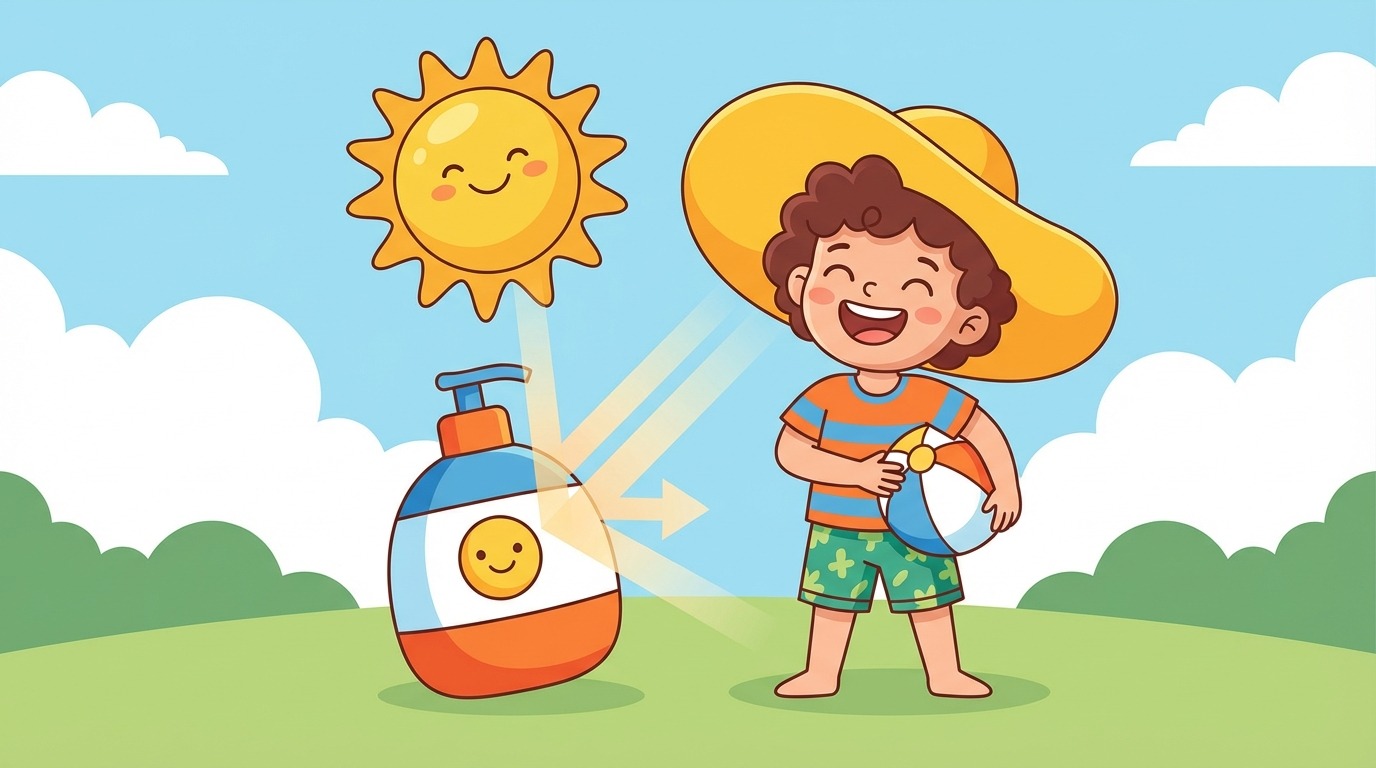
The big question often concerns filters. Mineral formulas (titanium dioxide and non-nano zinc oxide) act like mirrors. They reflect part of the rays and are well suited for reactive skin. Organic filters absorb UV energy and transform it. Some molecules remain debated for the youngest.
For a little one, caution steers toward a mineral sunscreen, especially in case of eczema or allergic history. A cream or lotion texture eases visible application. This “white veil” reassures, signaling well-covered areas. A very fine mist protects less if underdosed or dispersed by wind.
Labels, fragrances, and INCI lists: read without panic
Organic labels interest some families. They impose clear requirements and often remove fragrances. This reduces irritation risk, especially on sensitive skin. However, a label does not replace a localized test on the forearm the day before a big outing.
An unscented, alcohol-free children’s product limits tingling on the face. Next, look for the “water-resistant” mention. It reassures for swimming but does not cancel reapplication. After each dive, rinse with clear water, dry by patting, then apply a generous layer again.
Smart formats and shelf life
The large tube suits large families. A small format slips into a school backpack. Quantity matters as much as composition. Half a teaspoon for the face, and a walnut-sized amount per forearm, provide a simple reference. An opened product is not kept year to year if smell or texture changes.
The “adult” formula can sometimes help. However, fragrances or certain filters might irritate a small face. Better keep a dedicated tube and explain this to relatives, grandparents, and daycare teams.
- 🧴 Favor a broad-spectrum SPF 50+ UVA/UVB
- 🛡️ Choose a mineral base for the youngest
- 🌊 Check the “water-resistant” mention and reapply often
- 👃 Avoid fragrance and alcohol on face and hands
- ♻️ Check PAO and smell before the season
To visualize the proper gestures, a video demonstration helps a lot, especially at the first attempts on the beach or in the park.
Beyond the product, preparing the day matters. Plan shadow games and fresh water breaks to ease everything. And if going outside in the heat is necessary, full gear largely compensates. The next section details the winning routine.
Anti-UV routine: application, smart timing, and sunburn prevention
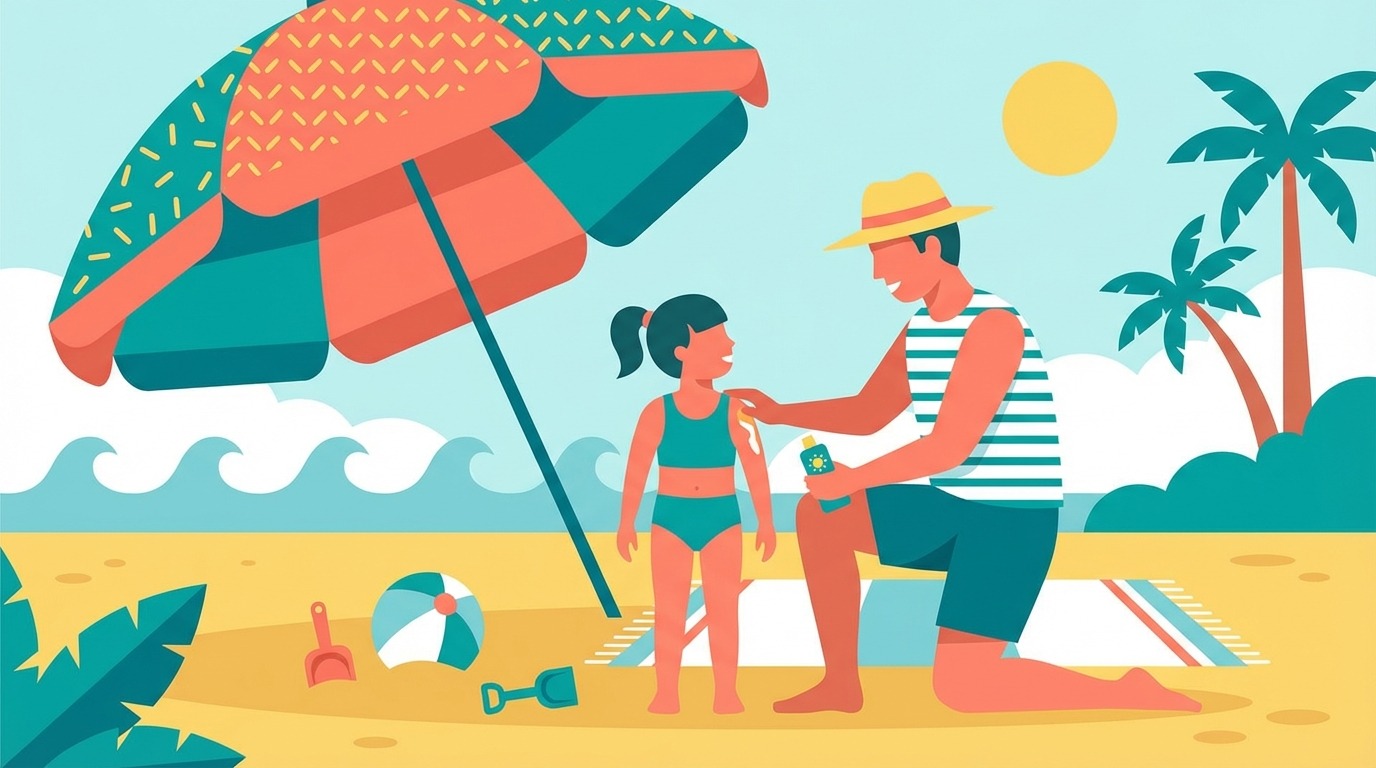
A successful sun protection starts before stepping outside. Fifteen minutes beforehand, apply children’s sunscreen on dry skin. Cover ears, neck, back of hands, and tops of feet. These zones are often forgotten yet highly exposed.
Quantity makes the difference. The two-finger rule for the face works well. For the body, think in “zones” to not miss any. Repeat after bathing, even if the “water resistant” mention is on the label. A towel rubbing removes a good part of the protective film.
Timings dictate much serenity. Between 11 a.m. and 4 p.m., arrange differently. You can offer indoor educational-fun activities, and keep the beach for early morning or late afternoon. Parasols and trees make the heat bearable but do not stop UVA. Sunscreen remains essential.
Park outings require specific attention. Metal structures heat quickly. Slides expose the neck and back of knees. Families benefit from knowing the rules for playgrounds to secure routes and anticipate available shade. A water mister soothes red cheeks as well.
Free play in the garden becomes a great ally. To learn autonomy, it’s best to let baby play outside during gentle hours, with a stable shaded spot. Set up a hut, some books, and reinforce the hat-sunglasses-sunscreen ritual. This repetition turns prevention into reflex.
Hydration and micro-breaks complete the whole. Frequent fresh water, water-rich fruits, and a dry t-shirt after swimming make a difference. In the car, stay vigilant as glass does not block all UVA.
This trio — sufficient quantity, smart timing, and reapplication — drastically reduces risk. It makes sunburn prevention simple and motivating for the whole family.
Risk situations: city, mountains, water, and daily trips
The mountains multiply the UV dose due to altitude. Snow strongly reflects light. Eye masks and high collars protect as much as sunscreen. Don’t forget lips, as they dry quickly in cold and sun.
At the sea, water reflects and disperses rays. Anti-UV lycra and a covering bucket hat reduce the energy received by skin. Shade is set near water, but keep children’s sunscreen handy after every exit from the bath.
The city often deceives. Light sidewalks and shop windows multiply reflections. Shade moves and surprises at school dismissal time. Instead of improvising, prepare a small solar kit in the bag, with a travel tube, sunglasses, and a cap.
In the car, UVA penetrate the windows. Prefer effective sunshades and learn to travel with children by car serenely. Regular stops allow sunscreen reapplication and airing the cabin. Absolutely avoid waiting in a vehicle in the sun.
Pollution enhances some radiation effects. Ozone- or particle-loaded air weakens the skin barrier. Better get local info and protect a child from air quality by adjusting outing time. Film-forming creams then help isolate skin.
Group outings require a simple protocol. Schools, daycares, and associations can rely on young children’s care modes to harmonize practices. Parental authorization, common kit, and time reminders help teams act quickly and well.
| UV Index 🌡️ | Immediate Actions 🛡️ | Observations 👀 |
|---|---|---|
| 0-2 | Hat and SPF 50+ on uncovered areas | UVA present even on cloudy days |
| 3-5 | Anti-UV clothing + reapplication every 2 h | Shade strongly recommended |
| 6-7 | Avoid 11 a.m. – 4 p.m., regular hydration breaks | Risk of fast redness ⚠️ |
| 8+ | Very short outings, complete gear | Double layer of sun care after swimming |
Anticipating these contexts transforms the day. Keep a light spirit, as the action plan leaves nothing to chance.
Unexpected events, sun education, and coordination with responsible adults
Still, heatstroke can occur. Rinse the skin with fresh water, hydrate, and apply a soothing emulsion. Avoid essential oils and scented products. If blisters appear or the child becomes drowsy, consult immediately.
Allergic reactions to a product exist. A test before the big outing reassures. In case of eczema, a simple mineral filter and fragrance-free base often work wonders. Extras like a sterile sprayer help calm plaques after returning from the beach.
Sun education starts early. A sung ritual at sunscreen time entertains the youngest. A timer turns reapplication into a little challenge. Assign the big one sunglasses duty, the little one the hat. This involvement strengthens the whole sibling group’s adherence.
Coordination with adults caring for the child is decisive. Families clarify the difference between nanny and childcare assistant and share a common “sun” sheet. In home childcare, store sunscreen at the entrance and check application time. Everyone gains serenity.
Storage matters. A tube stays in the shade, closed, far from the hot glove box. Expiry date and “sniff test” prevent bad surprises. A rancid or off product no longer protects properly.
The environment also deserves attention. Recent formulas limit some controversial filters. Quickly rinse hands before picking up live shells. Favor protected swimming areas and educate about nature as much as protection.
In the end, a clear, shared, and enthusiastic strategy anchors lasting reflexes. The skin flourishes, and summer memories do too.
“Protecting today is offering tomorrow’s skin a tailored sun.”
{“@context”:”https://schema.org”,”@type”:”FAQPage”,”mainEntity”:[{“@type”:”Question”,”name”:”Quelle quantitu00e9 de cru00e8me solaire enfant appliquer au visage ?”,”acceptedAnswer”:{“@type”:”Answer”,”text”:”La ru00e8gle simple: deux lignes de produit sur lu2019index et le majeur. On u00e9tale sur le visage, les oreilles et le cou. Pour le corps, on pense en zones et on ru00e9applique toutes les deux heures et apru00e8s chaque baignade.”}},{“@type”:”Question”,”name”:”Mineral ou organique: que choisir pour une peau sensible ?”,”acceptedAnswer”:{“@type”:”Answer”,”text”:”Les filtres minu00e9raux non nano conviennent tru00e8s bien aux peaux ru00e9actives des petits. Ils reflu00e8tent une partie des UV et contiennent moins du2019additifs odorants. Un test localisu00e9 la veille du2019une longue sortie reste recommandu00e9.”}},{“@type”:”Question”,”name”:”Faut-il remettre de la cru00e8me si elle est u2018ru00e9sistante u00e0 lu2019eauu2019 ?”,”acceptedAnswer”:{“@type”:”Answer”,”text”:”Oui. La serviette, le sable et lu2019eau ru00e9duisent le film protecteur. On su00e8che en tamponnant puis on ru00e9applique une couche gu00e9nu00e9reuse apru00e8s chaque baignade ou forte transpiration.”}},{“@type”:”Question”,”name”:”Comment organiser les sorties aux heures chaudes ?”,”acceptedAnswer”:{“@type”:”Answer”,”text”:”On u00e9vite 11 h-16 h, on privilu00e9gie lu2019ombre et on adapte lu2019activitu00e9. Les jeux calmes, la lecture et la sieste remplacent les courses au soleil. Des horaires matin et fin du2019apru00e8s-midi simplifient fortement la pru00e9vention.”}}]}Quelle quantité de crème solaire enfant appliquer au visage ?
The simple rule: two lines of product on the index and middle fingers. Spread on the face, ears, and neck. For the body, think in zones and reapply every two hours and after each swim.
Mineral or organic: which to choose for sensitive skin?
Non-nano mineral filters suit very well the reactive skin of little ones. They reflect part of the UV and contain fewer fragrance additives. A localized test the day before a long outing is still recommended.
Should you reapply sunscreen if it is ‘water-resistant’?
Yes. Towels, sand, and water reduce the protective film. Pat dry then reapply a generous layer after each swim or heavy sweating.
How to organize outings during hot hours?
Avoid 11 a.m. to 4 p.m., favor shade, and adapt activities. Calm games, reading, and naps replace running in the sun. Morning and late afternoon schedules greatly simplify prevention.