Video Baby Activities: Games and activities to stimulate baby.
| Short on time? Here’s the essentials 🚀 |
|---|
| 🎯 Vary short baby activities each day to nurture sensory awakening and fine motor skills. |
| 🧠 Educational games act as micro-workouts for the brain and body, from baby 0-12 months. |
| 👀 Black/white then primaries: strong contrasts boost visual attention before age 2. |
| 👋 Baby signs unlock early communication and soothe frustration. |
| 🧺 Sensory baskets, mini-worlds, ribbon boxes: simple, safe, and adaptable ideas 🧩. |
| 🏡 An exploration space designed for parents and baby guarantees safety and autonomy. |
| 🎵 Rhythms, voices, nursery rhymes + objects to manipulate = winning combo for baby development. |
| 🎥 A video guides adults, but real experience remains the best baby stimulation. |
Newborns learn with blazing intensity. Every touch, every contrast, every sound organizes the brain like an awakening orchestra. To channel this energy, simple and progressive baby games transform the home into a discovery ground. The secret is not to do more, but to do right: offer short, varied experiences adapted to the age, then observe signals of pleasure, fatigue, or curiosity. Within this framework, educational games and “step-by-step” formats in video help adults structure their ideas while keeping the essentials in the little one’s hands.
For a baby 0-12 months, a clear plan reassures. Edible mini-worlds, discovery baskets, a multisensory “little hut,” practical life trays, an activity wall, or even baby sign language make up a complete toolkit. Each idea aims at global baby stimulation, marrying fine motor skills, perception, and emotion. The challenge is twofold: strengthen the quality of parent and baby interaction and create an environment that invites the child to try, fail, retry, then succeed. Now to concrete and reasoned benchmarks to get started today.
Baby activity video and sensory awakening 0-12 months: frameworks, benchmarks and good practices
Before launching dozens of ideas, it is vital to mark out the ground. An infant cannot handle overload. They react better to short, targeted, repeated proposals. This guidance avoids dispersion and establishes a solid routine for sensory awakening. The key lies in a simple sequence: propose, observe, name, stop when signs of satiety appear. This loop nurtures the child’s confidence and clarifies the adult’s role.
In this respect, video plays an ally role for the adult. It offers concrete “step-by-step” guides and age benchmarks. However, the screen never replaces tactile, olfactory, and motor experience. It guides the preparation of a session and brings fresh ideas. Then hands and senses take over. This articulation avoids the pitfall of screen time unsuitable for baby 0-12 months.
Age by age: windows of opportunity to seize
From 0 to 3 months, strong contrast captures attention. Black and white mobiles, a melodious voice, and a soft texture suffice. Between 3 and 6 months, grasping strengthens. Soft sensory balls, fabric books, and textured mats multiply experiences. From 6 to 12 months, curiosity explodes: the child taps, pours, tastes, shakes, moves. It’s the perfect time for exploration bins, shape boxes, and secured water games.
A Parisian nursery measured the impact of a sensory path over six months. Textured mats, luminous objects, musical instruments, and manipulation bins were offered to a group. Result: better coordination, more social initiatives, and increased attention capacity to novelty. The experience confirms that regular sensory offerings energize baby development.
Safety framework and signals to read
Safety is built upstream. Objects must be non-toxic, clean, mouth-appropriate. The environment stays clear. The adult’s active presence frames without directing. Verbalization enriches the experience: name the texture, the color, the sound, then value the effort. Thus, educational games become emotional and cognitive springboards. They teach waiting, persevering, concentrating.
When pause signals appear, stop. A short quality moment is better than a long session that saturates the child. This strategy protects the pleasure of exploring, a cornerstone of durable baby stimulation.
In brief, success is built on three pillars: a simple framework, progressive activities, and fine observation. What follows details concrete implementations, ready to use.
Concrete sensory baby games: mini-worlds, discovery baskets and heuristic play
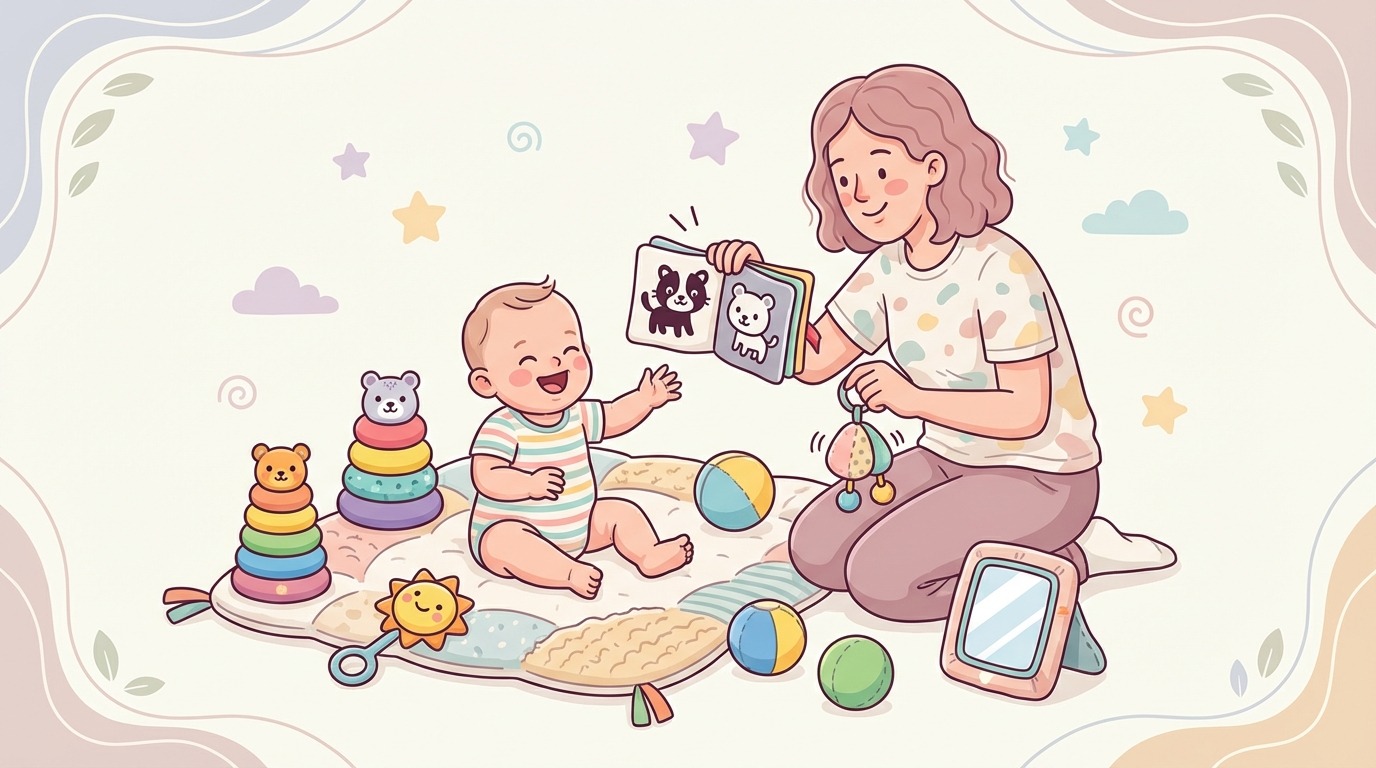
The mini-world is a miniature set that stages curiosity. A tray of fine sand with spoons, an “ice floe” with plain yogurt and edible ice cubes, or a “construction site” with large unmanageable pieces invite the little one to touch, smell, taste. The universe adapts to age. For the youngest, everything must be edible or bulky. After 12 months, pouring, funnels, soft tongs open up. This format transforms the house into a controlled adventure playground.
Discovery baskets, from six months, gather simple and safe objects. Polished wood, sponges, soft brushes, wide ribbons, textured balls. The goal is to awaken the hand and mouth, major entry doors for touch development. To deepen this theme, a clear article explains how skin perceptions progress and what they imply for play. Read here: touch development 🖐️.
Heuristic play: freely experimenting and understanding the world
Heuristic play is aimed especially at 6-24 months. It offers everyday objects organized in families: rings, boxes, lids, spoons, fabric scraps. The adult prepares, stays present, does not intervene. The child tests, combines, overturns, stacks. This methodical freedom establishes trial-and-error loops. It builds gesture intelligence, coordination, and confidence.
To vary proposals and support desires, a reservoir of updated ideas on multi-sensory supports is useful. This resource compiles many leads to evolve sessions according to age and current interest: sensory activity ideas 🌈.
- 🧺 Thematic baskets: wood, metal, fabrics, sound objects.
- 🍽️ “Kitchen” mini-world: whisks, light bowls, plastic sieves.
- ❄️ “Ice floe” mini-world: yogurt, ice cubes, wide spoons.
- 🌧️ Sensory bottles: colored water, glitter, oil.
- 🎶 Small sound boxes: rice, lentils, semolina well sealed.
Each choice has a purpose. Raw textures expand the tactile palette. Varied sounds guide listening. Bulky volumes encourage broad gestures, while small containers guide fine motor skills. This progression avoids skipping steps and prevents frustration.
Hygiene remains crucial: sensory games often go into the mouth. It’s better to favor washable materials and clean quickly after the activity. A simple routine secures the whole without cutting the exploration momentum.
In summary, mini-worlds, baskets, and heuristic play form a powerful trio. They install quickly, cost little, and adapt to the child’s pace. Exactly what’s needed for a rich and joyful awakening.
Fine motor skills and practical life: Montessori trays, ribbon box and first pouring activities
Fine motor skills build with useful, repeated gestures. Practical life trays, inspired by Montessori, focus on actions rooted in daily life. Wiping a small table, pouring semolina, opening and closing a box, passing a ribbon through a hole. These tasks, modest in appearance, sharpen the pincer, dose effort, synchronize eye and hand. They serve tomorrow to eat alone, draw, dress.
An essential is the ribbon box. A cardboard pierced with holes lets broad ribbons pass through each side. The child pulls, pushes, pinches, pulls again. The activity stimulates wrist, fingers, bilateral coordination. It excites curiosity through back-and-forth motion. Soft objects of varied textures can be slipped in to renew interest. The whole remains economical and adaptable.
Pouring, screwing, nesting: a meaningful progression
Pouring begins with large spoons and stable containers. Seeds are avoided at first, too volatile. Cooked semolina, cooked pasta, or soft pom-poms work well. The child gains precision, learns to anticipate, to correct a gesture. Then, screw boxes and adapted lids are introduced. Aiming strengthens wrist rotation and concentration.
These exercises go well with gross motor times. Crawling, rolling, climbing, then sitting focused in front of a tray creates a complete attentional cycle. A useful guide details how body organization supports hand and eye. Consult here: gross motor skills 🧗.
To boost hand-eye coordination and anticipation, one can also play with a ball between 6 and 12 months. Gently rolling the ball toward the child, then encouraging them to roll it back, triggers loops of visual pursuit and beneficial floor support. The exercise is done simply, on a mat, remaining watchful of the object’s size.
Winning rituals for smooth sessions:
- ⏱️ Short sessions (5-8 minutes), then break.
- 🧽 Clean material, defined tray, one goal at a time.
- 🗣️ Simple words to describe the gesture and value the effort.
- 🔁 Same activity repeated over several days to consolidate.
These habits anchor progress and strengthen the pleasure of succeeding. In the long term, they lay solid foundations for tracing, gluing, then writing.
In the end, the interest of the trays lies in their daily usefulness. The child discovers that their gestures have a real impact. This grounding motivates, reassures, and helps them grow.
Contrasts, activity walls and multisensory hut: setting up an effective awakening space
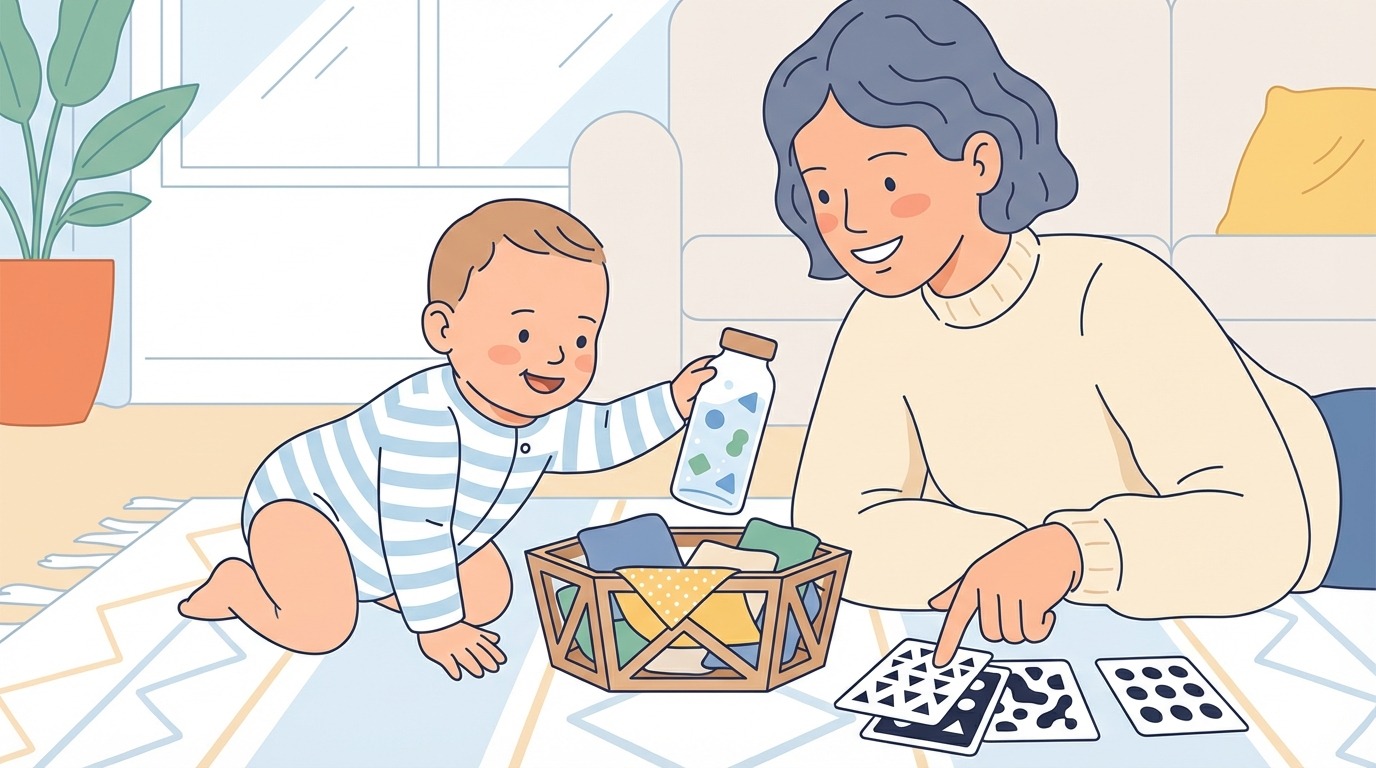
The infant’s sight builds step by step. Before age 2, simple shapes and contrasting colors best mobilize attention. Black/white cards, then geometric patterns in primary colors, placed at eye level, become observation targets. They trigger eye tracking and fixation. They also soothe, as the child quickly finds their favorite visual landmarks.
The “multisensory hut,” inspired by active approaches, creates a cocoon both reassuring and stimulating. Hanging objects, surfaces to touch, some soft sound elements, and a small acoustics that invite vocalizing transform a simple reinforced cardboard into a sensory laboratory. Partially slipping inside concentrates attention. The child even discovers their own voice thanks to the echo.
The activity wall: exploring vertically
Wall play introduces a new dimension. Vertically, gestures change: pulling, pushing, sliding, turning, with standing or kneeling support. The tactile, visual, and sound variety supports global coordination. This station also fosters postural endurance and balance. It prepares walking by giving meaning to pushes and rotations.
The Nido, a floor area dedicated to 3-16 months, complements the whole. Shatterproof mirror, firm mat, stable frames, simple baskets. Everything is within reach, nothing is excessive. The space invites freedom but imposes a clear frame. Time alternates on the back, side, then belly to strengthen neck and back. Each element has a reason to be, never a superfluous decoration.
Before any installation, a checklist reassures:
- 🧷 No small detachable parts.
- 🧴 Non-toxic materials, easy to clean.
- 🧱 Stable structures, no sharp angles.
- 🌡️ Soft temperature and light, without flickering.
Such a space simplifies adults’ lives. It frames explorations, reduces repeated “no”s, and values thoughtful “yes”es. The child gains a clear territory to climb, touch, listen, observe. The quality of presence improves. It is devoted to support rather than risk management.
Carefully designed, the environment becomes a partner. It naturally guides attention, stretches autonomous play time, and multiplies learning opportunities without overload. It is an investment that pays daily.
Language, music and signs: educational games for early and joyful communication
Language is rooted in the body. Tonic postures, breath, rhythm, listening, gaze. Educational games that blend music, nursery rhymes, and gestures provide concrete supports for future speech. Beating a rhythm on a soft tambourine, vocalizing in a little hut, playing “peekaboo” behind a fabric build powerful attention and social circuits.
Baby sign language accelerates this dynamic. A few key signs – more, drink, sleep, finish – reduce frustration cries. They open a bridge before words arrive. Routines are simple: repeat the sign simultaneously with the word, in coherent contexts, without demanding an immediate response. Then celebrate each attempt.
For further concrete benchmarks, this guide gives practical ideas to help baby develop language. Examples show how to rhythm the day with spoken and signed micro-rituals. They settle in without pressure and strengthen the affective bond.
Sensor tubes also offer a precious calm time. Colored water, glitter, floating beads. The child observes, follows with the eyes, shakes gently. The breathing slows. It’s perfect for calming down after a more energetic activity. This simple tool feeds visual attention and emotional regulation.
The awakening hoop provides a floor exploration area. On the back, the arranged objects encourage reaching out. On the belly, they invite pivoting, crawling, then climbing. These micro-challenges strengthen the shoulder girdle, a bodily base useful for breathing and phonation. The body prepares the voice.
To complete the arsenal, daily “music moments” are set up. A few minutes suffice. A soft song upon waking, percussion at noon, a lullaby in the evening. The alternation fast/slow, loud/soft, high/low, educates the ear and regulation. Eye-voice-gesture exchanges weave a founding complicity between parents and baby.
Finally, an activity with a soft ball stimulates motor skills, coordination and turn-taking. For adapted ideas, this guide details simple and safe games to play with a ball between 6 and 12 months ⚽. The ball’s back and forth leads the child to anticipate, point, vocalize, then wait their turn. All useful building blocks for language and socialization.
The winning trio is clear: music, signs, and small motor challenges. Together, they nourish a lively, pleasant, and deeply structuring communication for baby development.
Video resources to inspire without overstimulating
Watching a short demo before the session reassures and gives ideas. The challenge remains to turn off the screen at playtime. Here is a useful search to find step-by-step formats and safe ideas at home. Then head to reality, with hands and senses.
The right compass is simple: quality content for adults, a rich real environment for the child. The combination works wonders without overloading daily life.
Memory aid table: quick routines to slip into the day
| Routine idea ⚡ |
|---|
| Morning: contrasting cards 2 minutes + rhythmic nursery rhyme 🎵 |
| Late morning: texture basket + 3 new words 🧺 |
| Afternoon: gentle pouring 5 minutes 🥣 |
| End of day: sensory tube to soothe ✨ |
| Before bed: two repeated key signs 👋 |
“Every little routine repeats a strong message: you can, you learn, and we move forward together.”
How long should a baby awakening activity last for a 0-12 month old?
Short and frequent sessions are better. Between 3 and 8 minutes often suffice, with breaks as soon as signs of fatigue appear. Regularity counts more than duration.
What are the first activities to favor from birth?
Focus on visual contrasts, sung voice, skin-to-skin, soft textures, and very light rattles. These basics mobilize sight, hearing and touch without overstimulating.
How to secure homemade sensory games?
Choose non-toxic, bulky, washable materials, and check for the absence of small pieces. Install on a firm mat on the floor, and stay present to accompany without directing.
Why is baby sign language useful?
Signs offer a communication bridge before words. They reduce frustrations, strengthen joint attention and support spoken language development.
Should videos be used during play?
Videos serve as a memory aid for the adult before the session. During play, real experience and relationship take precedence. Turning off the screen to prioritize senses is the best option.
“From hands to voice, from gestures to gazes, every day writes a symphony of awakening.”