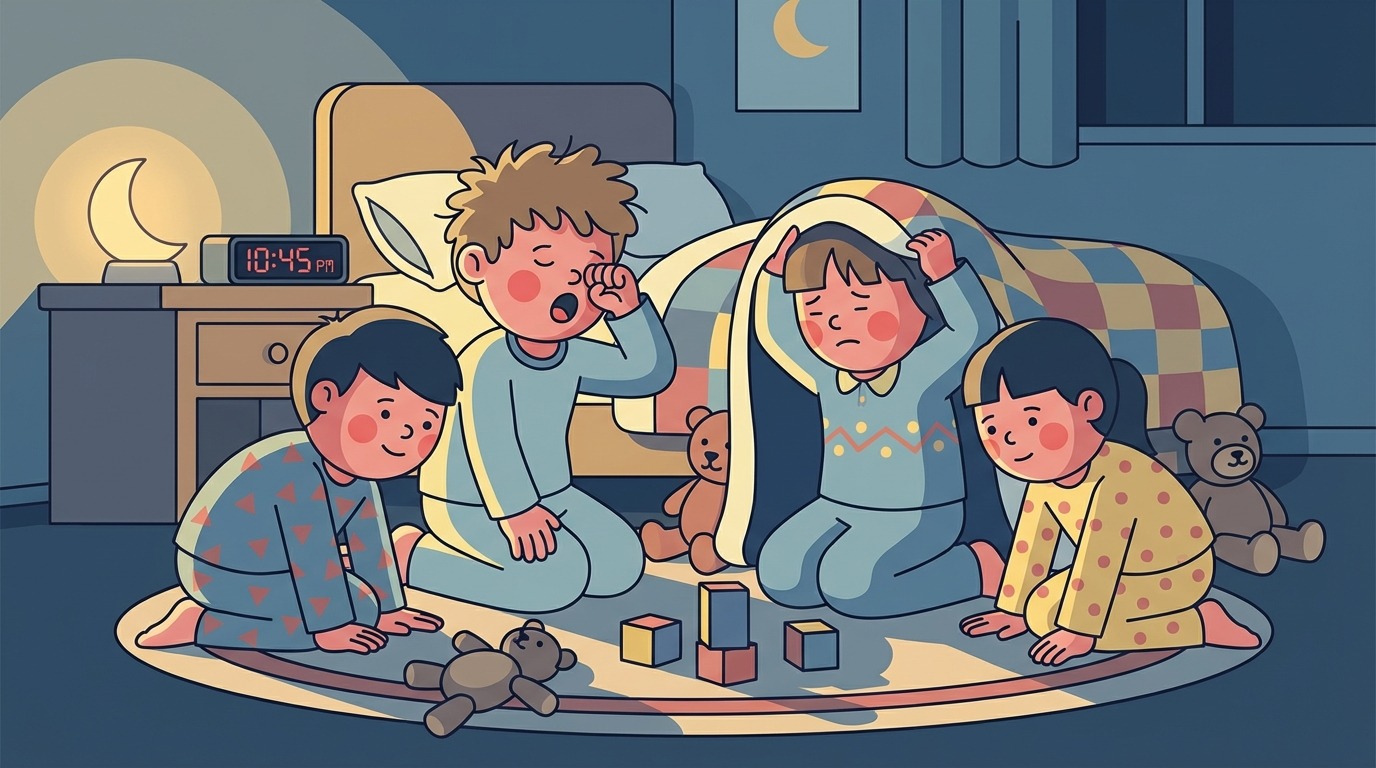
Children Embarrassed to Go to Bed: Chronicle: children embarrassed to stay up late and go to bed late.
Every evening, the scene repeats itself almost like a family chronicle: children embarrassed by the idea of leaving the living room, ready to stay up late, and adults torn between tenderness and fatigue. This bedtime theater is not just a simple whim. It reflects a precise dance between biology, habits, and daily constraints. Recent data shed light on this delicate moment: a regular schedule supports emotional regulation, while variable bedtimes promote impulsivity and agitation. Yet, many households juggle atypical schedules, sometimes until the middle of the night. A nuance then arises: regularity does not mean rigidity, but stable landmarks and predictable rituals. Sleep, especially at a young age, builds like a skill. It feeds on cues, coherence, and calm. Establishing a routine does not aim to take away freedom but to secure the brain in full maturation. And if this period sometimes seems exhausting, it remains a tremendous learning window.
| Short on time? Here’s the essentials ⚡ |
|---|
| 🕰️ Regular hours = better regulated emotions, less impulsivity. |
| 🌙 Staying up late disrupts the internal clock and concentration at school. |
| 🔁 A simple routine (meal, calm, bedtime) secures the developing brain. |
| 👪 Work constraints are part of life: aim for coherence, not perfection. |
| 🧩 Create bridge rituals (story, cuddle, soft light) to soothe children embarrassed at bedtime. |
Children embarrassed at bedtime: why staying up late disrupts sleep
Evening resistance is not just a matter of desire. It results from biological signals, accumulated excitement, but also family interactions. Children embarrassed at the idea of separating from the adult try to prolong contact through little tricks: a glass of water, an extra cuddle, a last-minute question. These gestures reflect a need for emotional security, especially when the day has been intense.
Science provides clear landmarks. A study published in 2024 followed groups of children with regular bedtimes and others with more variable ones. Children put to bed at a stable time, with less than 20 minutes difference, showed better control of emotions. Conversely, when bedtime fluctuated by one to two hours, impulsivity increased. Researchers validated these findings using wrist monitors and observations in frustrating situations.
Practically, these results confirm what many observe. When a child stays up too late, their wakefulness curve restarts. They seem full of energy, but it is a “second wind” linked to stress. Then, falling asleep becomes more difficult, the night becomes restless, and the next day brings more fatigue. Vicious circle: the less one sleeps, the harder it is to fight sleep.
In a life scene, imagine Éline, 4 years old, and her brother Noah, 7 years old. On Tuesday, the parents finish late. Dinner drags on, the screen stays on, and time flies. The next day, school becomes tiring, emotions overflow. By reestablishing the routine, even shortened, the atmosphere changes: soothing bath, short story, warm lights. Quickly, tension decreases, as do calls for reminders.
At the heart of the issue, there is a key notion: predictability. It does not imprison the child; it soothes them. Landmarks calm the brain’s vigilance and allow relaxation. The benefits are observed on mood, social interactions, and the ability to play autonomously. This stability also supports learning at school.
The next step is to transform these results into concrete actions. How to build a flexible, warm routine compatible with a busy daily life? The answer lies in structured bridge rituals, easy to duplicate, even when the evening goes off track. Underneath, a simple idea: better a short and constant routine than a perfect but unstable protocol. That opens the door to more peaceful nights.

Effective evening routine: turning habits into soothing landmarks
A routine works like a little end-of-day script, always in the same order. The child anticipates each step, which lowers tension. For it to hold in daily life, it must remain simple, short, and pleasant. A few decisions made in advance are enough to embed clear landmarks and reduce negotiation.
A sequence that reassures and soothes
A good sequence relies on three blocks: sensory transition, emotional connection, gradual reduction of stimulation. Practically: turn off screens at least an hour before, switch to a calm activity, share a cuddle moment, then reduce light and noises. The sleep signal becomes readable, like a lighthouse in the fog.
Creative supports help children embarrassed at bedtime to calm down. Ideas for adapted manual activities promote concentration and decrease agitation. A photo frame to decorate, a simple puzzle, or modeling clay in “heavy hands, slow movements” mode encourage self-regulation. The child no longer fights sleep but glides towards it.
Example of a realistic and replicable routine
- 🛁 Warm bath 10 minutes: slow down and relax the body.
- 📚 Short story: narrate and contain the day’s emotions.
- 🕯️ Warm light: prepare the internal clock.
- 🤝 Reminder of gentle rules: one last cuddle then bedtime.
- 💤 Light white noise: mask house sounds.
Bridge rituals can rely on simple playful supports. An inspiring path is found in concrete tools like the illustrated evening routine, which offers a reassuring thread and avoids repeated conflicts. When the image guides, speech can be lighter and more encouraging.
To solidify these habits, it is better to fix a stable bedtime and wake-up slot, including weekends. A short shift remains acceptable. Beyond that, the internal clock gets disrupted and falling asleep becomes complicated. In case of a late evening, keep the same structure but shorten each step. Coherence thus takes precedence over duration.
When opposition settles in, an emotional regulation tool proves useful. You can recap the day in three moments chosen by the child, then express a simple intention: “Tomorrow, you will show me how you fall asleep like a champion.” The goal reinforces skill, not constraint. With the more sensitive, a brief sensory practice calms the storm: breathing into the hands, foot massage, or stress ball.
Ultimately, a successful routine relies less on the setting than on pleasant repetition. It makes falling asleep more likely, even when energy rises. What matters is the regularity of a secure frame, not the ritual’s perfection.
When genetics and daily life intersect: “programmed” children to stay up late?
Some children seem naturally inclined to stay up late. Individual differences exist, and genetics contributes. Studies have identified a genetic variation that amplifies sensitivity to lack of sleep. In other words, some profiles would handle a shortened night more poorly. Should we be alarmed? Not necessarily, since the environment weighs heavily.
Chronobiology explains this heterogeneity. Chronotypes distribute on a continuum, from “early riser” to “night owl.” In children, this profile is not fixed and interacts with light, activity, and routines. A stable organization slowly reorients the internal clock. Parents then see their formerly resistant child slide more peacefully towards bedtime.
Work schedule constraints sometimes complicate presence at bedtime. In these cases, the lever is not the perfect hour but coherence. A referent adult can carry the ritual, even if the other returns late. Part of the scenario can also be delegated to a close one. The message matters more than the person: “You are safe, and the evening always goes this way.”
To harmonize practices between caregivers, resources exist. Early childhood professionals have tools and training to handle these rhythms. Drawing inspiration from dedicated content like early childhood-focused training helps build a common language. A shared framework makes bedtime more predictable, even in whirlwind weeks.
Separation emotions play a major role. A child who fears the night multiplies requests to delay the moment. This worry deserves to be named and contained. Targeted resources on separation anxiety offer concrete tools: courage scales, transitional objects, and social stories. These techniques give power back to the child and soothe the wait until morning.
And if the “late sleeper” profile persists, the strategy evolves: act on light, temperature, and physical activity during the day. Morning light exposure, time outside, and an active late afternoon bring the rhythm back to the right place. In parallel, reinforce evening signals: dim atmosphere, gentle rituals, and clear rules.
This approach recognizes differences without submitting to them. Children maintain a significant margin of plasticity. With an adjusted environment, even those inclined to stay up late eventually synchronize. The final message is simple: a sensitive genetic makeup is not a fate, it is an invitation to refine sleep hygiene.
Late bedtimes and developing brains: lasting impact on stress and emotions
Lack of sleep does not just add fatigue. It shapes how the brain reacts to the world. Recent work shows that bedtime irregularity and rest deficit modify regions involved in stress and emotion management. The amygdala activates faster, the prefrontal cortex regulates less, and frustration tolerance decreases.
This neurobiological signature is observed in daily life. The child poorly tolerates disappointment, endures waiting less, or flares up at a “no.” Paradoxically, they may seem overexcited in the evening. It is not healthy energy but a state of alertness. The body releases stress hormones to delay sleep. Night awakenings then increase, and recovery decreases.
Prosocial behavior also depends on this foundation. In structured observations, children who go to bed at a fixed hour cooperate more, undo activities less, and respond less sharply to instructions. The link is logical: better emotional regulation facilitates group play and school life. A constant routine thus matters as much for well-being as for socialization.
Evening meal affects falling asleep. A very salty or very sweet dinner stimulates wakefulness and disrupts the clock. It is better to stay light, with complex carbohydrates, and avoid stimulants. To sort this out, a guide on too salty or sweet foods helps adjust without dogma. Nutrition thus becomes an ally of the night.
Recognizing early signs helps act at the right moment. When the child rubs their eyes, yawns, becomes clumsy, or sulks, the sleep window opens. If missed, the famous second wind appears. Then returning to a calm activity and soft light prevents escalation. Small repeated adjustments build a big result.
Spot, adjust, repeat: that is the winning triptych. Late bedtimes are not a fatality. Fine evening management, with constant landmarks, protects the growing brain. It is an opportunity to make bedtime an emotional training zone, benefiting the whole day.
Handling evenings that derail: concrete action plans for calmer nights
When the day drags on, the risk is improvisation. However, a prepared plan B saves the evening. The principle: keep the same steps, but in express version. Cut the superfluous, keep the essential, and address the need behind the behavior. The child is not “testing,” they seek clear support to soothe themselves.
Express plan B, ready to use
The short protocol fits in fifteen minutes. Handwashing instead of bath, pajamas, very short story, soft light, reassuring message, then lights out. Between each step, announce: “After this, we will…” Narration creates continuity and reduces protests. The firm frame can remain warm: gentle tone, slow gestures, watchful gaze.
When frustration explodes, the brain needs a sensory anchor. Prefer calm proposals: hand massage, “candle and flower” breathing, or cocoon corner with a heavy blanket. Ideas for very simple sensory activities support this return to calm. The watchword: safety and predictability.
Anticipate triggers and harmonize the home
Triggers often return: hunger, thirst, fear of missing out, difficult separation. Anticipate them. A light snack early in the evening, a water bottle near the bed, a stable goodbye ritual for the parent working late. Upstream, managing the day’s conflicts also helps. A “repair” round before dinner secures attachment.
Agitated evenings sometimes come with major emotional storms. In these moments, it is better to reduce injunctions and increase landmarks. Resources on crisis management in toddlers help set clear limits without escalation. The message remains constant: “You are safe, and the rule protects us all.”
Finally, alternate very stimulating activities with creative boredom times to protect the internal clock. A selection of calm games and free explorations reduces pressure. Offer, do not impose. The child then takes ownership of their day’s end and enters the night with more serenity.
The most important? Name the skill. “You managed to calm down, despite the desire to stay up.” Each evening becomes a training session. Through repetition, confidence takes root. Bedtime stops being an arm-wrestle. It becomes a meeting that brings closer and builds.
“The night is not a battle to win, it is a path to mark out.” ✨
How to react when a child always wants to stay up late ?
Validate the emotion and maintain the structure. Calmly announce the next step of the routine, reduce the steps without removing them, and offer a bridge ritual (short story, warm light, cuddle). Coherence takes precedence over duration.
What to do if work schedules prevent a regular bedtime ?
Entrust the ritual to another referent adult and keep the same steps. Maintain a stable wake-up time to anchor the internal clock. The constancy of the scenario matters more than the presence of a specific person.
Do late bedtimes have a lasting impact ?
Yes, irregularity and lack of sleep increase reactivity to stress and disrupt emotional regulation. A soothing and repetitive framework reduces these effects and protects socialization and attention.
How to distinguish true fatigue from ‘second wind’ ?
True fatigue is accompanied by yawning, eye rubbing, clumsiness, mild irritability. The ‘second wind’ resembles a sudden excitement, with nervous laughter and agitation : it is time to dim the lights and shorten the routine.
What concrete tools make the routine motivating ?
Visual step charts, gentle timers, very short stories, calm music, and transitional objects. Pre-bedtime creative activity ideas also help channel energy and provide predictability.