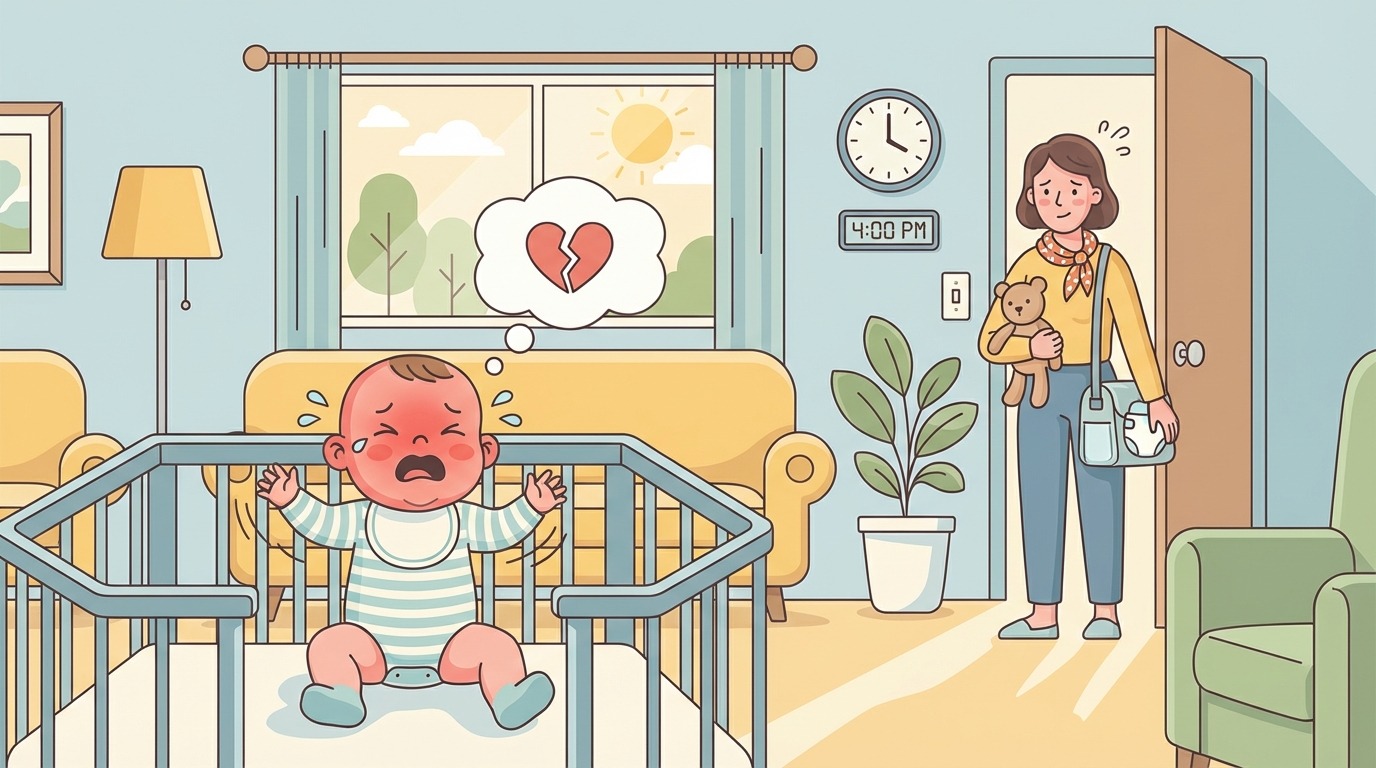
Why does my baby cry when the babysitter arrives?
To refine the analysis of crying by age, this concise guide on crying from 0 to 12 months helps place a child’s reactions on a typical development curve.
Need immediate and concrete ideas? Step-by-step tips are offered here: tips to calm crying, useful to pass on to the baby-sitter to harmonize your practices.
To better visualize the organization and reassuring gestures, a video resource can complement these markers.
These checkpoints prevent overlooking an organic problem, while honoring the legitimate emotion of the baby during separation.
Preparing for separation: welcoming rituals, transitional objects, and parent–baby-sitter handover
A well-thought-out welcome ritual transforms separation into a predictable stage rather than a rupture. It must remain short, identical, warm, and end with a clear departure phrase. The child anticipates, so they feel more involved. The baby-sitter and parent use the same words, the same gestures. This symmetry immediately reassures.
The parent introduces the baby-sitter, then verbalizes what follows: “Camille will play on the mat, then read the story, then sleep. See you later.” This sequence, repeated daily, lays down a guiding thread. The baby hears accessible temporal milestones.
Transitional objects: a sensory bridge
A cloth with a familiar scent, a comforter, a soft Vertbaudet t-shirt, a small Natalys blanket: these items link the two attachment figures. The smell, texture, weight become emotional anchors. The baby-sitter offers the object upon arrival and incorporates it into calm games.
Gentle exploration toys from Fisher-Price or a reading corner with The Book of Birth reinforce this emotional landing. Discovery remains slow, at baby’s height. Overly stimulating games are avoided during the first 10 minutes.
Setting up the welcome space
A visual transition corner helps. A dedicated and familiar mat captures attention. To choose a comfortable and safe support, this recent comparison can guide you: a suitable play mat facilitates soothing and free motor skills.
Safety also reassures the baby-sitter, thus the child: closed gates, padded corners, clear floor. A useful reminder is available here to prevent falls at home. Less anxiety for the adult equals more serenity for the baby.
Minute-by-minute scenario for the first 10 minutes
Minute 0–2: calm welcome, the parent names the steps, the baby-sitter approaches slowly. Minute 2–5: quick info transfer (time of last Avent bottle, nap, Mustela cues). Minute 5–7: transitional object + calm floor play. Minute 7–10: departure phrase, counted hug, parent leaves without looking back.
This simple mechanism, repeated every day, structures the separation experience. The key message becomes familiar: “We know what’s happening, and we’ll meet again.”
Effective soothing techniques and coordination of adult gestures
When crying occurs, the priority remains co-regulation. The baby-sitter breathes slowly, speaks softly, offers containing contact. Slow movements reduce baby’s activation. Short and consistent responses anchor security: “You are safe. Together we calm the body.”
Sucking regulates intensely. A well-chosen pacifier (Avent, Dodie) or a bottle already tested by the family avoids a cue conflict. Facing the world carrying is not necessary in this phase; a tummy-to-chest position suffices. The warmth of contact stabilizes heart rate and breathing.
Multimodal soothing
Combine one or two levers: dimmed light, soft white noise, regular rocking. A short stroll in a Baby Stroller Bébé Confort, weather permitting, transforms alertness into quiet curiosity. Repetitive movement, fresh air, and seat stability often calm very quickly.
A bath is not systematic. It can soothe, but sometimes it stimulates. Better to favor a stable ritual rather than add a new element at a fragile moment.
Harmonizing practices
Parent and baby-sitter align on three points: words used, durations, order of gestures. A simple sheet displayed near the welcome corner summarizes the sequence. Brands and objects already adopted at home remain priorities to avoid sensory breaks: Mustela lotions, Petit Bateau onesies, Avent bottles, Dodie pacifiers, Natalys blanket. This continuity nurtures trust.
If the child’s sleep is disturbed after several evenings of separation, a detour through this guide may help understand why a child suddenly stops sleeping through the night. The link between day and night is close: better-supported evening separations sometimes ease night awakenings.
To visualize soothing postures and voice quality, a targeted video search supports adults.
The key here: simple gestures, held together, repeated often. Relational stability always precedes the fading of crying.
Concrete action plans: scripts, anchoring games, exposure schedule, and follow-up
An action plan turns intention into measurable progress. It organizes short adaptation times, anchoring games, and weekly follow-up. The goal is not total absence of tears, but the reduction of their intensity and duration.
Days 1 to 3: parental presence 10 minutes with the baby-sitter, then ritualized departure. Days 4 to 6: same ritual, parent present only 5 minutes. Day 7: greetings at the door, immediate departure after the key phrase. This gradual exposure schedule respects the child’s pace.
Ready-to-use separation scripts
Script A (8–14 months): “Camille is here. We play on the mat, read a story, then sleep. After the nap, we meet again. I love you, see you later.” Script B (15–24 months): “You’re sad that it’s changing. You can take your comforter. Camille takes care of you. We’ll meet after snack time.” These phrases acknowledge the emotion and name the next appointment.
Anchoring games 5 minutes: sensory surprise box, cloth books, gentle Fisher-Price puzzles. Better calm games than exciting ones. The baby-sitter accompanies, follows the child’s initiative, gently comments on actions.
Follow-up and adjustments
A liaison notebook like The Book of Birth becomes a logbook: schedules, meals, naps, key moments. This tool allows observation of trends and adjustment of rituals. One change at a time, tested for three days, then re-evaluated: this rule avoids confusion of cues.
If the baby-sitter goes out, a passage in a Baby Stroller in a calm environment helps smooth the transition. The Bébé Confort car seat, if a trip is necessary, prolongs the coherence of sensations. Continuity of equipment reinforces perceived security.
Finally, free motor activity and floor time promote self-regulation. To nourish this awake time, several markers show why “tummy time” remains precious: the importance of tummy time supports tone and endurance, useful facing emotional transitions.
By bringing scripts, games, schedule, and follow-up together, separation stops being a black hole. It becomes a known path, therefore soothing.
How long do crying spells generally last at the arrival of the baby-sitter?
Most of the time, the intensity drops within 2 to 10 minutes after the parent leaves. The duration decreases even more with a consistent ritual, a transitional object, and a rapid, clear handover.
Should one leave quietly without saying goodbye?
It is better to avoid this. A clear and ritualized departure builds trust. Saying goodbye, naming the next step, then leaving without turning back reduces long-term anxiety.
Which objects soothe the most?
The comforter, a cloth with a familiar scent (Mustela care), a comfortable Petit Bateau onesie, or a small Natalys blanket. Sensory continuity takes precedence over novelty.
Can the baby-sitter use white noise?
Yes, at low volume and for a limited time. The goal is to aid regulation, not to mask a need. Observing the baby’s reaction remains a priority.
When should one consult as a priority?
If the crying becomes sharp and continuous, accompanied by fever, vomiting, a hard belly, apathy, or refusal to feed. Quick medical advice is necessary.
To refine the analysis of crying by age, this concise guide on crying from 0 to 12 months helps place a child’s reactions on a typical development curve.
Need immediate and concrete ideas? Step-by-step tips are offered here: tips to calm crying, useful to pass on to the baby-sitter to harmonize your practices.
To better visualize the organization and reassuring gestures, a video resource can complement these markers.
These checkpoints prevent overlooking an organic problem, while honoring the legitimate emotion of the baby during separation.
Preparing for separation: welcoming rituals, transitional objects, and parent–baby-sitter handover
A well-thought-out welcome ritual transforms separation into a predictable stage rather than a rupture. It must remain short, identical, warm, and end with a clear departure phrase. The child anticipates, so they feel more involved. The baby-sitter and parent use the same words, the same gestures. This symmetry immediately reassures.
The parent introduces the baby-sitter, then verbalizes what follows: “Camille will play on the mat, then read the story, then sleep. See you later.” This sequence, repeated daily, lays down a guiding thread. The baby hears accessible temporal milestones.
Transitional objects: a sensory bridge
A cloth with a familiar scent, a comforter, a soft Vertbaudet t-shirt, a small Natalys blanket: these items link the two attachment figures. The smell, texture, weight become emotional anchors. The baby-sitter offers the object upon arrival and incorporates it into calm games.
Gentle exploration toys from Fisher-Price or a reading corner with The Book of Birth reinforce this emotional landing. Discovery remains slow, at baby’s height. Overly stimulating games are avoided during the first 10 minutes.
Setting up the welcome space
A visual transition corner helps. A dedicated and familiar mat captures attention. To choose a comfortable and safe support, this recent comparison can guide you: a suitable play mat facilitates soothing and free motor skills.
Safety also reassures the baby-sitter, thus the child: closed gates, padded corners, clear floor. A useful reminder is available here to prevent falls at home. Less anxiety for the adult equals more serenity for the baby.
Minute-by-minute scenario for the first 10 minutes
Minute 0–2: calm welcome, the parent names the steps, the baby-sitter approaches slowly. Minute 2–5: quick info transfer (time of last Avent bottle, nap, Mustela cues). Minute 5–7: transitional object + calm floor play. Minute 7–10: departure phrase, counted hug, parent leaves without looking back.
This simple mechanism, repeated every day, structures the separation experience. The key message becomes familiar: “We know what’s happening, and we’ll meet again.”
Effective soothing techniques and coordination of adult gestures
When crying occurs, the priority remains co-regulation. The baby-sitter breathes slowly, speaks softly, offers containing contact. Slow movements reduce baby’s activation. Short and consistent responses anchor security: “You are safe. Together we calm the body.”
Sucking regulates intensely. A well-chosen pacifier (Avent, Dodie) or a bottle already tested by the family avoids a cue conflict. Facing the world carrying is not necessary in this phase; a tummy-to-chest position suffices. The warmth of contact stabilizes heart rate and breathing.
Multimodal soothing
Combine one or two levers: dimmed light, soft white noise, regular rocking. A short stroll in a Baby Stroller Bébé Confort, weather permitting, transforms alertness into quiet curiosity. Repetitive movement, fresh air, and seat stability often calm very quickly.
A bath is not systematic. It can soothe, but sometimes it stimulates. Better to favor a stable ritual rather than add a new element at a fragile moment.
Harmonizing practices
Parent and baby-sitter align on three points: words used, durations, order of gestures. A simple sheet displayed near the welcome corner summarizes the sequence. Brands and objects already adopted at home remain priorities to avoid sensory breaks: Mustela lotions, Petit Bateau onesies, Avent bottles, Dodie pacifiers, Natalys blanket. This continuity nurtures trust.
If the child’s sleep is disturbed after several evenings of separation, a detour through this guide may help understand why a child suddenly stops sleeping through the night. The link between day and night is close: better-supported evening separations sometimes ease night awakenings.
To visualize soothing postures and voice quality, a targeted video search supports adults.
The key here: simple gestures, held together, repeated often. Relational stability always precedes the fading of crying.
Concrete action plans: scripts, anchoring games, exposure schedule, and follow-up
An action plan turns intention into measurable progress. It organizes short adaptation times, anchoring games, and weekly follow-up. The goal is not total absence of tears, but the reduction of their intensity and duration.
Days 1 to 3: parental presence 10 minutes with the baby-sitter, then ritualized departure. Days 4 to 6: same ritual, parent present only 5 minutes. Day 7: greetings at the door, immediate departure after the key phrase. This gradual exposure schedule respects the child’s pace.
Ready-to-use separation scripts
Script A (8–14 months): “Camille is here. We play on the mat, read a story, then sleep. After the nap, we meet again. I love you, see you later.” Script B (15–24 months): “You’re sad that it’s changing. You can take your comforter. Camille takes care of you. We’ll meet after snack time.” These phrases acknowledge the emotion and name the next appointment.
Anchoring games 5 minutes: sensory surprise box, cloth books, gentle Fisher-Price puzzles. Better calm games than exciting ones. The baby-sitter accompanies, follows the child’s initiative, gently comments on actions.
Follow-up and adjustments
A liaison notebook like The Book of Birth becomes a logbook: schedules, meals, naps, key moments. This tool allows observation of trends and adjustment of rituals. One change at a time, tested for three days, then re-evaluated: this rule avoids confusion of cues.
If the baby-sitter goes out, a passage in a Baby Stroller in a calm environment helps smooth the transition. The Bébé Confort car seat, if a trip is necessary, prolongs the coherence of sensations. Continuity of equipment reinforces perceived security.
Finally, free motor activity and floor time promote self-regulation. To nourish this awake time, several markers show why “tummy time” remains precious: the importance of tummy time supports tone and endurance, useful facing emotional transitions.
By bringing scripts, games, schedule, and follow-up together, separation stops being a black hole. It becomes a known path, therefore soothing.
How long do crying spells generally last at the arrival of the baby-sitter?
Most of the time, the intensity drops within 2 to 10 minutes after the parent leaves. The duration decreases even more with a consistent ritual, a transitional object, and a rapid, clear handover.
Should one leave quietly without saying goodbye?
It is better to avoid this. A clear and ritualized departure builds trust. Saying goodbye, naming the next step, then leaving without turning back reduces long-term anxiety.
Which objects soothe the most?
The comforter, a cloth with a familiar scent (Mustela care), a comfortable Petit Bateau onesie, or a small Natalys blanket. Sensory continuity takes precedence over novelty.
Can the baby-sitter use white noise?
Yes, at low volume and for a limited time. The goal is to aid regulation, not to mask a need. Observing the baby’s reaction remains a priority.
When should one consult as a priority?
If the crying becomes sharp and continuous, accompanied by fever, vomiting, a hard belly, apathy, or refusal to feed. Quick medical advice is necessary.
To refine the analysis of crying by age, this concise guide on crying from 0 to 12 months helps place a child’s reactions on a typical development curve.
Need immediate and concrete ideas? Step-by-step tips are offered here: tips to calm crying, useful to pass on to the baby-sitter to harmonize your practices.
To better visualize the organization and reassuring gestures, a video resource can complement these markers.
These checkpoints prevent overlooking an organic problem, while honoring the legitimate emotion of the baby during separation.
Preparing for separation: welcoming rituals, transitional objects, and parent–baby-sitter handover
A well-thought-out welcome ritual transforms separation into a predictable stage rather than a rupture. It must remain short, identical, warm, and end with a clear departure phrase. The child anticipates, so they feel more involved. The baby-sitter and parent use the same words, the same gestures. This symmetry immediately reassures.
The parent introduces the baby-sitter, then verbalizes what follows: “Camille will play on the mat, then read the story, then sleep. See you later.” This sequence, repeated daily, lays down a guiding thread. The baby hears accessible temporal milestones.
Transitional objects: a sensory bridge
A cloth with a familiar scent, a comforter, a soft Vertbaudet t-shirt, a small Natalys blanket: these items link the two attachment figures. The smell, texture, weight become emotional anchors. The baby-sitter offers the object upon arrival and incorporates it into calm games.
Gentle exploration toys from Fisher-Price or a reading corner with The Book of Birth reinforce this emotional landing. Discovery remains slow, at baby’s height. Overly stimulating games are avoided during the first 10 minutes.
Setting up the welcome space
A visual transition corner helps. A dedicated and familiar mat captures attention. To choose a comfortable and safe support, this recent comparison can guide you: a suitable play mat facilitates soothing and free motor skills.
Safety also reassures the baby-sitter, thus the child: closed gates, padded corners, clear floor. A useful reminder is available here to prevent falls at home. Less anxiety for the adult equals more serenity for the baby.
Minute-by-minute scenario for the first 10 minutes
Minute 0–2: calm welcome, the parent names the steps, the baby-sitter approaches slowly. Minute 2–5: quick info transfer (time of last Avent bottle, nap, Mustela cues). Minute 5–7: transitional object + calm floor play. Minute 7–10: departure phrase, counted hug, parent leaves without looking back.
This simple mechanism, repeated every day, structures the separation experience. The key message becomes familiar: “We know what’s happening, and we’ll meet again.”
Effective soothing techniques and coordination of adult gestures
When crying occurs, the priority remains co-regulation. The baby-sitter breathes slowly, speaks softly, offers containing contact. Slow movements reduce baby’s activation. Short and consistent responses anchor security: “You are safe. Together we calm the body.”
Sucking regulates intensely. A well-chosen pacifier (Avent, Dodie) or a bottle already tested by the family avoids a cue conflict. Facing the world carrying is not necessary in this phase; a tummy-to-chest position suffices. The warmth of contact stabilizes heart rate and breathing.
Multimodal soothing
Combine one or two levers: dimmed light, soft white noise, regular rocking. A short stroll in a Baby Stroller Bébé Confort, weather permitting, transforms alertness into quiet curiosity. Repetitive movement, fresh air, and seat stability often calm very quickly.
A bath is not systematic. It can soothe, but sometimes it stimulates. Better to favor a stable ritual rather than add a new element at a fragile moment.
Harmonizing practices
Parent and baby-sitter align on three points: words used, durations, order of gestures. A simple sheet displayed near the welcome corner summarizes the sequence. Brands and objects already adopted at home remain priorities to avoid sensory breaks: Mustela lotions, Petit Bateau onesies, Avent bottles, Dodie pacifiers, Natalys blanket. This continuity nurtures trust.
If the child’s sleep is disturbed after several evenings of separation, a detour through this guide may help understand why a child suddenly stops sleeping through the night. The link between day and night is close: better-supported evening separations sometimes ease night awakenings.
To visualize soothing postures and voice quality, a targeted video search supports adults.
The key here: simple gestures, held together, repeated often. Relational stability always precedes the fading of crying.
Concrete action plans: scripts, anchoring games, exposure schedule, and follow-up
An action plan turns intention into measurable progress. It organizes short adaptation times, anchoring games, and weekly follow-up. The goal is not total absence of tears, but the reduction of their intensity and duration.
Days 1 to 3: parental presence 10 minutes with the baby-sitter, then ritualized departure. Days 4 to 6: same ritual, parent present only 5 minutes. Day 7: greetings at the door, immediate departure after the key phrase. This gradual exposure schedule respects the child’s pace.
Ready-to-use separation scripts
Script A (8–14 months): “Camille is here. We play on the mat, read a story, then sleep. After the nap, we meet again. I love you, see you later.” Script B (15–24 months): “You’re sad that it’s changing. You can take your comforter. Camille takes care of you. We’ll meet after snack time.” These phrases acknowledge the emotion and name the next appointment.
Anchoring games 5 minutes: sensory surprise box, cloth books, gentle Fisher-Price puzzles. Better calm games than exciting ones. The baby-sitter accompanies, follows the child’s initiative, gently comments on actions.
Follow-up and adjustments
A liaison notebook like The Book of Birth becomes a logbook: schedules, meals, naps, key moments. This tool allows observation of trends and adjustment of rituals. One change at a time, tested for three days, then re-evaluated: this rule avoids confusion of cues.
If the baby-sitter goes out, a passage in a Baby Stroller in a calm environment helps smooth the transition. The Bébé Confort car seat, if a trip is necessary, prolongs the coherence of sensations. Continuity of equipment reinforces perceived security.
Finally, free motor activity and floor time promote self-regulation. To nourish this awake time, several markers show why “tummy time” remains precious: the importance of tummy time supports tone and endurance, useful facing emotional transitions.
By bringing scripts, games, schedule, and follow-up together, separation stops being a black hole. It becomes a known path, therefore soothing.
How long do crying spells generally last at the arrival of the baby-sitter?
Most of the time, the intensity drops within 2 to 10 minutes after the parent leaves. The duration decreases even more with a consistent ritual, a transitional object, and a rapid, clear handover.
Should one leave quietly without saying goodbye?
It is better to avoid this. A clear and ritualized departure builds trust. Saying goodbye, naming the next step, then leaving without turning back reduces long-term anxiety.
Which objects soothe the most?
The comforter, a cloth with a familiar scent (Mustela care), a comfortable Petit Bateau onesie, or a small Natalys blanket. Sensory continuity takes precedence over novelty.
Can the baby-sitter use white noise?
Yes, at low volume and for a limited time. The goal is to aid regulation, not to mask a need. Observing the baby’s reaction remains a priority.
When should one consult as a priority?
If the crying becomes sharp and continuous, accompanied by fever, vomiting, a hard belly, apathy, or refusal to feed. Quick medical advice is necessary.
To refine the analysis of crying by age, this concise guide on crying from 0 to 12 months helps place a child’s reactions on a typical development curve.
Need immediate and concrete ideas? Step-by-step tips are offered here: tips to calm crying, useful to pass on to the baby-sitter to harmonize your practices.
To better visualize the organization and reassuring gestures, a video resource can complement these markers.
These checkpoints prevent overlooking an organic problem, while honoring the legitimate emotion of the baby during separation.
Preparing for separation: welcoming rituals, transitional objects, and parent–baby-sitter handover
A well-thought-out welcome ritual transforms separation into a predictable stage rather than a rupture. It must remain short, identical, warm, and end with a clear departure phrase. The child anticipates, so they feel more involved. The baby-sitter and parent use the same words, the same gestures. This symmetry immediately reassures.
The parent introduces the baby-sitter, then verbalizes what follows: “Camille will play on the mat, then read the story, then sleep. See you later.” This sequence, repeated daily, lays down a guiding thread. The baby hears accessible temporal milestones.
Transitional objects: a sensory bridge
A cloth with a familiar scent, a comforter, a soft Vertbaudet t-shirt, a small Natalys blanket: these items link the two attachment figures. The smell, texture, weight become emotional anchors. The baby-sitter offers the object upon arrival and incorporates it into calm games.
Gentle exploration toys from Fisher-Price or a reading corner with The Book of Birth reinforce this emotional landing. Discovery remains slow, at baby’s height. Overly stimulating games are avoided during the first 10 minutes.
Setting up the welcome space
A visual transition corner helps. A dedicated and familiar mat captures attention. To choose a comfortable and safe support, this recent comparison can guide you: a suitable play mat facilitates soothing and free motor skills.
Safety also reassures the baby-sitter, thus the child: closed gates, padded corners, clear floor. A useful reminder is available here to prevent falls at home. Less anxiety for the adult equals more serenity for the baby.
Minute-by-minute scenario for the first 10 minutes
Minute 0–2: calm welcome, the parent names the steps, the baby-sitter approaches slowly. Minute 2–5: quick info transfer (time of last Avent bottle, nap, Mustela cues). Minute 5–7: transitional object + calm floor play. Minute 7–10: departure phrase, counted hug, parent leaves without looking back.
This simple mechanism, repeated every day, structures the separation experience. The key message becomes familiar: “We know what’s happening, and we’ll meet again.”
Effective soothing techniques and coordination of adult gestures
When crying occurs, the priority remains co-regulation. The baby-sitter breathes slowly, speaks softly, offers containing contact. Slow movements reduce baby’s activation. Short and consistent responses anchor security: “You are safe. Together we calm the body.”
Sucking regulates intensely. A well-chosen pacifier (Avent, Dodie) or a bottle already tested by the family avoids a cue conflict. Facing the world carrying is not necessary in this phase; a tummy-to-chest position suffices. The warmth of contact stabilizes heart rate and breathing.
Multimodal soothing
Combine one or two levers: dimmed light, soft white noise, regular rocking. A short stroll in a Baby Stroller Bébé Confort, weather permitting, transforms alertness into quiet curiosity. Repetitive movement, fresh air, and seat stability often calm very quickly.
A bath is not systematic. It can soothe, but sometimes it stimulates. Better to favor a stable ritual rather than add a new element at a fragile moment.
Harmonizing practices
Parent and baby-sitter align on three points: words used, durations, order of gestures. A simple sheet displayed near the welcome corner summarizes the sequence. Brands and objects already adopted at home remain priorities to avoid sensory breaks: Mustela lotions, Petit Bateau onesies, Avent bottles, Dodie pacifiers, Natalys blanket. This continuity nurtures trust.
If the child’s sleep is disturbed after several evenings of separation, a detour through this guide may help understand why a child suddenly stops sleeping through the night. The link between day and night is close: better-supported evening separations sometimes ease night awakenings.
To visualize soothing postures and voice quality, a targeted video search supports adults.
The key here: simple gestures, held together, repeated often. Relational stability always precedes the fading of crying.
Concrete action plans: scripts, anchoring games, exposure schedule, and follow-up
An action plan turns intention into measurable progress. It organizes short adaptation times, anchoring games, and weekly follow-up. The goal is not total absence of tears, but the reduction of their intensity and duration.
Days 1 to 3: parental presence 10 minutes with the baby-sitter, then ritualized departure. Days 4 to 6: same ritual, parent present only 5 minutes. Day 7: greetings at the door, immediate departure after the key phrase. This gradual exposure schedule respects the child’s pace.
Ready-to-use separation scripts
Script A (8–14 months): “Camille is here. We play on the mat, read a story, then sleep. After the nap, we meet again. I love you, see you later.” Script B (15–24 months): “You’re sad that it’s changing. You can take your comforter. Camille takes care of you. We’ll meet after snack time.” These phrases acknowledge the emotion and name the next appointment.
Anchoring games 5 minutes: sensory surprise box, cloth books, gentle Fisher-Price puzzles. Better calm games than exciting ones. The baby-sitter accompanies, follows the child’s initiative, gently comments on actions.
Follow-up and adjustments
A liaison notebook like The Book of Birth becomes a logbook: schedules, meals, naps, key moments. This tool allows observation of trends and adjustment of rituals. One change at a time, tested for three days, then re-evaluated: this rule avoids confusion of cues.
If the baby-sitter goes out, a passage in a Baby Stroller in a calm environment helps smooth the transition. The Bébé Confort car seat, if a trip is necessary, prolongs the coherence of sensations. Continuity of equipment reinforces perceived security.
Finally, free motor activity and floor time promote self-regulation. To nourish this awake time, several markers show why “tummy time” remains precious: the importance of tummy time supports tone and endurance, useful facing emotional transitions.
By bringing scripts, games, schedule, and follow-up together, separation stops being a black hole. It becomes a known path, therefore soothing.
How long do crying spells generally last at the arrival of the baby-sitter?
Most of the time, the intensity drops within 2 to 10 minutes after the parent leaves. The duration decreases even more with a consistent ritual, a transitional object, and a rapid, clear handover.
Should one leave quietly without saying goodbye?
It is better to avoid this. A clear and ritualized departure builds trust. Saying goodbye, naming the next step, then leaving without turning back reduces long-term anxiety.
Which objects soothe the most?
The comforter, a cloth with a familiar scent (Mustela care), a comfortable Petit Bateau onesie, or a small Natalys blanket. Sensory continuity takes precedence over novelty.
Can the baby-sitter use white noise?
Yes, at low volume and for a limited time. The goal is to aid regulation, not to mask a need. Observing the baby’s reaction remains a priority.
When should one consult as a priority?
If the crying becomes sharp and continuous, accompanied by fever, vomiting, a hard belly, apathy, or refusal to feed. Quick medical advice is necessary.
- 🍼 Hydration and last meal checked (Avent/Dodie pacifier flow adapted).
- 🧷 Clean diaper and comfortable Petit Bateau clothes.
- 🧸 Comforter, cloth with familiar (Mustela) scent within reach.
- 🎶 White noise ready if needed, dim and quiet room.
- 🚗 Short outing in a Baby Stroller Bébé Confort possible if weather permits.
To refine the analysis of crying by age, this concise guide on crying from 0 to 12 months helps place a child’s reactions on a typical development curve.
Need immediate and concrete ideas? Step-by-step tips are offered here: tips to calm crying, useful to pass on to the baby-sitter to harmonize your practices.
To better visualize the organization and reassuring gestures, a video resource can complement these markers.
These checkpoints prevent overlooking an organic problem, while honoring the legitimate emotion of the baby during separation.
Preparing for separation: welcoming rituals, transitional objects, and parent–baby-sitter handover
A well-thought-out welcome ritual transforms separation into a predictable stage rather than a rupture. It must remain short, identical, warm, and end with a clear departure phrase. The child anticipates, so they feel more involved. The baby-sitter and parent use the same words, the same gestures. This symmetry immediately reassures.
The parent introduces the baby-sitter, then verbalizes what follows: “Camille will play on the mat, then read the story, then sleep. See you later.” This sequence, repeated daily, lays down a guiding thread. The baby hears accessible temporal milestones.
Transitional objects: a sensory bridge
A cloth with a familiar scent, a comforter, a soft Vertbaudet t-shirt, a small Natalys blanket: these items link the two attachment figures. The smell, texture, weight become emotional anchors. The baby-sitter offers the object upon arrival and incorporates it into calm games.
Gentle exploration toys from Fisher-Price or a reading corner with The Book of Birth reinforce this emotional landing. Discovery remains slow, at baby’s height. Overly stimulating games are avoided during the first 10 minutes.
Setting up the welcome space
A visual transition corner helps. A dedicated and familiar mat captures attention. To choose a comfortable and safe support, this recent comparison can guide you: a suitable play mat facilitates soothing and free motor skills.
Safety also reassures the baby-sitter, thus the child: closed gates, padded corners, clear floor. A useful reminder is available here to prevent falls at home. Less anxiety for the adult equals more serenity for the baby.
Minute-by-minute scenario for the first 10 minutes
Minute 0–2: calm welcome, the parent names the steps, the baby-sitter approaches slowly. Minute 2–5: quick info transfer (time of last Avent bottle, nap, Mustela cues). Minute 5–7: transitional object + calm floor play. Minute 7–10: departure phrase, counted hug, parent leaves without looking back.
This simple mechanism, repeated every day, structures the separation experience. The key message becomes familiar: “We know what’s happening, and we’ll meet again.”
Effective soothing techniques and coordination of adult gestures
When crying occurs, the priority remains co-regulation. The baby-sitter breathes slowly, speaks softly, offers containing contact. Slow movements reduce baby’s activation. Short and consistent responses anchor security: “You are safe. Together we calm the body.”
Sucking regulates intensely. A well-chosen pacifier (Avent, Dodie) or a bottle already tested by the family avoids a cue conflict. Facing the world carrying is not necessary in this phase; a tummy-to-chest position suffices. The warmth of contact stabilizes heart rate and breathing.
Multimodal soothing
Combine one or two levers: dimmed light, soft white noise, regular rocking. A short stroll in a Baby Stroller Bébé Confort, weather permitting, transforms alertness into quiet curiosity. Repetitive movement, fresh air, and seat stability often calm very quickly.
A bath is not systematic. It can soothe, but sometimes it stimulates. Better to favor a stable ritual rather than add a new element at a fragile moment.
Harmonizing practices
Parent and baby-sitter align on three points: words used, durations, order of gestures. A simple sheet displayed near the welcome corner summarizes the sequence. Brands and objects already adopted at home remain priorities to avoid sensory breaks: Mustela lotions, Petit Bateau onesies, Avent bottles, Dodie pacifiers, Natalys blanket. This continuity nurtures trust.
If the child’s sleep is disturbed after several evenings of separation, a detour through this guide may help understand why a child suddenly stops sleeping through the night. The link between day and night is close: better-supported evening separations sometimes ease night awakenings.
To visualize soothing postures and voice quality, a targeted video search supports adults.
The key here: simple gestures, held together, repeated often. Relational stability always precedes the fading of crying.
Concrete action plans: scripts, anchoring games, exposure schedule, and follow-up
An action plan turns intention into measurable progress. It organizes short adaptation times, anchoring games, and weekly follow-up. The goal is not total absence of tears, but the reduction of their intensity and duration.
Days 1 to 3: parental presence 10 minutes with the baby-sitter, then ritualized departure. Days 4 to 6: same ritual, parent present only 5 minutes. Day 7: greetings at the door, immediate departure after the key phrase. This gradual exposure schedule respects the child’s pace.
Ready-to-use separation scripts
Script A (8–14 months): “Camille is here. We play on the mat, read a story, then sleep. After the nap, we meet again. I love you, see you later.” Script B (15–24 months): “You’re sad that it’s changing. You can take your comforter. Camille takes care of you. We’ll meet after snack time.” These phrases acknowledge the emotion and name the next appointment.
Anchoring games 5 minutes: sensory surprise box, cloth books, gentle Fisher-Price puzzles. Better calm games than exciting ones. The baby-sitter accompanies, follows the child’s initiative, gently comments on actions.
Follow-up and adjustments
A liaison notebook like The Book of Birth becomes a logbook: schedules, meals, naps, key moments. This tool allows observation of trends and adjustment of rituals. One change at a time, tested for three days, then re-evaluated: this rule avoids confusion of cues.
If the baby-sitter goes out, a passage in a Baby Stroller in a calm environment helps smooth the transition. The Bébé Confort car seat, if a trip is necessary, prolongs the coherence of sensations. Continuity of equipment reinforces perceived security.
Finally, free motor activity and floor time promote self-regulation. To nourish this awake time, several markers show why “tummy time” remains precious: the importance of tummy time supports tone and endurance, useful facing emotional transitions.
By bringing scripts, games, schedule, and follow-up together, separation stops being a black hole. It becomes a known path, therefore soothing.
How long do crying spells generally last at the arrival of the baby-sitter?
Most of the time, the intensity drops within 2 to 10 minutes after the parent leaves. The duration decreases even more with a consistent ritual, a transitional object, and a rapid, clear handover.
Should one leave quietly without saying goodbye?
It is better to avoid this. A clear and ritualized departure builds trust. Saying goodbye, naming the next step, then leaving without turning back reduces long-term anxiety.
Which objects soothe the most?
The comforter, a cloth with a familiar scent (Mustela care), a comfortable Petit Bateau onesie, or a small Natalys blanket. Sensory continuity takes precedence over novelty.
Can the baby-sitter use white noise?
Yes, at low volume and for a limited time. The goal is to aid regulation, not to mask a need. Observing the baby’s reaction remains a priority.
When should one consult as a priority?
If the crying becomes sharp and continuous, accompanied by fever, vomiting, a hard belly, apathy, or refusal to feed. Quick medical advice is necessary.
| In Brief 🌟 |
|---|
| 😢 Crying at the arrival of the baby-sitter often reflects normal separation anxiety between 8 and 24 months. |
| 🧠 A baby cries to communicate a need (hunger, tiredness, contact, pain) and not out of whim. |
| ⏱️ Short and predictable rituals facilitate the handover and reassure the child. |
| 🧸 Transitional objects (comforter, familiar Mustela scent) help link the two attachment figures. |
| 👂 Alarm bells ring if the crying is inconsolable, accompanied by fever, vomiting, bloated belly, or refusal to eat. |
| 🤝 Parent–baby-sitter collaboration (same words, same gestures) limits crying over time. |
| 🎵 White noise, carrying, sucking (Avent, Dodie), stroll in a Baby Stroller soothe effectively. |
Tears at the arrival of a baby-sitter can be disconcerting, even when everything seems fine in their absence. This reaction often occurs at separation, when the baby realizes their parent is leaving. It reflects healthy emotional development: the child attaches, resists, then feels secure thanks to routines. Understanding these mechanisms helps soothe without trivializing the emotion.
This article explores the subject from the perspective of development, health, and practical support. Clear markers help distinguish what is expected from what raises questions, with concrete tools to implement from tonight. Everyday brands and equipment (Avent, Dodie, Bébé Confort, Mustela, Vertbaudet, Fisher-Price, Petit Bateau, Natalys) can also become discreet allies to support rituals, strengthen sensory cues, and promote calm. Finally, real examples, like Lina’s story and her nanny Camille, illustrate adjustments that make a difference over days.
Crying at the arrival of the baby-sitter: understanding separation anxiety and real needs
Why does a baby cry precisely when the baby-sitter enters the room? The answer lies in attachment. Around 8–10 months, the child clearly recognizes faces and understands a separation will happen. They cling, protest, sometimes scream. This is not a rejection of the baby-sitter as a person. It is the manifestation of a secure bond with their parent and difficulty coping with the transition.
This key moment may last only a few minutes. Once the parent has left, many children calm quickly when in contact with a reassuring figure. The immature brain first reacts emotionally, then regulates itself using stable cues. A baby needs visibility: who is caring for them, where, and for how long. Constant rituals establish this framework.
Communication through crying: decoding to better respond
The infant cannot speak, so they cry. These sounds express hunger, tiredness, need for arms, discomfort, or pain. Body cues help identify causes: folded legs and hard belly? Digestive issue likely. Eye rubbing and arched back? Fatigue predominates. An appropriate response soothes faster and strengthens the sense of security.
At the end of the day, discharge crying frequently occurs between 6 p.m. and 11 p.m. It happens after a build-up of stimulation. The baby needs to release tension. A calm presence is often enough: soft light, gentle voice, supportive contact. No need to pile on stimuli; better to lighten the environment.
Practical case: Lina, 13 months, and Camille, the baby-sitter
Lina cries every time Camille arrives. She clings to the parent, seeming inconsolable. Yet, after two minutes of cuddling with the nanny, she smiles and plays. The issue is therefore not the relationship with Camille, but the shift between two attachment figures. A simple handover ritual was established: a few identical words each day, a counted hug to 10, and the parent announces their departure while showing the door. Repetition reduced crying intensity within a week.
A transitional object amplifies the effect. The favorite comforter, a cloth soaked with the familiar scent of a Mustela care product, or a Petit Bateau onesie worn the day before serve as a sensory bridge. The baby-sitter then offers a quiet Fisher-Price toy or flips through The Book of Birth with the child. Attention shifts, and tension decreases.
Sensorial cues and environment
A consistent setting soothes. A play mat, a night light, olfactory cues, familiar music create a home signature. Soft Vertbaudet or Natalys textiles dedicated to welcoming moments signal the transition. This repetitive marking gives the baby a feeling of control, hence security.
At the heart of this dynamic, the key idea remains simple: the child does not cry to “hurt,” they cry to say something. When this message is understood, separation is easier to handle.
Differentiating normal discomfort from warning signs: when to worry and what to check
Most crying at the arrival of the baby-sitter is transient and normal. However, certain signs require vigilance. A baby inconsolable for hours, refusing to drink, vomiting, showing a bloated belly, or having a fever must be seen by a doctor. An ear infection, reflux, food intolerance, or infection can manifest through intense crying.
An infant who sleeps very little, wakes up screaming, or arches their back at feeding time sometimes indicates reflux. Inadequate milk quantities or too fast a flow worsen discomfort. Trying a slower pacifier (Avent, Dodie) or adjusting feeding postures often relieves quickly.
Discharge crying vs digestive pain
Discharge cries come in waves and respond to a soothing presence. Digestive pains come with clearer physical signs: knees drawn to belly, gas, grimaces, red face. Gentle abdominal massage, upright carrying, or warm compresses can help. If pain persists, medical advice is necessary.
In the evening, dimming light and tiredness increase emotional vulnerability. The baby then needs less stimulation and a simple ritual. A short bath, whispered story, then a cuddle set a secure frame.
Quick checklist for baby-sitter arrival
- 🍼 Hydration and last meal checked (Avent/Dodie pacifier flow adapted).
- 🧷 Clean diaper and comfortable Petit Bateau clothes.
- 🧸 Comforter, cloth with familiar (Mustela) scent within reach.
- 🎶 White noise ready if needed, dim and quiet room.
- 🚗 Short outing in a Baby Stroller Bébé Confort possible if weather permits.
To refine the analysis of crying by age, this concise guide on crying from 0 to 12 months helps place a child’s reactions on a typical development curve.
Need immediate and concrete ideas? Step-by-step tips are offered here: tips to calm crying, useful to pass on to the baby-sitter to harmonize your practices.
To better visualize the organization and reassuring gestures, a video resource can complement these markers.
These checkpoints prevent overlooking an organic problem, while honoring the legitimate emotion of the baby during separation.
Preparing for separation: welcoming rituals, transitional objects, and parent–baby-sitter handover
A well-thought-out welcome ritual transforms separation into a predictable stage rather than a rupture. It must remain short, identical, warm, and end with a clear departure phrase. The child anticipates, so they feel more involved. The baby-sitter and parent use the same words, the same gestures. This symmetry immediately reassures.
The parent introduces the baby-sitter, then verbalizes what follows: “Camille will play on the mat, then read the story, then sleep. See you later.” This sequence, repeated daily, lays down a guiding thread. The baby hears accessible temporal milestones.
Transitional objects: a sensory bridge
A cloth with a familiar scent, a comforter, a soft Vertbaudet t-shirt, a small Natalys blanket: these items link the two attachment figures. The smell, texture, weight become emotional anchors. The baby-sitter offers the object upon arrival and incorporates it into calm games.
Gentle exploration toys from Fisher-Price or a reading corner with The Book of Birth reinforce this emotional landing. Discovery remains slow, at baby’s height. Overly stimulating games are avoided during the first 10 minutes.
Setting up the welcome space
A visual transition corner helps. A dedicated and familiar mat captures attention. To choose a comfortable and safe support, this recent comparison can guide you: a suitable play mat facilitates soothing and free motor skills.
Safety also reassures the baby-sitter, thus the child: closed gates, padded corners, clear floor. A useful reminder is available here to prevent falls at home. Less anxiety for the adult equals more serenity for the baby.
Minute-by-minute scenario for the first 10 minutes
Minute 0–2: calm welcome, the parent names the steps, the baby-sitter approaches slowly. Minute 2–5: quick info transfer (time of last Avent bottle, nap, Mustela cues). Minute 5–7: transitional object + calm floor play. Minute 7–10: departure phrase, counted hug, parent leaves without looking back.
This simple mechanism, repeated every day, structures the separation experience. The key message becomes familiar: “We know what’s happening, and we’ll meet again.”
Effective soothing techniques and coordination of adult gestures
When crying occurs, the priority remains co-regulation. The baby-sitter breathes slowly, speaks softly, offers containing contact. Slow movements reduce baby’s activation. Short and consistent responses anchor security: “You are safe. Together we calm the body.”
Sucking regulates intensely. A well-chosen pacifier (Avent, Dodie) or a bottle already tested by the family avoids a cue conflict. Facing the world carrying is not necessary in this phase; a tummy-to-chest position suffices. The warmth of contact stabilizes heart rate and breathing.
Multimodal soothing
Combine one or two levers: dimmed light, soft white noise, regular rocking. A short stroll in a Baby Stroller Bébé Confort, weather permitting, transforms alertness into quiet curiosity. Repetitive movement, fresh air, and seat stability often calm very quickly.
A bath is not systematic. It can soothe, but sometimes it stimulates. Better to favor a stable ritual rather than add a new element at a fragile moment.
Harmonizing practices
Parent and baby-sitter align on three points: words used, durations, order of gestures. A simple sheet displayed near the welcome corner summarizes the sequence. Brands and objects already adopted at home remain priorities to avoid sensory breaks: Mustela lotions, Petit Bateau onesies, Avent bottles, Dodie pacifiers, Natalys blanket. This continuity nurtures trust.
If the child’s sleep is disturbed after several evenings of separation, a detour through this guide may help understand why a child suddenly stops sleeping through the night. The link between day and night is close: better-supported evening separations sometimes ease night awakenings.
To visualize soothing postures and voice quality, a targeted video search supports adults.
The key here: simple gestures, held together, repeated often. Relational stability always precedes the fading of crying.
Concrete action plans: scripts, anchoring games, exposure schedule, and follow-up
An action plan turns intention into measurable progress. It organizes short adaptation times, anchoring games, and weekly follow-up. The goal is not total absence of tears, but the reduction of their intensity and duration.
Days 1 to 3: parental presence 10 minutes with the baby-sitter, then ritualized departure. Days 4 to 6: same ritual, parent present only 5 minutes. Day 7: greetings at the door, immediate departure after the key phrase. This gradual exposure schedule respects the child’s pace.
Ready-to-use separation scripts
Script A (8–14 months): “Camille is here. We play on the mat, read a story, then sleep. After the nap, we meet again. I love you, see you later.” Script B (15–24 months): “You’re sad that it’s changing. You can take your comforter. Camille takes care of you. We’ll meet after snack time.” These phrases acknowledge the emotion and name the next appointment.
Anchoring games 5 minutes: sensory surprise box, cloth books, gentle Fisher-Price puzzles. Better calm games than exciting ones. The baby-sitter accompanies, follows the child’s initiative, gently comments on actions.
Follow-up and adjustments
A liaison notebook like The Book of Birth becomes a logbook: schedules, meals, naps, key moments. This tool allows observation of trends and adjustment of rituals. One change at a time, tested for three days, then re-evaluated: this rule avoids confusion of cues.
If the baby-sitter goes out, a passage in a Baby Stroller in a calm environment helps smooth the transition. The Bébé Confort car seat, if a trip is necessary, prolongs the coherence of sensations. Continuity of equipment reinforces perceived security.
Finally, free motor activity and floor time promote self-regulation. To nourish this awake time, several markers show why “tummy time” remains precious: the importance of tummy time supports tone and endurance, useful facing emotional transitions.
By bringing scripts, games, schedule, and follow-up together, separation stops being a black hole. It becomes a known path, therefore soothing.
How long do crying spells generally last at the arrival of the baby-sitter?
Most of the time, the intensity drops within 2 to 10 minutes after the parent leaves. The duration decreases even more with a consistent ritual, a transitional object, and a rapid, clear handover.
Should one leave quietly without saying goodbye?
It is better to avoid this. A clear and ritualized departure builds trust. Saying goodbye, naming the next step, then leaving without turning back reduces long-term anxiety.
Which objects soothe the most?
The comforter, a cloth with a familiar scent (Mustela care), a comfortable Petit Bateau onesie, or a small Natalys blanket. Sensory continuity takes precedence over novelty.
Can the baby-sitter use white noise?
Yes, at low volume and for a limited time. The goal is to aid regulation, not to mask a need. Observing the baby’s reaction remains a priority.
When should one consult as a priority?
If the crying becomes sharp and continuous, accompanied by fever, vomiting, a hard belly, apathy, or refusal to feed. Quick medical advice is necessary.