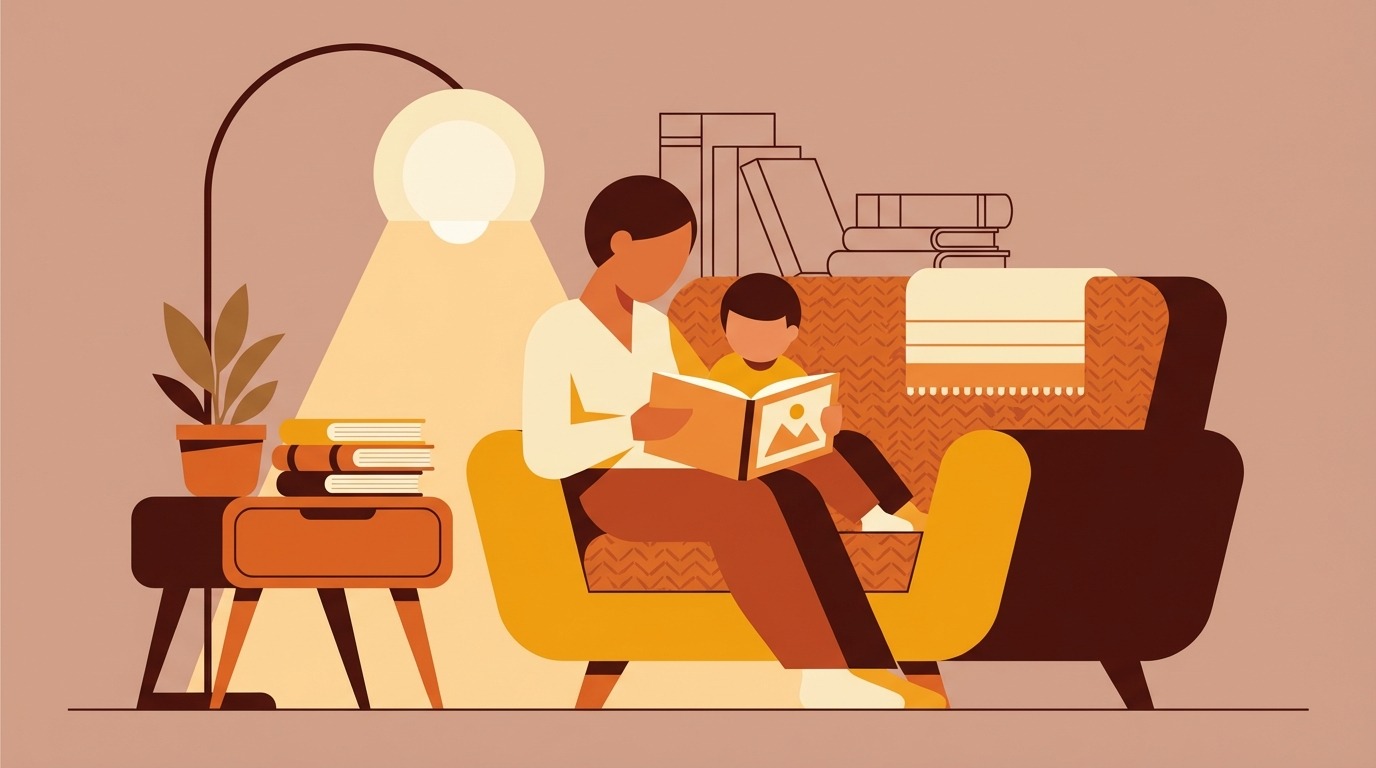
Read-Me Story: File: read-me the same story, the importance of repetition.
Every evening, the same scene plays out in many households. A little reader climbs onto the couch and enthusiastically says, « read to me again ». This request sometimes surprises, often amuses, and can wear out over time. Still, developmental researchers confirm the educational importance of this habit. By repeatedly returning to the same story, the child strengthens their memory, sharpens their understanding, and broadens their vocabulary. Repeated reading then becomes a discreet, daily, and powerful tool for learning. In a world saturated with novelties, this ritual shows the value of consistency.
This dossier highlights the concrete mechanisms of repetition and its effect on cognition. It also explores practical strategies to support the child, without boredom or constraint. In the evening, just before bedtime, the brain retains events better. This moment therefore offers an ideal window to reread, name, and link ideas. Moreover, children’s picture books contain more rare words than everyday conversation. Rereading is revisiting this lexical treasure to put it at the service of thought. Far from being a whim, the request « again » paves a way towards intellectual autonomy and emotional security.
| Short on time? Here’s the essential ⏱️ |
|---|
| Repetition improves memory and understanding of the story 📚 |
| Rereading before sleep consolidates learning 🌙 |
| Picture books contain more rare words than everyday conversation 🧠 |
| Vary attention: one evening focus on images, another on words, then on connections with experience 🔁 |
| Stable rituals = emotional security + cognitive curiosity ❤️ |
Read to Me Again Story: what repetition changes in the child’s brain
Why do so many children request the same story with a knowing smile? First, because the developing brain prefers familiarity when effort is high. Novelty attracts, but stability reassures. Regularity reduces cognitive load and frees up resources to decode details. Next, repetition creates temporal and narrative landmarks. Sequences become fixed, anticipations become clearer, and the child begins to “read” with their body: they turn the page at the right moment, notice rhymes, and comment on the plot.
On the memory level, two simple laws are noted early. Younger children encode slowly and forget quickly. Thus, replaying the same scene multiple times supports encoding. Over successive evenings, working memory gives way to long-term memory. Actions flow better. The child then extracts new information even without changing the book. This consolidation is also observed after video demonstrations, provided exposure is increased.
Familiarity, security and initiative-taking
In families, Lina’s example, 3 years old, illustrates this process well. She demands “read to me again” for an animal picture book. At first, she smiles at the images. Gradually, she names the elephant, highlights the rhythm, then asks questions. Finally, she corrects an omission by the adult. This trajectory clears up a common misunderstanding. Repetition is not a step backward. It is a springboard leading to initiative-taking, critical thinking, and confidence.
The more a sequence is revisited, the more the child can focus their energy on micro-novelties. They hear a rare phrase, notice a subtle symbol, or make a connection with their day. From one evening to the next, the focus shifts: the setting, a minor character, a rhyme. This sidestep feeds curiosity. Thus, the learning mechanism remains lively.
Lexical richness and documented effects
Another key point: children’s picture books concentrate a more varied lexicon than ordinary exchanges. Words like “giraffe,” “clearing,” or “somersault” naturally appear. The child hears them several times in a rich context. Thanks to repetition, these terms move from exoticism to mental tool. In the same spirit, educational programs have built their effectiveness on the structured repetition of episodes. Children learn to follow a structure, anticipate, then transfer these landmarks to new content. The repeated book achieves the same feat, but with the warmth of human connection.
Finally, repetition supports self-regulation. The child knows where they are going. They better manage the anticipation of the “big bad” or the tension of a twist. The predictable sequence helps tame emotions. In the background, they experiment with self-control, a useful skill when other challenges arise, like daycare or school.

Repetition, understanding and memory: a practical dossier for families in the evening
In the evening, a golden window opens. Calm activities prepare sleep and support memory. In this context, rereading the same story acts as an anchor. The brain attaches auditory and visual cues to the evening’s framework. The next day, these cues facilitate information retrieval. With Noah, 4 years old, the difference is clear. After three rereadings in one week, he uses “perched,” “venture,” and “caution” at breakfast. Understanding is shown by simple yet subtle reformulations.
To strengthen this dynamic, the parent can vary guidance. One evening, they invite describing an image. Another, they ask to predict what happens next. Then, they relate the book to a familiar event. This alternation keeps the pleasure intact. It also respects the natural progression of skills. If the child gets restless, gentle techniques help to calm down. In this regard, concrete tips are found here: learning to calm a child. Better regulated, the child listens more and retains better.
Connecting reading to experience and transitions
Rereading offers a safe ground to address transitions. For example, before a first separation, choosing a book about the day at the nanny reassures. Then, rereading it several times reduces the unknown. Useful advice is found in this resource: separation with the first nanny. Narrative repetition supports emotional adjustment. It builds bridges between imagination and reality.
As the child grows, goals evolve. Between 5 and 8 years, the challenge shifts from global plot recognition to viewpoint analysis. Rereading rituals feed this level. They allow comparing characters’ motivations, identifying temporal markers, and spotting inferences. To explore these milestones, one can consult this guide on development 5-8 years. Routine does not freeze. It accompanies momentum.
Of course, every family experiences ups and downs. Itchy eczema, teething, or worries. These difficulties influence attention. During these times, lightening expectations and maintaining the ritual’s structure often suffices. Some parents also seek reliable health guidelines. This clear guide on skin and eczema in children can reassure. When the body is soothed, the joy of the book quickly returns. And the magic of rereading resumes its path.
Concrete strategies for rereading without boredom: turning “again” into an adventure
Rereading does not mean repeating identically. The secret is intentional variation. One week, the parent focuses on images. The next, they linger on rhymes or onomatopoeias. Then, they introduce gestures. Next, they suggest a “pause” on a page to search for a detail. This scripting maintains freshness. It prevents monotony from pitching its tent. And above all, it pushes the child to explore angles they might have neglected.
Golden checklist for lively rereading
- 🔍 Shine a spotlight on a minor character and tell their point of view.
- 🎨 Look for three dominant colors and deduce the scene’s mood.
- 🎵 Notice sound repetitions, rhymes or refrains, and gently sing them.
- 🧩 Ask a “why” question and then a “how” question on the same page.
- 🧭 Connect a passage to a memory of the day to reinforce meaning.
- ⏳ Plan a “pause page” where the child tells the story instead of the narrator.
These micro-variations sculpt learning. They solidify understanding without breaking narrative momentum. Moreover, they nourish social skills. Discussing characters’ emotions prepares exchanges with peers. One can deepen this field with the repertoire of social skills. The book becomes a discreet training ground for group life.
The ritual also adapts to current concerns. After a birth, the family reorganizes evenings. Some parents revisit their own bodily comfort and memories of delivery. Practical guidelines on positions that relieve childbirth may contribute to a calm return to daily life. When the adult feels better, the quality of shared reading benefits. The child picks up these signals and calms down.
Finally, a word on posture. A comfortable chair, a soft lamp, a book within reach. In 2026, streaming offers multiply options for animated stories. Yet, human proximity retains a unique role. Affective attunement, shared silences, and eye contact build attentional availability. This alchemy cannot be binge-watched. It is cultivated, one evening at a time.
Rare vocabulary, iterative narration: why repetition boosts comprehension
A repeated reading exposes to rare words, with context and images. The triple association sound-image-use fixes words in memory. It also supports grammar. Syntax structures return, the ear adjusts. Thus, children reuse these forms outside the book, at the park or at the table. Iterative narration is therefore a little school of thought.
To activate this effect, the “rotating focus” method works well. On Monday, listen to the phrase rhythm. Tuesday, hunt logical connectors. Wednesday, identify lexical fields. Thursday, play journalist by summarizing the page. Friday, invent an alternative ending. This cycle revives the importance of repetition without lengthening the session. It leaves space for freedom but supports the course.
Transfer of learning and adult roles
The more the child understands the “grammar” of a story, the more they transfer these landmarks. They anticipate narrative patterns and quickly navigate new books. The same principle applies when discovering an educational series built on recurring episodes. They recognize the structure, focus attention at the right moment, and test hypotheses. This know-how goes beyond literature. It helps decode the world.
Adults set the tone. Their vocal engagement, patience, and curiosity create a fertile climate. Fathers are increasingly involved in reading routines. This movement relies on very real physiological changes. To better understand this change, one can explore the dossier on new fathers’ hormones. When each adult brings their color, the child benefits from a broader emotional palette. Repetition gains nuances and depth.
If a baby was born breech, some bodily tensions may hinder reading position. Sometimes consultation can help. On this point, an explanation exists here: breech baby and osteopath. Physical comfort makes attention more stable. And stability opens the door to rare words and subtle ideas.
In the end, repetition does not drone on. It delves deeper. It makes the implicit surface. It sculpts semantic networks useful at school, in play, and in life. It is a light investment with lasting returns.
Evening rituals, emotional security and autonomy: the architecture of “read to me again”
A strong ritual begins with a simple structure. Always the same time slot, the same corner, the same favorite book within reach. This predictability provides security. It signals to the brain that it is time to learn without defending itself. The child draws emotional and temporal landmarks from the narration. Over days, they become co-pilot. They turn the page skillfully, comment on a scene, correct a name. This active participation extinguishes the specter of passivity.
This framework also welcomes everyday emotions. If the day has been intense, the book acts as a gentle transition. The calm voice, familiar images, and paper scent form a bubble. In this space, the child can speak or be silent. Gestures match the mood. Some families add a hug, others a lullaby. The essential lies in consistency. Thanks to it, understanding and memory strengthen.
From repetition to autonomy
Gradually, the child tries “reading for fun”. They recite snippets, point to words, and comment on layout. It is a serious game. They discover the mechanics of writing. When school comes, this background helps. Connectors, anaphora, and inferences no longer come out of nowhere. They have already been tamed by rereading. “Read to me again” becomes “I can tell the story”. And autonomy settles in gently.
This ritual also serves as a compass when the family goes through changes. A move, the arrival of a little brother, or a new schedule. Repetition protects, as it reminds that some pillars remain stable. It offers a common language for naming change. Even under pressure, a brief routine makes a difference. Fifteen minutes suffice. The heart does the rest.
“Rereading does not imprison the mind. Rereading gives it wings.”
Pourquoi mon enfant réclame-t-il toujours la même histoire ?
La familiarité rassure et libère des ressources cognitives. Grâce à la répétition, il consolide sa mémoire, capte des détails nouveaux, et gagne en confiance pour interpréter et raconter.
Relire n’empêche-t-il pas la découverte de nouveautés ?
Au contraire, la redite crée un socle. Ensuite, l’enfant peut explorer d’autres livres, fort d’une meilleure compréhension des structures narratives et d’un vocabulaire enrichi.
Combien de relectures sont nécessaires ?
Il n’existe pas de chiffre magique. Deux à quatre passages rapprochés d’un même livre suffisent souvent à améliorer la compréhension et l’appropriation du vocabulaire.
Comment éviter l’ennui des adultes ?
Variez le focus: images, sons, émotions, prédictions, liens avec le vécu. Utilisez une checklist simple et courte pour alterner les angles chaque soir.
La relecture aide-t-elle les enfants plus grands ?
Oui. Entre 5 et 8 ans, la répétition soutient l’analyse des points de vue, le repérage des indices et la maîtrise des connecteurs logiques, utiles à l’école.