Video Sensory Activities: Ideas for sensory activities for young children.
| Short on time? Here’s the essentials ✨ |
|---|
| Videos of sensory activities guide step by step and ensure setup at home 🎬 |
| Sensory development supports attention, curiosity, and fine motor skills 🧠✋ |
| Alternate calm and dynamic playful activities to avoid fatigue ⚖️ |
| Favor gradual tactile stimulation and safe materials 🧪 |
| Offer short, age-appropriate educational games with a clear goal 🎯 |
| Main thread: a sensory exploration that begins with touch and opens to the 5 senses 👣👀👂👃👅 |
Everywhere, families and professionals rediscover the power of video-guided sensory activities. This format reassures, structures the steps, and shows precise gestures that save time. Relying on simple scenarios and everyday materials, these proposals create a rich exploration ground for young children. They reinforce fine motor skills, support attention, and invite cooperation. Even better, they establish soothing routines that help channel energy.
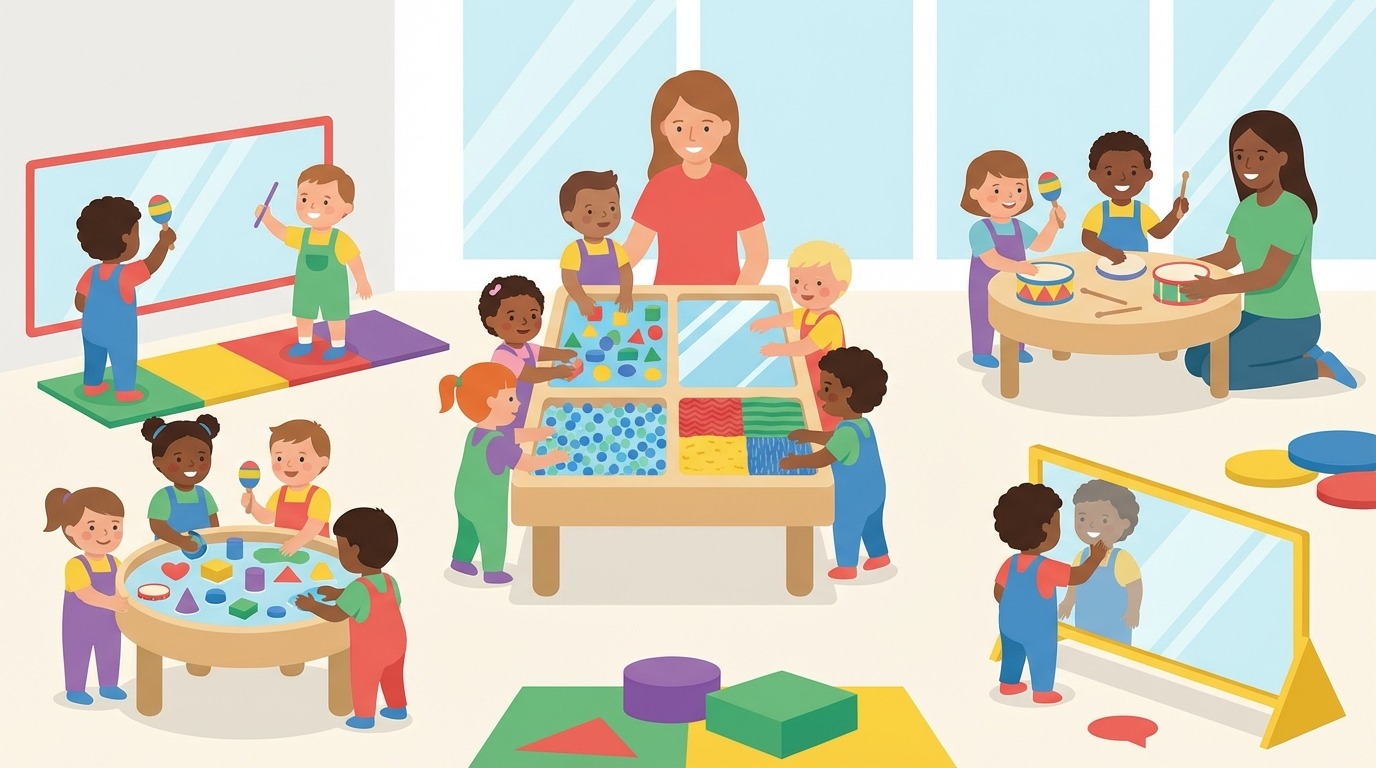
In the fictional workshop “The Little Explorers,” Camille prepares tactile bins, an exploration mirror, a small percussion kit, and scented bottles. Each sequence lasts ten minutes, with a clear objective and an opening ritual. The children derive visible pleasure: more initiative, enriched language, and growing confidence. Inspired by reliable resources and filmed demonstrations, it becomes easy to orchestrate finely dosed sensory awakening moments. The key remains to observe the child, adjust intensity, and maintain a joyful and secure atmosphere, progressing step by step without pressure.
Awakening the senses with video: why sensory activities make a difference
A filmed situation makes the instructions readable and concrete. The adult sees the right gesture, posture, and adapted difficulty level. Result: fewer hesitations, and better calibrated playful activities for young children with very variable rhythms. Moreover, the video facilitates preparation. Material lists appear clearly, as well as timings and variations.
On the sensory development front, the effect is twofold. On one side, sensory exploration nourishes brain plasticity. On the other, step-by-step structuring anchors learning over time. Each mini-sequence links a sensation to a word, then to an action: touching water beads, naming “slippery,” pouring with a ladle. This sensation–language–gesture trio accelerates integration.
In the “Little Explorers” workshop, Lila (2 years) and Naël (4 years) experiment with the same tactile bin but in different ways. Lila plunges her hands, observes, then imitates Camille. Naël sorts, counts, and invents a game rule. The video framework, seen before the activity, set the model. Yet, the freedom to explore remains complete. This just balance triggers the desire to try, then to dare to try again.
Safety is another advantage. Serious tutorials detail precautions: sizes of elements, non-irritating textures, cleaning. This vigilance makes tactile stimulation reassuring. Additionally, a reference article on the consequences of overstimulation helps dose stimulations. Signs of fatigue are spotted and adjustments are made gently.
Finally, these videos inspire rich vocabulary. Describing a sensation, comparing two textures, telling an action—all this structures language. Consequently, comprehension sharpens and attention lengthens. Benefits also transfer to image reading and more abstract educational games, as the child has anchored references in the sensory.
Guiding principles for effective sessions
Some solid benchmarks are necessary. First, announce the objective: “Today, we explore soft and rough.” Then, offer a limited but attractive choice. Next, alternate cold and warm textures, calm sounds and rhythmic beats, soft lights and vivid reflections. Finally, ritualize the end: sort, wipe, name what was preferred.
- 🧭 Clear and visible objective on the work surface
- ⏱️ Short durations, frequent pauses, guided breathing
- 🧼 Clean, non-sharp materials, no small parts before age 3
- 🗣️ Simple keywords: soft, rough, slippery, cool
- 🧺 Participatory tidying up to finish the activity calmly
Adopted together, these principles create a safe, motivating exploration dynamic that is easy to repeat.
Tactile stimulation and fine motor skills: easy sensory exploration bins (with video)
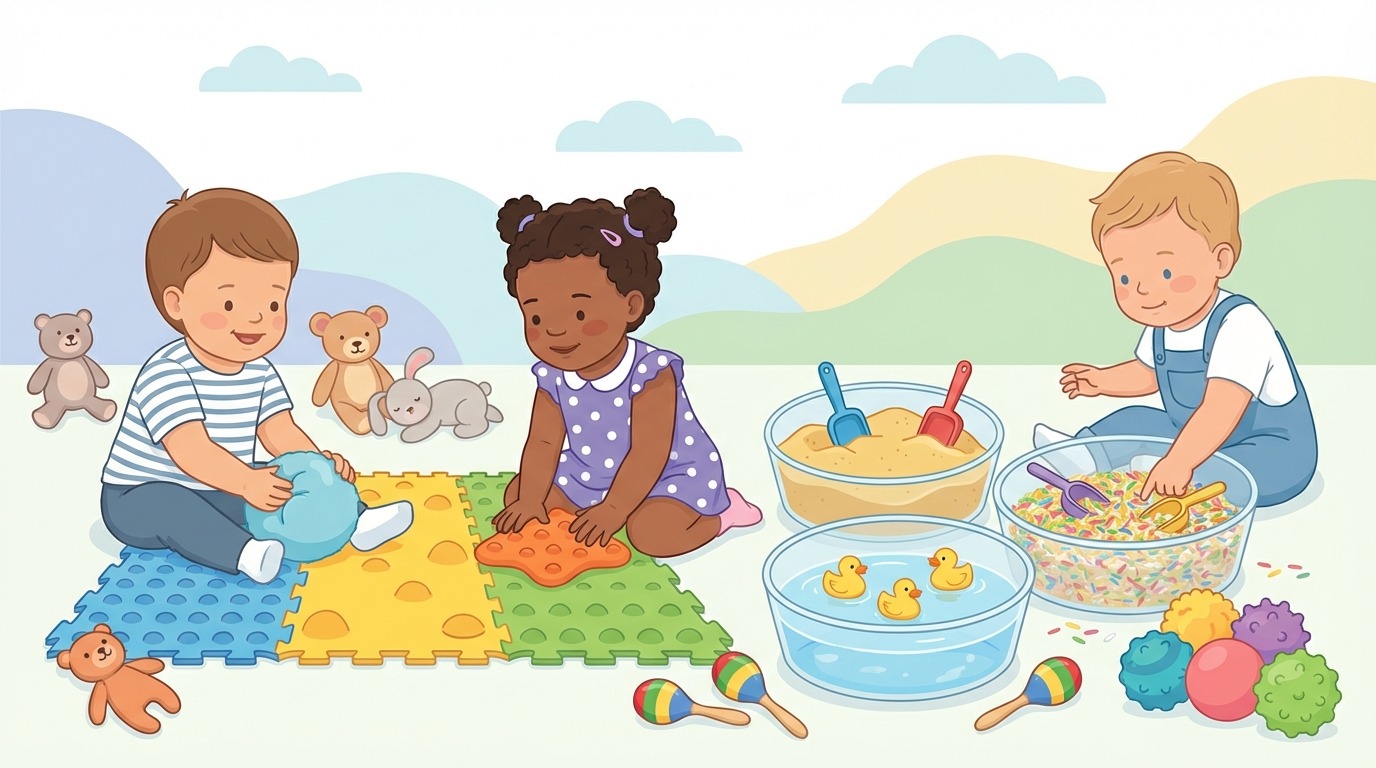
Touch remains the most obvious entry point. With a bin and three ingredients, you get a complete experience. Moreover, these proposals train fine motor skills, refine the pincer grip, and channel energy. Here is a progressive path, designed for different ages, with common materials.
Soothing bins and gradual discoveries
To start, a “cloud” bin is prepared in two minutes: shaving foam and a few drops of food coloring. The youngest trace paths, write with a thick brush, or hide figurines that are easy to rinse. One verbalizes: “it’s light,” “it melts,” “it sticks a bit.” The goal is pure sensory exploration, with no complex instructions.
Then you can move on to water beads. They swell and roll gently. The adult offers ladles, cups, funnels. One pours, sorts by color. Eye-hand coordination works intensely, while curiosity remains very active. For a drier variant, rice dyed with vinegar and colorants works wonders. It sounds, it slips, and it cleans up well with a broom.
Motor challenges and matching games
The “touch wall” emphasizes tactile identification. An opaque box, two openings for hands, and everyday objects to guess. This constraint strengthens attention while soliciting descriptive language. In parallel, the “texture memory” – two pieces of cardboard glued with different textures – exercises memory and discrimination.
To spice things up, “clothespins” on the edge of a box offer a short challenge. Eight pins to attach, then remove. Finger strength builds, and the child measures progress. You can time it, calmly compare two tries, or invite a friend to mimic the gestures.
Sensory bags and homemade modeling clay
Sensory bags, carefully sealed, reassure the youngest. Gel, glitter, flat beads are slipped inside. Fingers press, trace, encircle. Homemade modeling clay brings resistance and shape. Two cups of flour, one of salt, lukewarm water, a few drops of oil, and off you go. Roll, cut, use cookie cutters; the palette of action verbs explodes.
To visualize step by step and adjust the level, a filmed tutorial remains precious. Demonstrations allow anticipating splashes, dosing quantities, and arranging space without stress.
After watching, organization becomes smooth. The mat is laid, the towel ready, the soap within reach. Each child receives a simple role: pour, count to ten, sort. We conclude by naming three sensations, then tidying up together. The satisfaction felt depends as much on the experience as on this closing ritual.
For even more graduated and tested ideas, the proposals of sensory activities for toddlers form an excellent base. Seasonal variants ideal for renewing pleasures without multiplying materials can be picked there.
Educational games for sight: visual and observation experiences inspired by nature
Vision guides fine exploration. Yet, it is not just about “looking.” It involves learning to compare, distinguish, anticipate. Very simple workshops reinforce these skills. Bonus: they transpose outdoors as soon as a sunbeam joins in.
Magnifying frame, color sorting, and shape hunt
A magnifying frame transforms a walk into a miniature safari. Veined leaves, cracked bark, mottled petals, each detail unfolds a story. Back inside, a palette is reconstructed: moss green, olive green, fir green. Children sort, line up, name. Vocabulary enriches, attention settles.
Color sorting is organized with egg cartons. The cells are painted, matching objects offered. The goal? To associate, but also to argue: why does this bead go in the “midnight blue” compartment? This micro-negotiation develops cognitive flexibility as much as visual precision.
Exploration mirror and creative reflections
The exploration mirror multiplies perspectives. Transparent blocks, shells, symmetrical figurines are placed. Reflections stimulate imagination and logic. Older children trace the shadow of an object on paper, then compare with its real silhouette. They understand that light, angle, and material continuously interact.
A “light corner” is built with a soft lamp, tracing paper, and some prisms. Prisms diffract, tracings soothe, shadows dance. A child sensitive to too bright flashes then benefits from muffled atmospheres. The instruction remains brief, the observation prolonged. Silences are accepted, signaling quality concentration.
Go outside when possible
As soon as the sky clears, nature becomes a laboratory. Shiny pebbles after rain, leaf veins, bark varieties nourish contrast perception. These experiences extend table workshops and solidify references. To organize outings and vary points of interest, one can draw inspiration from this selection of spring outings with family. Impromptu sensory trails benefit from increased diversity without extra costs.
Finally, the eye rests better when the alternation rule is respected: near/far, still/moving, dark/light. This balance protects engagement and good mood. It installs a reflex: first explore, then name, finally tidy up. Again, repetition creates mastery.
Discovering sounds: mini-concerts, active listening, and language in motion
The sound world is a playground that shapes attention and supports speech. When a child taps, rubs, blows, or shakes, they test simple laws. At the same time, they synchronize gestures and enrich syllable stock. A well-led musical sequence thus associates rhythm, coordination, and language.
Percussion kit and sound-reflecting balls
A light percussion kit is enough. Start with a common beat: tapping together on a tambourine. Then alternate hands and maracas. The group learns to stop suddenly on a signal. This inhibitory control game pleases as much as it structures. Reflective sensory balls add a visual dimension. They roll, ring, sometimes light up. Children make hypotheses: “this one goes straighter,” “that one rings.”
Verbalize in parallel: loud/soft, fast/slow, low/high-pitched. This lexicon prepares ears for language sounds. When doubt arises about articulation, it is useful to consult documentation. An insight like “when a child mispronounces certain sounds” helps distinguish what’s typical development and what requires professional advice.
Guided listening and sound paths at home
“Sound bingo” is prepared with everyday noises: crinkling a bag, running water, turning key. A sound is played, the child checks the corresponding box. This matching game sharpens the ear and stimulates working memory. In addition, a short “listening walk” in the apartment or garden offers a simple challenge: note three nearby sounds, then three distant sounds.
A well-thought video shows how to organize space, adjust volume, and ritualize breaks. It also gives ideas for body rhythms: walk–tap–clap–silence. This setup keeps on course while allowing improvisation to join in.
After this musical time, a calming down is required. Turn off the music, listen to breathing. Name a positive sensation experienced: “I liked the sound of cymbals.” This loop closes the activity and anchors a pleasant memory. Mechanically, future sessions become smoother, as the brain associates the musical framework with mastered pleasure.
Smell and taste: olfactory workshops, sensory cooking, and lasting memories
Smell is linked to emotions and memories. It deserves its space in the path. You can start with three differentiated bottles: vanilla, lemon, cinnamon. Children smell, describe, then sort from “sweetest” to “strongest.” The instruction remains light. Every description attempt is validated, even approximate. This climate of trust encourages exploration.
Multisensory gels and everyday scents
A multisensory gel, applied on the hand, brings a double surprise: identifiable scent and fresh, sometimes crackling, sensation. Laughter and curiosity join in. This is an opportunity to work the sequence: smell, describe, compare, clean. This “four gestures” parable makes the activity reproducible. It facilitates autonomy in the youngest.
Next are smelling pouches. Ground coffee, thyme, zest are slipped in. Bags are pressed, sniffed, placed down. You can play “find the duplicate”: two identical pouches among six. This game structures olfactory memory. It also builds bridges to cooking.
Sensory cooking and useful precautions
A buttered tartine with fine herbs sums up the approach. Spread, smell, taste. Texture changes under fingers, smell precedes the bite. Children lean in, compare, joke. This simple ritual nurtures self-esteem: “I prepare, so I can.” As a precaution, allergies are checked and everything is cut into very small pieces.
To vary, “scent powders” are made with icing sugar and mild spices. A stencil placed on a white plate allows sprinkling a pattern. Gesture becomes precise, almost calligraphic. Photographs are taken, then tasting follows. Older children note three keywords per scent. Memory fixes better this way.
When inspiration lacks, a reservoir of creative activities at home can restart the engine. There you find artistic detours useful to make tastes, smells, and colors dialogue. Ultimately, these relays maintain motivation and renew wonder.
Organizational guidelines
Three to five scents per session are more than enough. The order of presentation matters: start with the mildest. The alternate sequence smell–fresh air–smell protects against saturation. This olfactory hygiene makes the activity available day by day without weariness. Behind the scenes, the child learns to listen to themselves and calibrate effort.
At the end of these workshops, children possess a small aroma map. They dare to say “I like” or “I don’t like” without shame. This emotional skill, often neglected, becomes a pillar for other learning. It also smooths group life.
Rhythms, safety, and serenity: orchestrating sessions and preventing overstimulation
Well dosed, sensory input illuminates everyday life. Poorly dosed, it tires. The difference comes down to three levers: duration, intensity, and variety. The adult adjusts these controls using observable clues. Fluttering eyes, scattered gestures, raising voice: all signs it’s time to slow down.
Recommended durations and alternation
A simple guideline is to modulate sequence length according to age. This table serves as a reminder. It does not impose a rigid constraint. It recalls good pedagogical sense.
| Age 👶👧 | Suggested duration ⏱️ |
|---|---|
| 12–24 months | 5–8 minutes per proposal |
| 2–3 years | 8–12 minutes, then pause |
| 4–5 years | 12–15 minutes, with variation |
Between two proposals, guided breathing is enough to reset attention. Drink a little water, stretch, each puts away an object. This micro-pause prevents tension buildup. It establishes a rhythm that children anticipate and reassures everyone.
Preparing space and afterward
A washable sheet or mat under the bins reduces mishaps. Paper towel rolls and a basin of lukewarm water wait discreetly. Anticipation saves mental load. The child feels the adult is available. They explore better. They also accept the end ritual more willingly because everything is smooth.
Inviting relatives can amplify success. A grandparent playing “time keeper” or “tidying chief” strengthens cohesion. Additionally, one can draw inspiration from feedback such as these activities tested with a 17-month-old baby. The concrete adjustments there are instructive and reassures beginners.
Preventing overstimulation and bouncing back
The golden rule: few objects, placed with intention. Too many stimuli cancel the learning effect. In case of overflow, reduce the bin size, lighten the goal, lower the noise. This refocusing soothes. To go deeper, a documented insight on the consequences of overstimulation distinguishes temporary overload and chronic overload. Refer to it to build a sustainable progression.
Deep down, the issue is not to “do a lot.” It is to “do well, appropriately.” Seek intimate resonance: what awakens the desire to learn without extinguishing momentum. This simple compass guides all sessions, whatever the tool or theme.
“Light a spark through play, and let it grow at its own pace.”
How much time to plan per sensory activities session?
For toddlers, 5 to 8 minutes are sufficient. Between 2 and 3 years, aim for 8 to 12 minutes. From 4 to 5 years, 12 to 15 minutes with internal variation. Always insert a short break to avoid fatigue.
How to film a good sensory activity video at home?
Place the phone at hand height to capture gestures. Prepare materials beforehand and announce the objective in one sentence. Film a short take, in soft light. Add simple subtitles to recall the steps.
What signs show overstimulation in a child?
Sudden agitation, avoiding eye contact, abrupt gestures, rising voice or quick crying. Then lighten the activity, lower volume, offer water, then move to a calm tidying task. A useful insight: the consequences of overstimulation presented by specialized sources.
What to do if a child doesn’t like getting hands dirty?
Offer a closed sensory bag, thin gloves, or a wide brush. Start with dry textures (rice, pasta), then gradually move to wet at their pace. Value every attempt and provide a basin of lukewarm water nearby for reassurance.
How to renew ideas without buying materials?
Recycle kitchen and cupboards: rice, pasta, egg cartons, fabrics, clothespins. Vary rules rather than objects. To quickly pick ideas, consult lists of regularly updated home activity ideas.