
Development 3-4 Years: Key milestones in the development of a child from 3 to 4 years old.
| Short on time? Here’s the essentials |
|---|
| 🧠 Between 3 and 4 years old, learning explodes: language, motor development, curiosity and attention strengthen. |
| 🤸 Motor skills: gross motor skills become smoother, fine motor skills prepare for writing. |
| 🗣 Talk, read, sing: these rituals nurture language and thinking. |
| 🤝 Socialization is structured through simple rules, taking turns and symbolic play. |
| 💛 Emotions are learned: naming, validating, breathing, then acting. |
| 🎒 Autonomy is based on clear routines: dressing, tidying up, washing hands. |
At 3-4 years, the child goes through a decisive period where their motor development, language, and social skills intertwine to build solid landmarks. Every day offers an opportunity to practice fine motor skills and gross motor skills, to question the world and forge connections. In a safe environment, their desire for autonomy shows everywhere: dressing, negotiating a turn on the slide, telling about their day.
This milestone phase before kindergarten benefits from enthusiastic and methodical support. Concrete activities, simple words, coherent rules, and symbolic play form an ecosystem favorable to learning. The goal is not to go fast, but to honor each progress and cultivate the joyful attention that arises when the child feels understood and competent.
Development 3-4 years: boosting gross motor skills and fine motor skills daily
Between 3 and 4 years old, running becomes smoother, jumping with both feet gains stability, and climbing is no longer a risky challenge. This confidence in gross motor skills can be seen both in the playground and the living room: the child better anticipates space, adjusts supports, and regulates effort. Meanwhile, fine motor skills make a decisive leap: holding a pencil between thumb and fingers, threading large beads, cutting on a thick line consolidates key abilities for school.
A concrete example? Lina, 3 and a half years old, draws “roads” for her cars. She holds her felt-tip pen too tightly, then discovers that a “pinch-slide” grip tires less. A few modeling clay sessions, pinching clothespins, and lines become more precise. This slow but steady process builds confidence: every success fuels the desire to try again.
Targeted activities that make the difference
Duplo Lego blocks, Janod and Melissa & Doug sets, puzzles with large grips or giant beads stimulate eye-hand coordination. Balance games, free dance, and improvised cushion courses work the body axis. Tools also matter: blunt-tip scissors, triangular pencils, height-adjusted tables. The challenge? Suitable materials that support effort without hindering it.
- 👣 Dynamic outings: walking, short runs, slaloms between cones for postural attention.
- ✂️ Cutting workshops: colored strips, stickers to guide fine motor skills.
- 🎨 Varied creativity: finger painting, stamps, modeling clay to strengthen fingers.
- 🧩 Construction: interlocking blocks, 6-12 piece puzzles for logic and coordination.
- 🧸 Ergonomic toys: large handles, varied textures, non-slip support.
A well-prepared environment helps a lot: soft clothes like Petit Bateau style, stable shoes, clear play area, protected “crafts” corner. The adult adjusts the challenge: neither too easy nor discouraging. When the setting is well prepared, the child dares more, which accelerates motor learning and regulation of attention.
As a reminder, postural foundations start early. Curious families can revisit the interest of “tummy time” in the first year on this clear article: the benefits of tummy time for babies. These basics partially explain the quality of head support and shoulder girdle observed thereafter.
Ultimately, motor progression at 3-4 years does not aim for performance. It establishes reliable automatisms, guarantors of autonomy and pleasure in action, which will serve equally on a bike or behind a kindergarten desk.
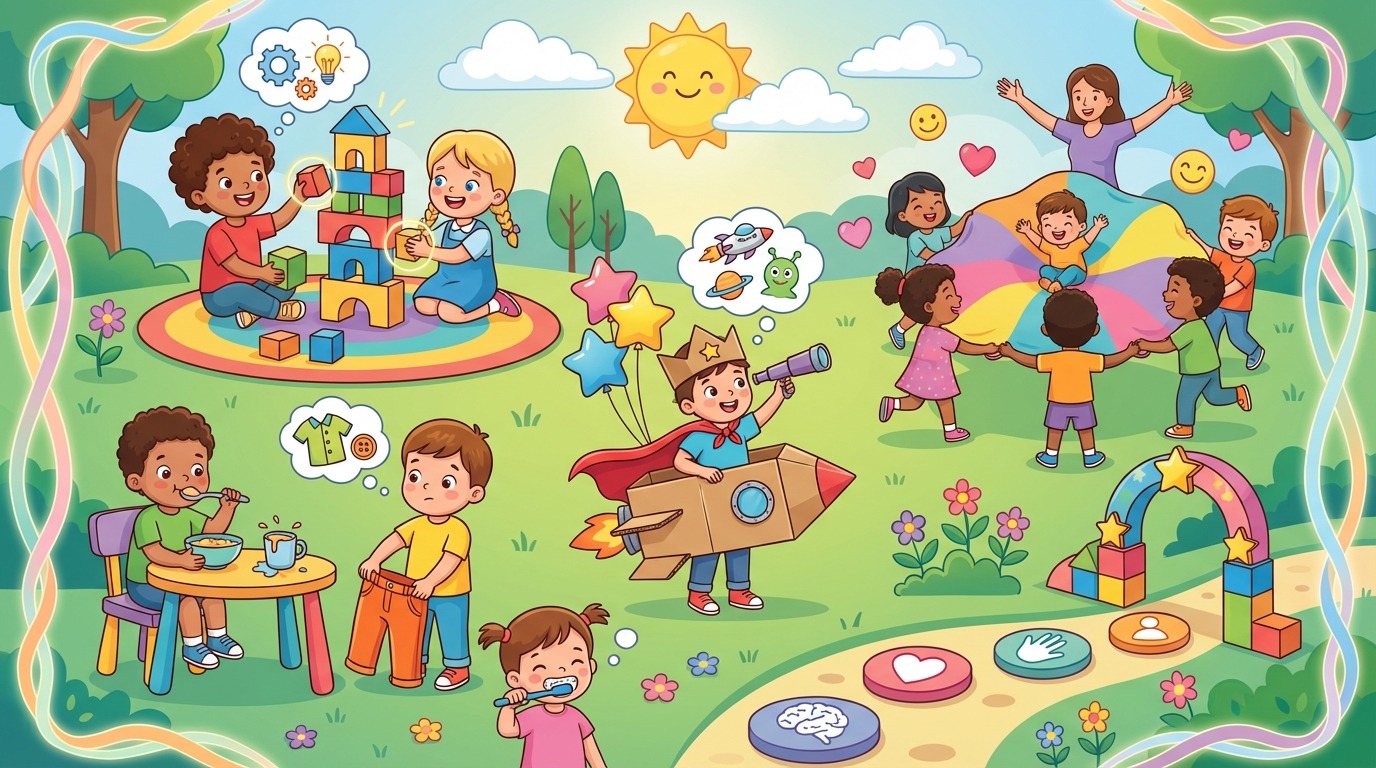
Language and communication at 3-4 years: questions, stories and conversations that build thinking
At this age, language unfolds rapidly. The “Why?” questions follow one another and reveal a brain seeking cause-and-effect links. Sentences lengthen, grammar becomes more stable, narration emerges. This verbal burst is not anecdotal: it structures thought and facilitates socialization. To speak is to organize the world.
How to nurture this momentum? With short, regular rituals. Reading at night, turning trips into verbal observation games, describing daily gestures (“You open the tap, the water flows…”) turn each moment into a linguistic learning workshop. Nursery rhymes add rhythm and memory, ideal for articulation and breath control.
Simple and powerful levers
Answering questions is not enough; you must also prompt further. Good practice is to reformulate and enrich. If the child says “red car,” add “Yes, a big red car driving fast on the wet road.” This kind mirror stretches vocabulary without harsh correction.
- 📚 Dialogued reading: point to pictures, anticipate what’s next, discuss the emotions of the characters.
- 🎵 Nursery rhymes and finger games: excellent for rhythm and articulation. See also these nursery rhymes for children.
- 🎭 Symbolic play: tea set, dollhouse, “veterinary workshop” for narration.
- 👥 Meetings: exchanges between children for turn-taking and politeness.
Need to clarify some common questions about children’s speech? This concise resource usefully enlightens parents: language questions in children. It helps distinguish normal variability and warning signs.
Music and movement further strengthen the body-voice link. A time for songs with coordinated gestures develops internal rhythm and auditory attention. It’s also an excellent moment of shared pleasure, therefore highly memorable.
The guiding principle is clear: multiply opportunities for expression without making it an evaluation. When the adult welcomes speech with curiosity, the child dares more ambitious structures. This is how language becomes an ally for autonomy and social understanding.
Autonomy and socialization: effective routines, clear rules and joyful cooperation
Around 3-4 years, “I do it myself” resonates in the home. Autonomy asserts itself in dressing, meals, and hygiene. This conquest is not egocentric; it supports socialization. A child able to put on their coat or tidy their blocks relates better to the group, as they can follow transitions without stress.
Routines, briefly explained then repeated, are the key. For example: “We put on shoes, check the fastening, choose the hat.” Three visual steps are often enough. Suitable materials help greatly: clothes with wide elastics, Velcro shoes, short toothbrushes, non-slip stools.
Cooperate, wait your turn, share: skills that are learned
Group life is built on simple rules. Cooperative games, cooking workshops and turn-taking set concrete frameworks. A card game like “families” is ideal to memorize rules, learn to lose and be patient. For example, this classic family game energizes exchanges: a fun 7 families game.
- 👕 Progressive dressing: first the coat, then the shoes; celebrate each step.
- 🧽 Ritualized hygiene: “hands-water-soap” song for sequential attention.
- 🧸 Fun tidying: baskets by category, visual timer ⏲️ for time.
- 🤝 Cooperation: simple cooking, watering plants, distributing towels.
Everyone progresses at their own pace. Some children, dreamy and slow to start, need visual signals and gentle transitions. To better understand these profiles and adapt expectations, this post provides insightful guidance: supporting a child in the clouds. Avoiding labels protects self-esteem and the desire to try.
Finally, beware the trap of an overloaded schedule. Too many activities harm emotional stability and the quality of learning. A useful guideline: if bedtimes become tense and irritability rises, lighten up. This analysis of overstimulation sums up the stakes: the impact of overstimulation in children. Offering free time is offering thoughtful autonomy.
The golden rule? Clear routines, realistic expectations, and contagious humor. This exact mix makes socialization bloom without drama.
Emotions and self-regulation at 3-4 years: understand, name, soothe, then repair
At this age, the inner world becomes complex. The child notices their emotions, but still struggles to regulate them. Tantrums erupt quickly, waiting is heavy, frustration stings. Rather than extinguish the fire at all costs, we learn to guide the flame: name, validate, breathe, propose an alternative. This approach sets lasting circuits of self-soothing.
The “3-4 year storms” are real and frequent. Understanding them helps to worry less and intervene better. To set useful and concrete landmarks, this concise guide is precious: better manage crises at 3-4 years. It also extends the famous “terrible two” while nuances the scale depending on profiles.
Concrete tools for the calm box
The calm corner is not a punishment but a refuge. We place a cushion, a glitter hourglass, an emotions picture book, a favorite plush toy there. We also practice butterfly breathing: hands on ribs, inhale as if smelling a flower, exhale as if blowing out a candle. Three cycles often suffice to lower the pressure.
- ❤️ Validate: “You are very angry; your toy was taken, that’s hard.”
- 🗨 Simple words: “You can say: I’m waiting my turn.”
- 🧘 Breathing: 3 slow inhales, 3 long exhales; find your body again.
- 🔄 Repair: propose a concrete gesture, like giving back, fixing, waiting.
Visual supports help a lot: emotions wheels, pictograms “I wait / I ask / I breathe.” Family consistency matters even more: if the adult models calm and repair, the child imitates. And when energy remains high, a short outing or dance release healthy tension.
During sensitive periods, the question of limits also returns. They protect and reassure when stable. Saying no to a third ice cream in the evening offers a framework where the brain can rest. Ultimately, self-regulation is taught every day, one micro-situation at a time.
Learning and preparation for kindergarten: symbolic play, logic, and sustained attention
Curiosity is the engine of learning between 3 and 4 years. Symbolic play transforms a box into a bus, a sheet into a cape, a living room into a forest. Through this intimate theater, the child assimilates social rules, experiments with roles, and weaves a coherent story. Meanwhile, logic games, sorting, and construction sharpen working memory and sustained attention, essential for listening in groups.
The winning duo? Variety and freedom. A sorting tray by colors, figurines to tell stories, 12-piece puzzles, magnetic letters and numbers open avenues without locking in. We follow the interest of the moment, change only one parameter at a time (size, number of pieces, instruction) to stay in an achievable challenge zone.
Concrete ideas to nurture cognitive momentum
- 🧩 Logic: progressive puzzles, interlocks, image dominos.
- 🔠 Pre-reading: movable letters, magnetic names, daily sound hunts.
- 🔢 Counting: setting the table, dice games, numbered egg cartons.
- 🔎 Science: water/sand, magnets, plants to observe and form hypotheses.
- 🎭 Symbolic play: huts, simple costumes, co-created scenarios.
While stimulating, we watch not to saturate. Attention builds better with alternating times: action then calm, noise then silence, group then individual. When fatigue signals appear (excitement, conflicts, clumsiness), we slow down. Balancing is not giving in; it optimizes learning.
Rich thematic vocabulary stories also prepare for school: job picture books, animal documentaries, slightly longer versions of tales. In case of fixating on the same story, repetition is accepted: it consolidates narrative structure and the pleasure of anticipating.
One last useful note: some late “crises” surprise near school age. They are not always worrying. To put these behaviors in developmental context, this reading offers a soothing framework: understanding the 2-year-old crisis and possible extensions.
In the end, preparing for schooling mainly means strengthening three pillars: emotional security, clear routines, and protected curiosity. The rest will follow with consistency and joy.
“Between 3 and 4 years, every small step is a great victory: cultivate momentum, frame play, and confidence will do the rest.”
What key signs show good motor development progress at 3-4 years?
A child runs and stops without falling, jumps with both feet together, climbs more smoothly. Regarding fine motor skills, they hold the pencil better, thread large beads, stick stickers and start cutting on wide lines.
How to enrich language without pressure?
Set up short rituals: dialogued reading, nursery rhymes, role games. Reformulate and add a word or idea to each of the child’s utterances. Avoid harsh corrections; rather show the good model with kindness.
What routines promote daily autonomy?
Dressing in three steps, washing hands with a song, tidying up by illustrated baskets, visual timer. Adapted materials (Velcro, wide handles) and brief instructions reassure and motivate.
How to react to tantrums?
Name the emotion, validate the feeling, suggest 3 slow breaths, offer a calm corner. When soothing returns, repair with a concrete gesture. Consistency of adults and stable limits reassure.
How to avoid overstimulation while supporting learning?
Alternate activity and rest, group and solo, screen off during key times. Watch for fatigue signals. Better fewer well-experienced activities than too many offers that eat up attentional availability.