Crafts 5-8 Years: Craft ideas for children aged 5 to 8.
| Short on time? Here’s the essentials ✨ |
|---|
| 🎨 Encourage childlike creativity with short, simple, and progressive hands-on activities. |
| 🔧 Focus on easy DIY and recycled materials for economical craft projects. |
| 🧠 Turn each workshop into educational activities that develop logic, language, and motor skills. |
| 🕒 At 5 years old as well as 8 years old, alternate quick challenges and longer manual games to maintain attention. |
| 🌱 Embed creative rituals throughout the seasons to give meaning to everyday creative hobbies. |
At the age of great discoveries, children’s crafts become an ideal playground to learn, dream, and assert oneself. Between 5 and 8 years old, hands coordinate better, curiosity explodes, and the need to act independently appears. Hands-on activities then provide a safe framework where one experiments with colors, materials, and precise gestures. They also open useful discussions: why recycle, how to cooperate, when to persevere. Each creation is not just a cute object, it’s a micro-adventure that structures thought and confidence.
For truly meaningful afternoons, the workshop is conceived as a little daily laboratory. Nature is invited, packaging is repurposed, stories are imagined, and games are even made. The goal is clear: offer suitable, stimulating, and progressive children’s DIY projects without overwhelming. Thus, a simple cardboard tube becomes a rocket, a jar turns into an ambient lamp, and a shoebox transforms into a theater. Between balance, pleasure, and autonomy, these creative hobbies do more than occupy time; they build shared memories that will last long.
DIY 5-8 years: basics, safety, and educational benefits
At this age, the hand refines and the mind organizes. Structuring a workshop corner encourages concentration and avoids conflicts over materials. A non-slip mat, a scrap bin, and appropriate scissors are often enough. With short and visual instructions, children move from trial to project. This clear framework supports childlike creativity without stifling it. Even better, it establishes a positive routine that reassures.
Fine motor skills and technical gestures
Cutting curves, piercing hole in foam board, gluing neatly, listing steps… all fine motor skills exercises that also prepare writing. We encourage slow and precise gestures, then progressively speed up. For example, making a pleated paper garland trains symmetry and patience. A child who perseveres on these gestures gains ease, visible in notebooks and crafts.
Autonomy and organization of thought
By offering simple checklists, the child visualizes progress on the craft project. They prepare, make, then tidy up. This triptych becomes a ritual. At 6, they can choose materials. At 8, they plan variations, like adding a mechanism to a pop-up card. Autonomy grows with room left for initiative. The adult supports, encourages, and values effort as much as the result.
Safety and suitable materials
Tools matter. Round-tipped scissors, non-toxic glue, mini glue gun under supervision, and everything goes well. The rule “hands behind the line” is taught when cutting. We favor lightweight and easy-to-handle materials: thin cardboard, felt, wooden sticks. Safety doesn’t limit ambition: a night lamp with a jar remains accessible if sensitive steps are guided.
Live example: during a Wednesday workshop, Lina improves her thumb grip with beads to string, while Max tackles a marine mobile. Each progresses at their own pace, but both discover that preparing a plan and checking pieces saves time. This joyful rigor installs itself durably. In short, a clear framework, adapted tools, and guided freedom are the foundations of fruitful workshops.
Smart recycling: easy craft ideas with everyday materials
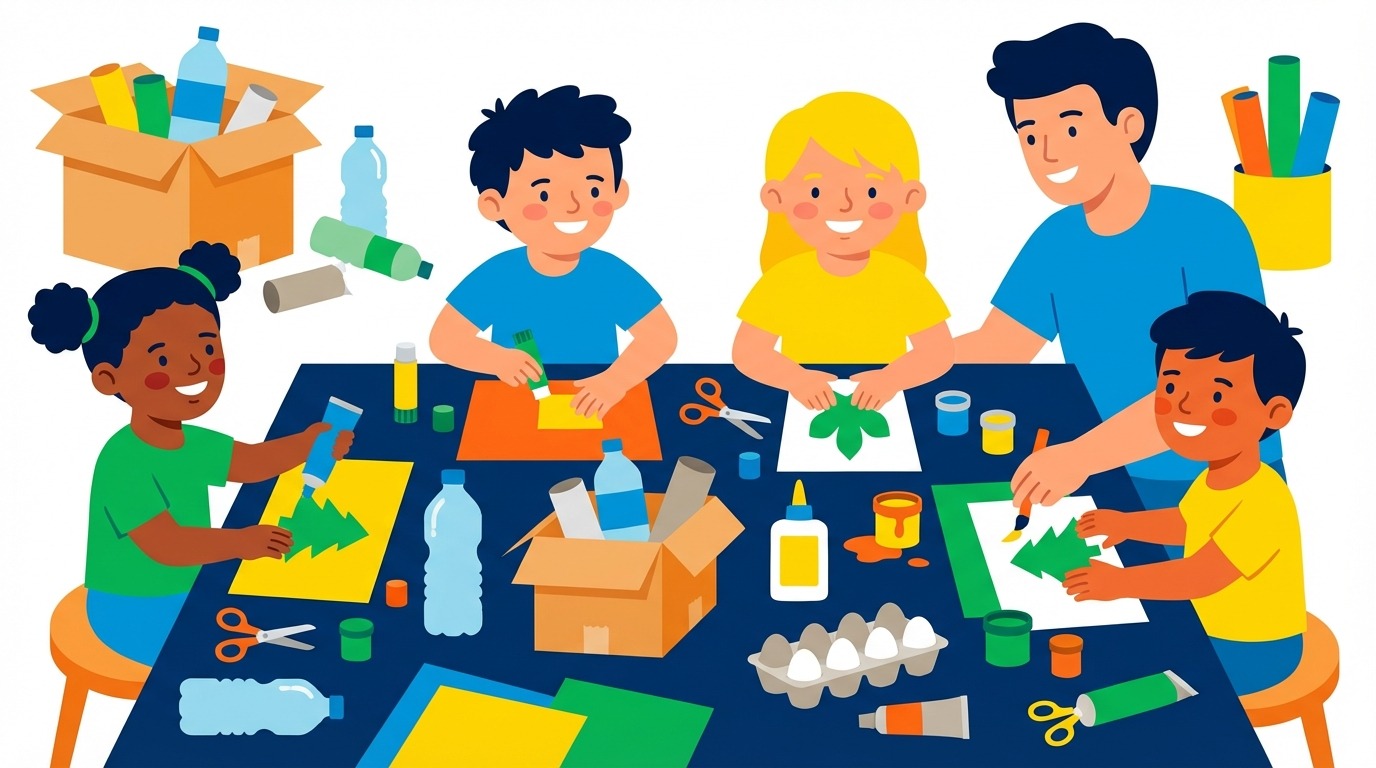
Recycling gives meaning to educational activities. By transforming scraps and packaging, children experiment with eco-design. The home overflows with treasures: egg cartons, tubes, caps, fabric scraps, jars. They are repurposed into animals, mini-gardens, or useful decorations. The joy of “doing with” feeds inventiveness and pride.
Egg cartons and tubes: animals and vehicles
The cells become turtle shells, caterpillars, or ladybugs. Tubes transform into rockets, owls, or small cars. Paint, glue on googly eyes, add paper wings. For more, homemade chalk always intrigues: the recipe with crushed shells stimulates scientific curiosity. A clear step-by-step is here: make chalk with eggshells. Children observe the material and compare colors.
Animal jars and soft lanterns
Glass or plastic jars morph into foxes, pandas, or jellyfish. Paint the outside, glue felt ears, then add a ribbon. Inside, an LED candle creates comforting light. This activity works layering and transparency effects. It suits a wide age range and keeps an elegant look on a shelf.
Smart printables to save time
When energy dips, printables restart the workshop stress-free. Cut, fold, assemble. Mechanism cards, masks, mini games… everything goes fast. A handy selection is here: DIY printables to keep handy. These supports free concentration for decoration and stories children invent.
For smooth sessions, preparing a “recycling box” remains strategic. Week by week, clean and interesting materials are slipped inside. Thus, the current desire finds its material immediately.
- 🧃 Caps, egg cartons, tubes: the base for versatile children’s DIY.
- 🧵 Felt scraps and ribbons: soft textures for animals and badges.
- 🖍️ Colored paper and light cardboard: structures, wings, roofs, pennants.
- ✨ Googly eyes, stickers, biodegradable glitter: quick finishes.
- 🧪 White glue, washable paint, water-based varnish: safety and cleanliness.
These paths combine motor skills, imagination, and eco-responsibility. Recycling stimulates resourcefulness, a key for engaged and joyful workshops.
After the video, invite children to choose a creation and personalize it with a common motif, for example a star or a wave. The group then produces a coherent collection, perfect for decorating a party or a room.
Holidays and seasons: hands-on activities that tell the year
Marking creative hobbies with the year’s highlights enhances creations. Each season inspires distinct materials and colors. We rely on this natural setting to give coherence to themes. The child better orients in time and understands traditions through creating.
Warm winter and December magic
In December, soft textures and dimmed lights comfort. A Santa Claus bag in kraft paper or felt becomes a symbol to personalize with letters and pompoms. An inspiring tutorial is available here: make a Santa Claus bag. Folding, cutting, and neat assembling are practiced. The workshop can include embossed greeting cards to explore relief.
Spring blooms and creative Easter
In spring, nature provides seeds, petals, and pastel shades. We make crepe paper flower crowns, vinegar-marble eggs, or napkin holder rabbits. These hands-on activities combine observation and invention. They invite to tell the cycle of life and germination. To memorize season-related nursery rhymes, workshop can be enriched with this list: nursery rhymes and songs for children. Music anchors memories and energizes the session.
Autumn nature and graphic Halloween
Leaves used as stencils allow exploring symmetries. We paint cardboard pumpkins, glue bat silhouettes. Children also design manual games like a “leaves and seeds” memory game. Ambiance-wise, orange and purple jar-lanterns create a soft glow for reading evenings.
Bright summer and travel journals
In summer, outdoor activities are favored: sun catchers from shrink plastic (with caution and ventilation), easy cyanotypes, or marine rain sticks. Travel journals mix maps, drawings, tickets, and mini envelopes. The child tells their discoveries with a narrative thread, strengthening written and oral expression.
Linking creation to seasons gives meaning, expands vocabulary, and sets exciting rituals. We make, contemplate, tell: the year becomes a story to decorate.
Craft projects lasting more than an hour: build, play, tell
Some long challenges nurture perseverance and teamwork. They turn the workshop into a joyful construction site. Children learn to measure, adjust, correct, and finalize. They then play with what they made, which extends interest.
Cardboard house and puppet theater
The cardboard hut remains a timeless classic. Doors and windows are drawn, angles reinforced with paper tape, then a facade is painted. A useful guide is here: build a cardboard house. After building, a curtain cut from an old t-shirt brings the theater to life. Children write a mini-script and make puppets and sets. They work on language, cooperation, and staging.
Homemade instruments and games to make
Tambourines from cardboard plates, guiros from caps, simplified kalimbas from sticks: sound becomes a material. Rhythm and intensity are explored, then a “concert” is recorded on the family phone. For games, a garden bowling with recycled bottles mixes sport and creation. To extend momentum, check this idea: make a family bowling game. The build seeks stability, decoration asserts style.
Mini-engineer challenges
At 7 or 8 years old, simple mechanisms are daringly tried: spinning wheel, sliding tab, lever model. Children test, err, retry, then succeed. This brain gymnastics feeds logic and patience. Adults ask questions: what happens if the cardboard is too thin? How to spread glue?
When the project becomes a game, motivation soars. Children then protect, repair, and improve their creation. The loop is virtuous: design, build, use, then optimize.
After this source of inspiration, propose a “committee of improvements”: everyone suggests a useful or decorative addition. We vote, plan, and carry out. Collective decisions strengthen the project’s meaning.
Cross-cutting skills and digital-creative balance
Children’s craft workshops radiate well beyond the gesture. They develop vocabulary, logic, sense of effort, and mutual aid. Each session can connect several areas. We measure a hut door (math), describe a set (language), cut to the millimeter (motor skills), recycle (environmental education). This weaving of knowledge makes learning tangible.
Motor skills, autonomy, and daily gestures
Learning to tie, lace, tighten a ribbon: these gestures matter in daily life. A clear guide helps a lot, for example with loops and knots: learn knots and loops. In workshops, they are practiced on cardboard lace cards. The child gains autonomy and transfers these skills to dressing.
Language, storytelling, and expression
Giving a title to a creation, describing a step, pitching a story: so many opportunities to enrich vocabulary. We encourage “before/after” photos and mini-exhibitions at home. Children become proud ambassadors of their craft projects, strengthening speaking skills.
Math, science, and critical thinking
Measuring, counting, comparing: proportion becomes concrete with a stick bridge. Science-wise, making chalks, mild reaction volcanoes, or plant-based inks gives meaning to concepts. We ask questions, observe, and conclude. Scientific thinking awakens through the hand.
Balance with screens
Screens attract, it’s normal. The challenge is to balance time. The workshop can be presented as a tempting alternative to video games. Guidelines on usage help families get organized: video games and children 5 to 8 years old. Then a “busy hands” slot is ritualized giving easy DIY its place without demonizing digital devices.
One last tip: creating felt foods for playing chef stimulates imagination and language. We sort “vegetables,” invent menus, swap roles. Here is a creative kitchen that whets the appetite and strengthens social skills.
“A hand that creates lights a mind that grows.”
What basic materials are needed to start workshops for 5-8 year olds ?
Prepare round-tipped scissors, white glue, paper tape, colored paper, light cardboard, felt, wooden sticks, googly eyes, washable paint, and some brushes. Add a clean recycling box and a protective mat. ✂️🧼
How to adapt an activity for 5 years old and then 8 years old ?
Offer a simple version with few steps and large pieces for 5 year olds. At 8 years, add details: patterns, mechanisms, more precise assemblies. Same theme, two levels, everyone benefits. 🎯
How long should a session last ?
Between 25 and 35 minutes for a short activity, up to 90 minutes for a long project. Alternate paces and plan a break in the middle of extended workshops. 🕒
How to value children’s creations ?
Organize a mini-exhibition at home, take before/after photos, create a “hallway museum.” Also offer some works: they become gifts filled with emotion. 🎁
Where can you find ready-to-use ideas ?
Combine household recycling, handy printables, and some video tutorials. Keep resource-links handy to avoid creative block. 💡