Power Puppets Children: The power of puppets in children
| Short on time? Here’s the essentials ⚡ |
|---|
| Puppets free the emotional expression of children and encourage peaceful communication 🤝 |
| As an educational game, they boost attention, language, and active learning 📚 |
| Creativity flourishes through making and staging, while strengthening fine motor skills ✂️ |
| For managing fears, anger, and transitions, pocket theatre becomes a true therapeutic power 💡 |
| A well-guided story helps each child find solutions and strengthens their socio-emotional development 🌱 |
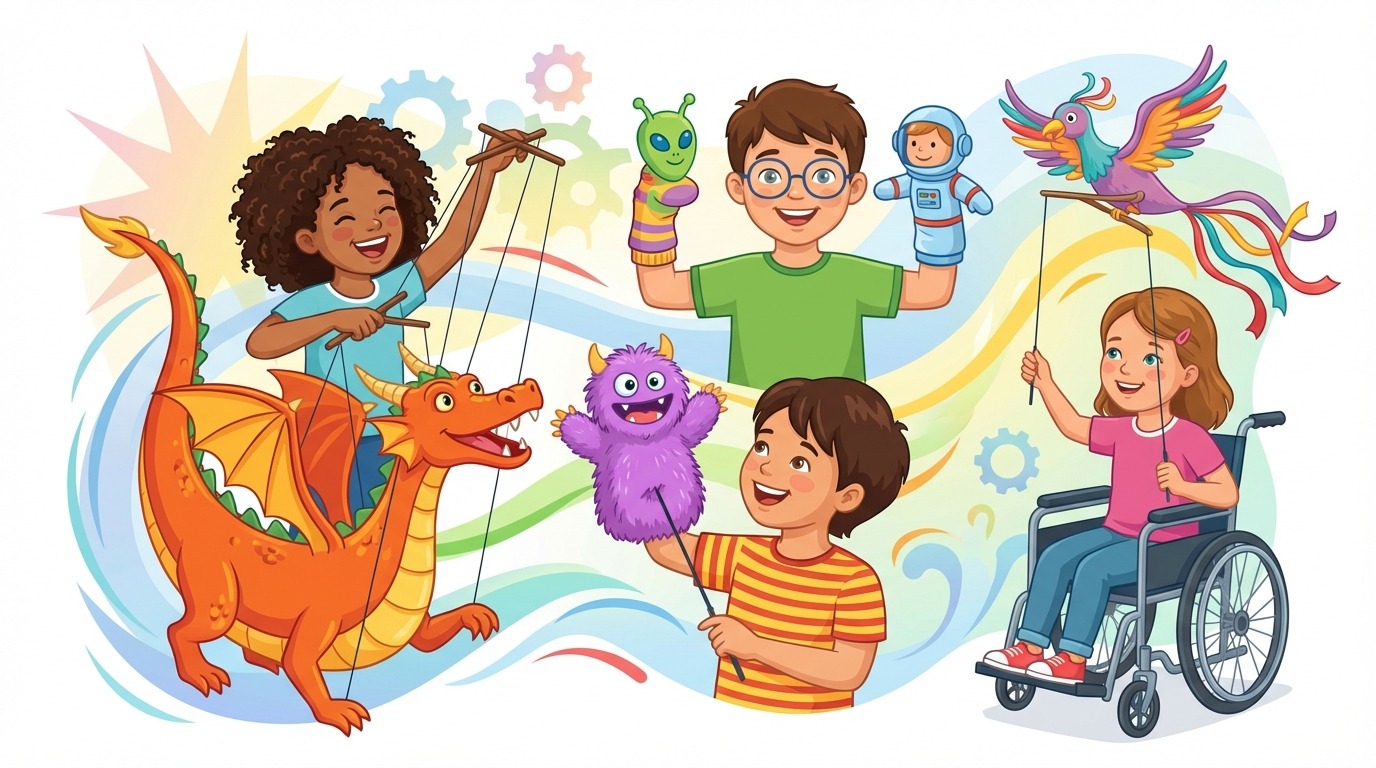
In a child’s hands, a puppet is never just a simple toy. It becomes an ally who dares to speak, feel, question, and propose outlets when words are missing. Thanks to this little character, imagination takes the lead, emotions find a safe path, and the brain learns to make connections. In nurseries, schools, and workshops, one can observe surprisingly rich scenes: a “little bear” that reassures, a “sock” asking for help, a “toad” finally daring to jump towards others. Suddenly, the room transforms into a living learning stage.
This success owes nothing to chance. Children quickly enter the story and naturally identify with the hero. As a result, messages get through better and sensitive topics can be approached without rushing. Through this, creativity activates, communication opens up, and overall development is strengthened. So, why miss out on such a lever? Between laughter, felt silhouettes, and modulated voices, puppets prove day after day their discreet and powerful influence.
Power of Children’s Puppets: Emotions and Imagination in Action
Immediate Identification and Removal of Blockages
Children bond within seconds to a character who looks at them and speaks to them. Thus, a “little wolf” or “little toad” puppet attracts tenderness and invites expression without fear of judgment. Because symbolic distance protects, delicate topics become speakable. For example, a reserved child offers to help “Little Toad” reach the pond, while suggesting in an undertone what he needs to dare to integrate. Thanks to this mediation, expression gains clarity and the message takes shape.
According to several clinicians, including psychologists specialized in hypnosis and therapeutic narration, focusing on the story activates useful internal processes. In other words, identification diverts conscious attention from obstacles and opens a door to emotional adjustment. In practice, when children shout “watch out!” to the hero, they fully engage, and this involvement becomes a ramp toward trust. This mechanism promotes a calm regulation of emotions.
Attachment Observed Live
Nothing illuminates the attachment system better than a mini-adventure. Thus, placing the puppet in a short dead-end — lost in the forest or separated from its favorite bag — reveals children’s internal compass. Some remain still, others seek an adult, others still imagine a solution. Then, the adult can prompt: “What can Little Bear do now?” This simple question pushes the group to co-construct outcomes and, gradually, to internalize the idea that help or strategies always exist.
In a neighborhood workshop, a group of children aged 4 to 6 suggested calling the puppet’s grandmother using a “leaf-phone.” This playful detail brings smiles but also signals an inner resource: transforming the environment to cooperate and reassure. Through this light drama, socio-emotional development finds fertile ground, because the child tests hypotheses within a safe space.
Putting Words to What One Feels
When the puppet worries, trembles, then breathes deeply to calm down, it shows a model of emotional learning. Then, the adult gently names the state: “You seem angry,” “That looks like fear.” Thanks to this mirror, communication adjusts and children understand that an emotion is experienced and regulated. To complement this work, resources on social skills support adults wishing to extend this ritual daily.
For the shyest, a detour through fiction eases pressure. Thus, a puppet wanting to talk to the librarian but not daring becomes a bridge. Then, generalization happens with concrete advice, echoing content like helping a child talk to adults. Through brief staged scenes, confidence rises, the voice settles, and the child feels ready to try in real life.
Educational Game and Active Learning with Puppets
Capture Attention, Anchor Concepts
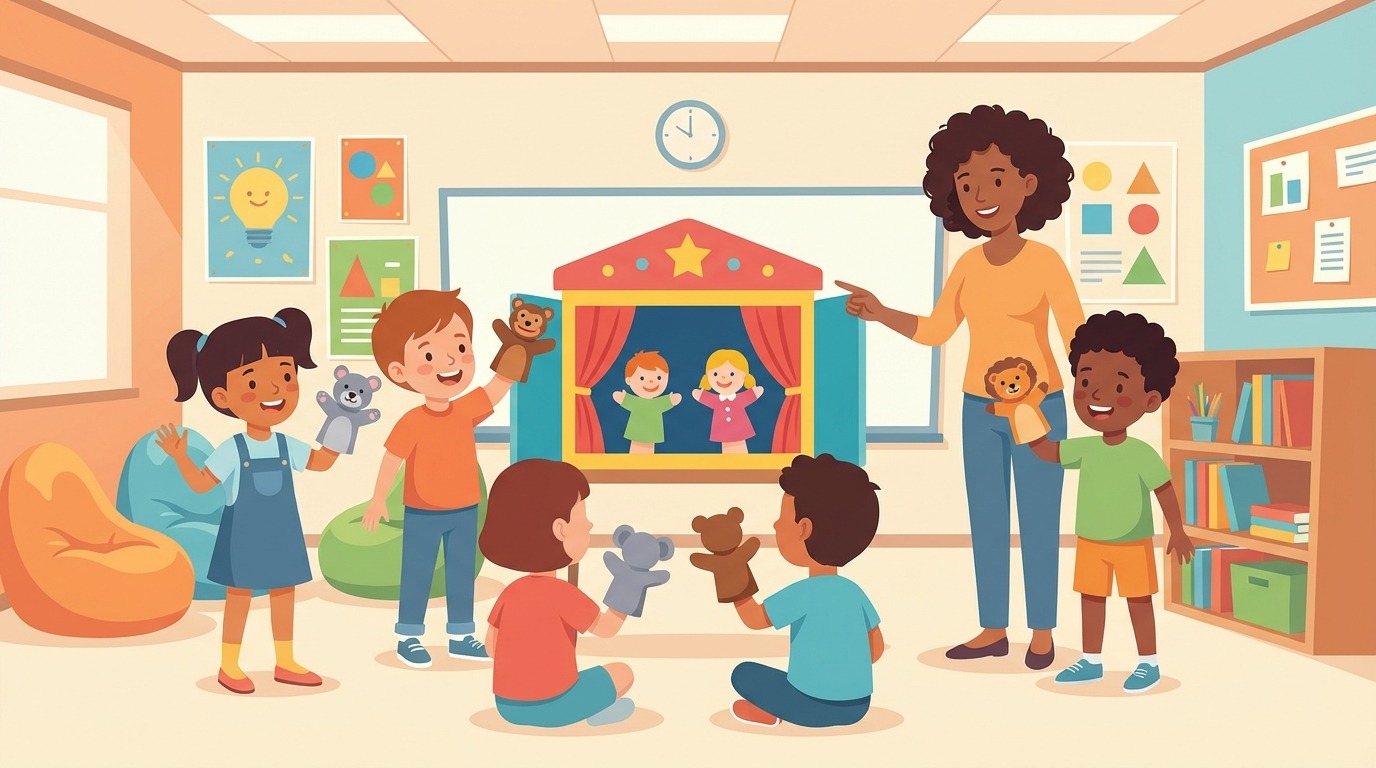
Introducing a puppet in the middle of a lesson creates a narrative break that recaptures attention. Then, everything becomes more concrete: the felt tyrannosaurus explains the food chain; the paper giraffe measures cubes; the frog counts its hops. Thanks to this “theatrical detour,” learning happens through action and dialogue. Moreover, children manipulate, question, correct, and a rapid transition from passive listening to reasoning is observed.
In a multi-age class, a teacher places a “Mrs. Sound” puppet to work on rhyme and intonation. Thus, students repeat with pleasure, correct the heroine when she purposely makes mistakes, and remember better. To nourish reflection, these sessions can be combined with insights on intellectual development, alternating memorization, comprehension, and transfer.
Language, Mathematics, and Sciences in Pocket Theatre
The strength of the setup lies in its flexibility. On one hand, language is worked through dialogues, stories, and reformulations. On the other, mathematics gain meaning through scripted problem situations. Then, sciences are illustrated with models and simple experiments carried by characters who ask the right questions. This approach encourages precise communication and self-correction: children confront their hypotheses and adjust collectively.
In the “Zoom on Insects” workshop, the Ladybug puppet miscounts the number of legs. Thus, students check, count together, and reformulate. Through this back and forth, creativity blends with rigor. At the end of the session, a short written record fixes the acquired knowledge, while the puppet commits to “come back to check tomorrow,” strengthening the desire to learn more.
Class Rituals and Joyful Assessment
An opening ritual carried by a puppet favors the class atmosphere. Then, the assessment can become playful: the child “explains” to the puppet how to solve a problem, revealing what they really know how to do. This principle strengthens self-efficacy and metacognition. To enrich practice, rely on explicit criteria displayed by the character to clarify expectations. Thus, success is no longer a verdict but a visible progression.
Finally, the pivotal role of the puppet facilitates inclusion. In a heterogeneous group, the character reformulates instructions with gestures and images. Then, the whole class benefits from this body language, as understanding broadens. Bit by bit, common learning gains in depth and kindness.
To continue independently, a short narration video with puppets guides parents and teachers toward effective and easy-to-reproduce formats.
Socio-emotional Development: Communication, Attachment, and Regulation
Giving Voice to Emotions Without Overwhelming the Child
The puppet speaks loudly, softly, or very quietly. Thus, it stages joy, jealousy, fear, then shows calm. Then, the child observes, imitates, and tries naming their own inner weather. Through this detour, shame recedes, and communication gains nuance. In parallel, the group learns to listen and validate. This foundation strengthens bonds and equips each for relational challenges.
In case of a storm, a simple ritual reassures: “We breathe with the puppet, name the feeling, choose a strategy.” To go further, practical content on tantrums provides clear markers. Then, the character can model the return to calm: drink water, ask for a hug, isolate for a moment, then return to the group. This scenario gives a map for reality.
I Cooperate, You Cooperate, We Play Better
Role plays with puppets generate opportunities for cooperation. Thus, sharing props, waiting your turn, negotiating an ending foster micro social skills. To support this work, the pathways on social skills help structure expectations. Then, the adult assigns rotating roles — narrator, handler, observer — to balance responsibilities. This framework promotes speaking up and active listening.
In an after-school club, Kenzo, initially a spectator, becomes the puppet’s “voice coach.” Immediately, he discovers a skill and dares to ask for the floor. As a result, his posture changes within the group, and fewer interruptions are noticed. Through this dynamic, relational development advances in small, steady, visible steps.
Daring the Adult Through Fictional Detour
Many children dread talking to an unknown adult. Thus, a puppet who asks for help from the janitor or nurse stages keywords: hello, please, thank you. Then, the child repeats in duo with the character, then tries alone. Supported by a guide like helping a child talk to adults, concrete scenarios are provided. Over repetitions, skill consolidates and extends beyond the playful frame.
Ultimately, the puppet acts as a ramp to social autonomy. Once the phrase is tested on stage, the child feels legitimate to reuse it. And when hesitation returns, the character reappears, like a benevolent tutor.
These video formats inspire micro-sessions of 5 to 10 minutes, ideal to ritualize regulation and speaking up.
Creativity and Making: From Craft to Stage, a Driver of Self-Esteem
Building to Grow Better
Making a puppet is already telling a story. Thus, choosing a material, gluing eyes, attaching a mouth, then testing voices engages fine motor skills and imagination. Then, the child feels the pride of creating a stage ally with their own hands. This step nourishes learning by doing. To guide 5-8 year olds, ideas for easy crafts provide a safe and adaptable base.
Choosing tools also matters. To limit frustration, soft materials and fast glues are preferred. In parallel, textures vary: foam board, felt, wool. Thus, every child finds a way to succeed. As a bonus, the final scene highlights effort: the audience applauds, and self-esteem rises.
Ages, Media, and Objectives
Adapting the format to the group profile smooths the experience. Then, short cycles with visible progression from session to session can be planned. The table below offers useful tracks to personalize according to your constraints.
| Age 👶👧🧒 | Type of Puppet 🎭 | Main Objectives 🎯 | Practical Tip 💡 |
|---|---|---|---|
| 1-3 years | Paper bags, socks | Motor skills, non-verbal communication | Play with boxes: see box ideas 📦 |
| 4-6 years | Finger, stick | Expression of emotions, listening | Short rituals, 10 minutes ⏱️ |
| 7-9 years | Sleeve, rods | Language, narration, cooperation | Simple storyboard 🗂️ |
| 10+ years | Shadows, marottes | Research, staging | Technical team and stage management 🎚️ |
Choosing Well and Scriptwriting
Good equipment serves the story, not the other way around. Thus, few accessories are selected, but coherent with the character’s universe. Then, voice, gestures, and space are considered. To refine the kit, benchmarks for choosing suitable toys help find the right balance between robustness, safety, and educational interest. As a bonus, a “backstage” box holds the sets and structures the session.
Before the performance, a simple storyline suffices: starting situation, obstacle, solution, return to calm. Thus, the child learns narrative logic without getting lost. Repeating, creativity grows, and everyone dares their variation.
- 🎯 Define a clear goal for the session (emotion, concept, cooperation)
- 🎭 Limit the number of characters to encourage communication
- 🗣️ Work on one voice per puppet for expression
- 🧩 Plan a small unexpected event to stimulate creativity
- 🧘 Include a return to calm to anchor learning
- 👏 Value effort, not just the result
Puppets and Support: Rituals, Transitions, and Well-being
Markers for Navigating Major Changes
Puppets offer a reassuring framework during sensitive times. Thus, a move, starting school, or temporary separation can first be told on stage. Then, the child tries solutions with their hero: packing the suitcase, saying goodbye, visiting the new place. To prepare these steps, resources on moving with toddlers provide concrete milestones to transpose in pocket theatre.
Rituals structure emotional time. Thus, opening the session with a “backstage song,” then closing with a “curtain salute” frames the emotion. At home, drawing inspiration from family rituals and traditions strengthens the sense of belonging. Then, the puppet becomes guardian of these moments, reminding that here, everything can be said with respect and kindness.
A Tool for Regulation and Resilience
When anger spills over, the puppet can exaggerate then model coming down. Thus, it blows, counts, drinks a sip of water, then explains what helped it. Then, the child imitates and chooses their favorite strategy. This trial-and-error game secures self-discovery. Through repetition, the child integrates that an emotion is neither enemy nor eternal, but useful information to welcome.
In a socio-cultural center, Lina created “Miss Star,” a finger puppet. After an argument, she makes it speak: “I’m angry, I need air.” Immediately, she proposes a stage solution: three breaths and a return to apologize. This scenario gradually transfers to the schoolyard. Thus, communication calms and the group opens up to sincere repairs.
Measuring Progress, Adjusting Practices
To monitor impact, simple indicators are observed: speaking up, listening, named emotional variety, proposed solutions. Then, the framework is adjusted: shorter for energetic groups, more images for non-native children, more repetitions to consolidate. In parallel, linking these data to global development objectives guarantees a readable progression for adults and reassuring for children.
Over weeks, a logbook illustrated by puppets records progress. Thus, everyone sees the path traveled, which sustains motivation and sharpens imagination. Ultimately, pocket theatre becomes a habit that heals and grows.
How long should a puppet session last?
Between 8 and 15 minutes for young children, then up to 20 minutes in primary school. Better to keep it short and regular: attention stays sharp, learning anchors, and joy remains.
Do I need a lot of equipment to start?
No. A sock, a paper bag, two sticker eyes are enough. The essential lies in the relationship, the voice, and a clear story thread. A minimalist set focuses attention on expression and communication.
How to handle a sensitive subject without rushing?
Go through fiction: have the puppet experience the subject, then ask open questions. Naming the emotion, proposing 2-3 options, and letting the child choose promotes safety and mastery.
What if a child refuses to participate?
Leave the door ajar: observer today, handler tomorrow. Offer varied roles and value each contribution. Curiosity often wins in the end.
How to link these games to the school curriculum?
Associate each scene with a precise objective: vocabulary, rhyme, counting, spatial orientation. Note a success indicator and create a small joyful assessment ritual with the puppet.
“A puppet in the hand is a world opening up: when the heart speaks, learning follows.” ✨